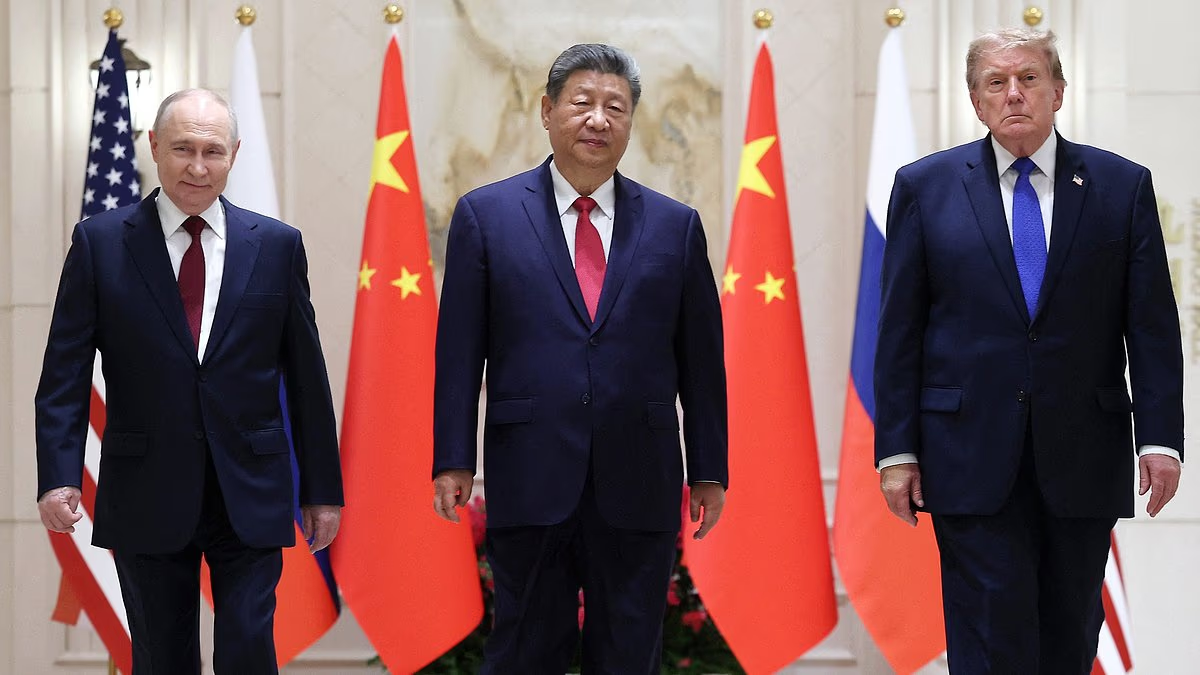

President Donald Trump’s much-anticipated meeting with Russian President Vladimir Putin and Chinese President Xi Jinping ended without a major agreement being announced.
The landmark discussion at Kylin Villa lasted about 90 minutes. Despite the significance of the encounter, the leaders offered no detailed update or dramatic announcement afterward.
Trump left soon after the talks concluded, heading to the airport to board Air Force One for the flight back to the United States.
The leaders of the world’s three largest nuclear powers gathered around a large circular table on the sidelines of the Asia Pacific Economic Cooperation (APEC) summit in Shenzhen on Thursday, delivering opening remarks before beginning their private discussions.
“I’m delighted that this trip has also given us the opportunity for this first-ever trilateral meeting between the leaders of the United States, Russia and China,” Trump said. “Today, in that sense, and I think in lots of other ways, we are really making history.”
Trump said he intended to raise the war in Ukraine with Putin and Xi, although the precise details of the conversation remain unknown. The White House has yet to issue an official readout of the closed-door meeting.
Before the talks began, Trump thanked Xi for welcoming him “so warmly” to China. He also described his visit as an “honor” and congratulated the Chinese leader on what he called a “very successful APEC summit.”
A breakthrough was never expected, given the sharp disagreements among the three governments over Ukraine, Iran, nuclear weapons and trade. Any meaningful progress from the historic gathering remains uncertain.

China’s President Xi Jinping, US President Donald Trump and Russia’s President Vladimir Putin take part in a trilateral meeting on the sidelines of the Asia-Pacific Economic Cooperation (APEC) summit in Shenzhen, China, on Thursday

The central question surrounding the historic meeting is whether the three leaders can make progress on nuclear disarmament, trade or the Russia-Ukraine war—and whether they can maintain peaceful relations without provoking one another

1 Thailand’s Prime Minister Anutin Charnvirakul 2 Malaysia’s Prime Minister Anwar Ibrahim 3 Canada’s Prime Minister Mark Carney 4 Australia’s Prime Minister Anthony Albanese 5 New Zealand’s Prime Minister Christopher Luxon 6 Chinese President Xi Jinping 7 President Donald Trump 8 South Korea’s President Lee Jae Myung
The biggest unresolved issues include nuclear arms control, global trade, the war in Ukraine and whether the United States, Russia and China can coexist without escalating tensions.
Putin opened the meeting by praising Xi for hosting the leaders. He portrayed the three countries as sharing a special responsibility for international stability because of their roles as World War II victors and founding members of the United Nations.
The Russian president also identified possible areas for cooperation, including food and energy security, regional conflicts such as Ukraine, counterterrorism and the fight against organized crime operating across national borders.
Putin said the three nations could help advance global peace by working together on the principles of “mutual respect, equality, and a balance of interests.”
“No peace was ever forged by declining opportunities for engagement and speech,” Trump said, describing the meeting as a chance to explore new solutions to international crises. He said the leaders had “a great deal to discuss” and had already spent considerable time addressing the Russia-Ukraine conflict.
Trump placed particular emphasis on nuclear weapons, arguing that the three countries were “uniquely positioned” to consider reducing their arsenals and minimizing the danger of their use.
Neither Putin nor Xi addressed the subject during the opening remarks. China, meanwhile, has been expanding its nuclear capabilities and has tripled its estimated stockpile to 620 warheads, according to the Pentagon’s latest assessment.
Trump also said he planned to discuss protecting national sovereignty from international bodies, specifically naming the International Criminal Court.
The US president was accompanied by Secretary of State Marco Rubio, Treasury Secretary Scott Bessent and US Trade Representative Ambassador Jamieson Greer, who sat at a nearby table.
Several members of Putin’s and Xi’s delegations were also present.
Before the three-way discussion, Trump and Putin held a short bilateral meeting.
Footage of the private encounter showed Putin appearing tense and rigid at first.
The atmosphere appeared to soften when Trump entered, pointed toward Putin and jokingly asked, “Who is he?” before adding, “He’s my friend.”

Trump said the United States, Russia and China were “really making history” by holding the trilateral meeting

Trump and Putin met briefly before the trilateral talks. Video from the one-on-one showed the Russian president appearing tense and reserved
“We have had a great relationship for many years—we’ve known each other for a long time, and I think a lot of wonderful things can come out of this or at least start,” Trump told reporters after leaning toward Putin and whispering in his ear.
Rubio and Bessent stood beside Trump, and Putin approached both men to shake their hands. The press was then asked to leave the room.
“The first power statement from Trump came as he was the one arriving and Putin was the one kept waiting,” body-language expert Judi James told Our News Outlet. “Delays and waits diminish authority and status.”
“Trump’s ‘social signal’ was a warm friendly smile as he approached Putin, complete with eye-crinkling and a partly opened mouth,” she said. “He also role-played affability by appearing to talk across to Putin before the two were even close, suggesting he couldn’t wait to chat.”
FIND OUT MORE: Ukraine Hits Major Southern Russian Oil Refinery Ahead of Putin-Trump Meeting in China
The brief “pull-aside” lasted only a few minutes before Trump moved on to a bilateral meeting with Xi.
The White House did not release an official account of the Trump-Putin conversation. Trump had already indicated that Ukraine would be among the topics he planned to discuss with Xi after their formal photo opportunity.

President Donald Trump, left, shakes hands with Russian President Vladimir Putin, right, during a meeting on the sidelines of the APEC summit

At the start of the talks, President Xi said the three countries should “work together to address global challenges”
“It’s been an incredible meeting,” Trump said while sitting across from Xi ahead of their one-on-one discussion. “I think something will come out. We’re looking to both help with respect to the war with Russia and Ukraine.”
“Would like to see it ended. I think I can speak for both of us, very much. Twenty-five thousand, mostly soldiers, a month are being killed, and President Putin is going to be coming here a little bit later, so we’ll have a tri-meeting, trilateral as they call it.”
“We just had a little meeting with President Putin just to set the stage, and I think we’ll have maybe a successful meeting.”
Trump made denuclearization a central theme of the historic summit. Alongside the Russia-Ukraine war, he has indicated that he wants to discuss the conflict involving the United States and Iran, as well as new trade arrangements.
With China, Trump also planned to address the flow of fentanyl into the United States and seek Xi’s help in stopping the deadly synthetic opioid, which has been linked to hundreds of thousands of American deaths since 2020.
The private trilateral session marked the first time the three leaders had met together in that format, creating an unprecedented summit between two major US rivals whom Trump has described as “friends.”

China’s President Xi Jinping (2-R) meets with US President Donald Trump (2-L) during a bilateral discussion on the sidelines of the Asia-Pacific Economic Cooperation (APEC) Summit in Shenzhen, China
The summit took place amid unease in the United States, where Americans have been concerned about outages affecting major technology and financial companies, along with a series of failures involving federal government systems.
Earlier that day, Trump urged Americans “to relax” and said they should not be alarmed by the disruptions, which have not been officially classified as cyberattacks.
He nevertheless warned that anyone who deliberately targeted the United States would face unprecedented consequences.
Trump also unsettled some Americans when asked about a reported plan to attack Washington, DC, with a “dirty bomb.”
“There is indication that Iran is looking at gasses, looking at bio, because we’ve shut them out with the nuclear,” Trump told Fox News during his trip to China for the APEC summit.
His comments followed a CNN report citing intelligence sources who claimed Iran could be considering an attack involving a “dirty bomb”—a conventional device combined with radioactive or biological material—in the nation’s capital.
“And they’re looking at gas and biological weapons,” Trump added.
He suggested the possibility of an attack timed around the start of the new year.
“And we’ll see,” Trump said. “We’re gonna have a new year coming up, and we’ll see what comes after January 1.”
Trump did not explain why he singled out that date, later referring to those behind the alleged threats as “nasty people.”
Concerns about potential Iranian retaliation have reportedly led several senior Trump administration officials to leave their private homes and relocate to a military installation in Washington.
Rubio, Bessent, Secretary of War Pete Hegseth, Attorney General Todd Blanche and White House Chief of Staff Stephen Miller are all said to be staying on the same base, where their security teams can exercise tighter control over their protection.
Sources familiar with the intelligence told CNN that the alleged plans contain detailed information about possible locations and targets.
Some of the Iranian communications cited in the reports also claim that materials needed to build a bomb have already been hidden inside the United States.
The alarming report, published Sunday, followed revelations that members of Trump’s Cabinet had moved onto military bases because of threats attributed to Iran’s Islamic regime.
According to the CNN report, US officials believe it may have been relatively easy—and potentially likely—for Iran to pre-position nuclear or chemical materials that could be combined with a conventional weapon to create a dirty bomb.
“As porous as our border has been for the better part of 10 years, it would have been extremely easy to get operatives inside the country” who could obtain and position bomb components, one source said.
Trump was expected to depart on Air Force One shortly after the trilateral meeting ended and return to Washington.


