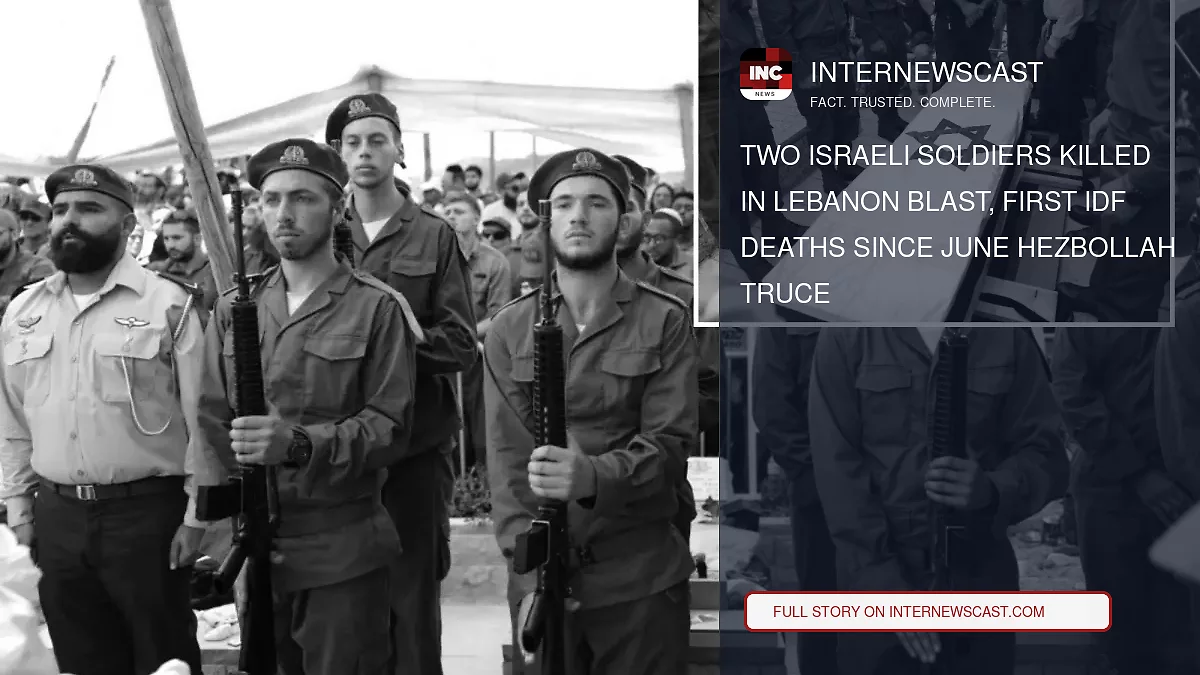

BEIRUT (AP) — Two Israeli soldiers were killed by an explosion in southern Lebanon, the Israeli military said Thursday, marking the first Israeli fatalities since a fragile cease-fire with the Lebanese militant group Hezbollah took effect nearly two months ago.
The military said four additional soldiers suffered serious injuries in the blast.
An Israeli military official, speaking anonymously in line with army rules, said the explosion went off as troops entered a location in the village of Majdal Zoun. The official said the type of explosive device involved was still being examined.
Israeli news outlets had reported the deaths on Wednesday.
The incident came as Israel carried out strikes Wednesday across southern Lebanon, saying the attacks were a response to what it called Hezbollah’s breach of the cease-fire. The Israeli army also urged residents of the village of Mansouri to evacuate, the first such warning issued by Israel in Lebanon in several weeks.
Lebanon’s Health Ministry said an Israeli strike on the town of Tebnine killed one person and wounded 12 others on Wednesday. It added that eight more people were injured in overnight strikes on the village of Burj al-Shemali.
Lebanon’s state-run National News Agency reported that artillery fire also hit the areas of Mansouri and Majdal Zoun.
Hezbollah, which is backed by Iran, did not immediately issue a statement.
The latest Israel-Hezbollah war erupted on March 2, when Hezbollah fired rockets across the border two days after the US and Israel launched their attacks on Iran.
More than 4,000 people have been killed by Israeli strikes in Lebanon since then, including hundreds of civilians.
About 40 soldiers and three civilians — including a military contractor — have been killed on the Israeli side.
A precarious truce between Israel and Hezbollah has largely held since June 20, but Israeli forces have continued to occupy swaths of southern Lebanon and to carry out periodic airstrikes and shelling.
The UN peacekeeping force in southern Lebanon known as UNIFIL said it had recorded 113 projectiles launched by the Israeli military on Wednesday, the highest number recorded since June 21.
The latest escalation came as Lebanese and Israeli negotiators met in Rome to discuss implementation of a June 26 deal reached between Israel and the Lebanese government under which Israeli forces are supposed to withdraw from areas they occupy in southern Lebanon and allow the Lebanese army to take control, in exchange for Hezbollah’s disarmament.
Hezbollah has refused to disarm and opposed the direct Lebanon-Israel talks. It was not a party to the deal. The group has accused the Lebanese government of making too many concessions without guaranteeing an Israeli withdrawal.
Wednesday’s talks ended early due to the escalation on the ground, but resumed on Thursday.
The talks in Rome have focused on implementation of “pilot zones” where Israeli forces would withdraw and the Lebanese army would take control.
Implementation began last month with an initial pilot zone in an area that wasn’t occupied by Israeli forces but had previously sustained Israeli fire.
The Lebanese army entered the town of Zawtar al-Gharbieh and some civilians returned, although many came only to find their homes destroyed and left again.
A diplomat familiar with the negotiations who spoke on condition of anonymity because they were not authorized to comment publicly said earlier this week that Lebanon had asked for the next pilot zone to be either in the town of Khiam or Bint Jbeil.
Both areas saw heavy fighting in the latest Israel-Hezbollah war and are currently occupied by Israeli forces.
But US Ambassador to Lebanon Michel Issa suggested ahead of the three-day talks that no new pilot zones would be immediately implemented, saying that “moving too quickly risks jeopardizing the very civilians this process is meant to protect.”


