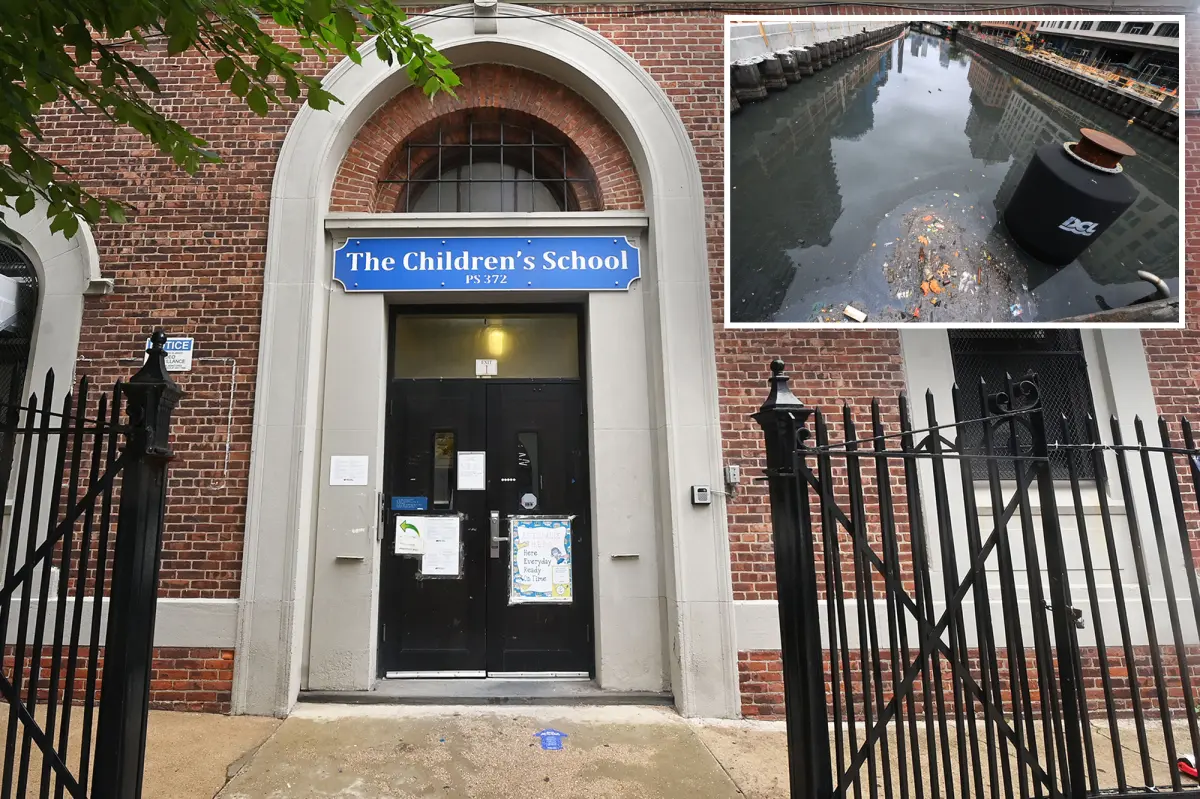

Roughly 450 young children at a special-needs elementary school near Brooklyn’s foul-smelling Gowanus Canal have continued breathing potentially toxic air inside their building more than two years after New York state pledged to address the hazard.
The state Department of Environmental Conservation installed an air-filtration system in 2025 at the PS 372 annex at 219 First St., but the system did not sufficiently clean the contaminated indoor air.
Parents, however, were told only last week that their children may have been exposed for two years — and that the building still may not be safe when the next school year begins.
Despite years of mitigation work, testing found traces of potentially cancer-causing vapors along with other dangerous substances. Officials still have not determined whether the polluted air is seeping in from the heavily contaminated canal or from “unknown secondary sources,” the DEC disclosed last month to Principal Rosa Amato and Father Orlando Ruiz of Our Lady of Peace Church, which owns the school buildings.
The annex houses the school’s pre-K and kindergarten classrooms around the corner from the main PS 372 building at 512 Carroll St. Students in all grades also use the space for gym, science and other specialty classes.
Julia Finnegan, a parent whose children are entering fifth grade and pre-K at the school, said officials have tried to calm families by saying “it would take a lifetime of exposure” for the chemicals to pose health risks.
“But these are our youngest, smallest children,” she said. “If they stay at the school for pre-K and kindergarten, that’s half their lives they’ve spent in this space exposed to chemicals.”
Finnegan said parents have been kept largely in the dark.
“We were under the understanding as families that this system was up and running, and working,” said Finnegan of the filter system. “But little did we know they were continuing to do testing. . . . and they have discovered that there’s basically still chemicals and vapors being found in the air, with the system running.”
Officials admitted that some of the chemicals detected inside the annex — including cancer-linked byproducts of the gas industry such as benzene and xylene, “are above levels that would typically be found in indoor air,” the DEC and the State Health Department told The Post in a joint statement.
But they were “determined not to pose an increased health risk,” the officials insisted.
Environmental groups are not buying it.
“The school epitomizes the massive uncontrolled toxic hazards throughout the entire Gowanus Canal area,” said Walter Hang, the president of Environmental Health Research Group, which leads toxic cleanup campaigns across the state. Another elementary school, PS 32 on Union Street, sits on the east side of the canal.
“The state has completely failed to protect the health of the students, the faculty and the staff in the school.”
Trouble began in March 2024, when the DEC collected air and soil samples from both PS 372 buildings. The department found the dangerous compounds at both sites, records show.
But officials determined that the results only at the annex building were alarming enough to warrant intervention. No work has been done at the main building.
They suspected the contamination was coming from a leaking underground fuel tank or from a nearby Con Edison facility on Third Avenue with a long history of environmental problems.
A sub-slab depressurization system – a system of pipes and fans that removes harmful gases from beneath a building and vents them outside – wasn’t installed until a year later.
But by July 2025, officials found that air samples “remained similar to pre-mitigation results,” according to the letter.
They conducted more tests in November 2025, finding that “no secondary source of soil vapor intrusion was identified, but also that the sub-slab depressurization system was operating as designed.”
Both state agencies “are currently developing a plan for additional mitigation measures that may be applied to further reduce concentrations of volatile organic compounds in indoor air from unknown secondary sources,” officials wrote in the letter.
The DEC and DOH said they are working on improving indoor air quality by increasing ventilation in the annex’s basement by adding a heat recovery ventilator system — which replaces dirty, warm air from inside the building with fresh air from outside.
The Land Use Committee of the Gowanus Community Advisory Group has demanded an explanation for the air contamination and transparency about the state’s mitigation efforts before the start of the school year.
The committee listed its demands, including a health risk evaluation for the children, in a July 31 letter to the DEC, urging the agency to respond within 15 days.
“This depressurization system simply was not a sensible solution from the very beginning,” Hang said. “It would never vent all of the toxics underneath the school, around the school. And that’s evidently now been brought out by the available data.”
A city DOE spokesperson said the department is “committed to keeping our schools safe for staff and families” and is working with the state to improve the school’s air quality.
Amato and Ruiz did not return requests for comment.