
Before dawn breaks, Shameema pulls on her scuffed rubber sandals and inspects the insulated carrier. The ice packs inside must keep the vaccines within the vital cold-chain range of 2C to 8C (35.6-46.4F). Satisfied, she lifts the box on to her shoulder and walks into the darkness.
Tanzeela is close behind, tightening the laces on her canvas shoes before shouldering her own pack. The two women are from Pulwama, a district where summer heat can reach 37C. Their route leads uphill, away from the valley, past the point where tarmac gives way to dirt track and then to a faint foot trail running through mountain pine forest.
Shameema, 45, has spent more than 10 years working as a vaccinator. Tanzeela, 28, joined the programme three years ago. Together, they are part of India’s 2.5 million-strong frontline health workforce, the vast human network that powers the world’s largest immunisation drive.
Over the years, Shameema believes she has given polio drops to more than 3,000 children. One memory remains especially vivid: a boy from her village who walked with a limp and a deformed leg after contracting polio before India had completely eradicated the disease. She says his struggle is one reason she continues the work.
Tanzeela and Shameema must walk 12 miles to reach the remote Gujjar and Bakarwal communities in the hills. Photograph: Kamran Yousuf
“I saw that child struggle to walk to school,” Shameema says as the women stop briefly beside a stream. “His mother held him on her back until he grew too heavy. [People in] these mountains need protection too – the children here deserve the same health as those in the cities.”
Their destination this morning is Namblan, a pine-fringed meadow where almost 50 dhokas – the seasonal mud-and-stone shelters used by Gujjar and Bakarwal nomadic families – are spread across the surrounding slopes.
Long before the road disappears, the electricity lines have already ended far below. For the families who bring their animals to these highland pastures during the summer months, horses remain the main way to travel.
Carrying heavy cold boxes filled with oral vaccine vials, ice packs and thick paper registers, the two women climb more than 12 miles (20km) to complete the day’s immunisation round.
Tanzeela has given polio drops to about 800 children since she joined the programme. She wears the same shoes she uses for farm work. The soles have worn thin, but they grip the rocky paths better than the sandals of some colleagues, she says. One fellow worker walks barefoot for parts of the trail.
“The payment is small and the paths are steep,” Tanzeela says. “I think about my own nephews when I climb. The drops take seconds, but they change a life for ever.”
Their compensation is 125 rupees a day – about £1 – from the state government for the two-day vaccination campaigns, which happen four to six times a year during the national immunisation drives that target all children under five.
The oral formula of the vaccine creates communal immunity. Photograph: Kamran Yousuf
India’s polio programme represents a triumph of planning, vigilance and human endurance. The country has been certified polio-free since 2014 – with the final confirmed case in January 2011 in West Bengal – largely thanks to a surveillance network of 60,000 health workers, who monitor 40,000 reporting sites for acute flaccid paralysis, the signature symptom of wild poliovirus.
The oral polio vaccine uses a live but weakened form of the virus developed by a Polish scientist, Albert Sabin, in the late 1950s. The two drops placed on a child’s tongue stimulate antibodies in the intestinal lining that destroy the virus before it can enter the bloodstream and attack the nervous system.
The same gut immunity reduces viral shedding in infected children, ending the chain of transmission in communities where clean water comes from streams and springs. The oral formula creates communal immunity, protecting whole clusters of children who share courtyards and water sources.
This biological shield proves especially vital in the disputed region of Indian-administered Kashmir, where 73% of the 14 million population live in rural areas, with hundreds of thousands of children under six living in far-flung villages and mountain settlements.
after newsletter promotion
Seasonal migration routes take the Gujjar and Bakarwal pastoral communities of about 1.2 million people far from clinics and hospitals during the summer. Reaching them requires coordination between state health departments, local panchayats (village councils) and the frontline workers who know the mountain trails.
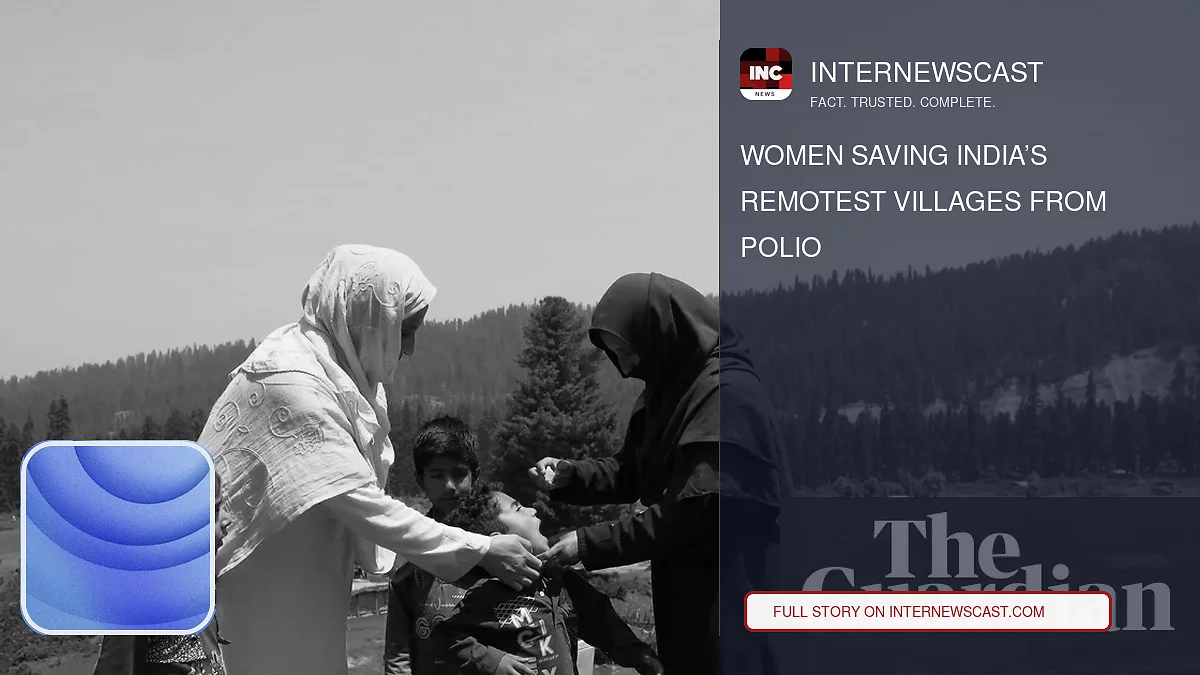
Shameema gives vaccine drops to a child in the hills. Up to 27 million children under five will be targeted in one day during a polio vaccination drive in India. Photograph: Kamran Yousuf
The national immunisation effort targets 27 million children under five, and up to 1.7 million vaccinators can be deployed during a single day of a national immunisation drive. Those workers staff 750,000 booths, then fan out with mobile teams into forests, deserts and urban slums.
The scale of this operation dwarfs most military logistics exercises. Insulated boxes travel by foot, bicycle, boat and bus, but in regions such as Kashmir, the final leg of this journey is always down to women travelling on foot.
The dhokas sit miles apart, sometimes separated by ravines and streams that swell with melted snow. A mother might walk two hours to meet the vaccinators halfway, her baby strapped to her back. The workers record these encounters in their paper registers, marking the child’s name, age and the date of the dose.
Shameema and Tanzeela know the terrain and the communities, and time their ascent to reach the first dhokas as the families finish their morning prayers.
“The families welcome us with tea and bread,” Shameema says. “They know the value of these drops. Some remember the days prior to full eradication, when children in neighbouring villages fell ill.”
India’s greatest public health victory still depends on these health workers willing to make such critical journeys for little reward, dedicated to maintaining the country’s protection against the devastating disease.
By late afternoon, the final dhoka receives the vaccinators. A child opens their mouth, gets two drops on their tongue, another name goes on the register and the insulated box is a bit lighter as the women begin their descent down the same tracks they climbed hours earlier. It will be dark by the time they reach home.