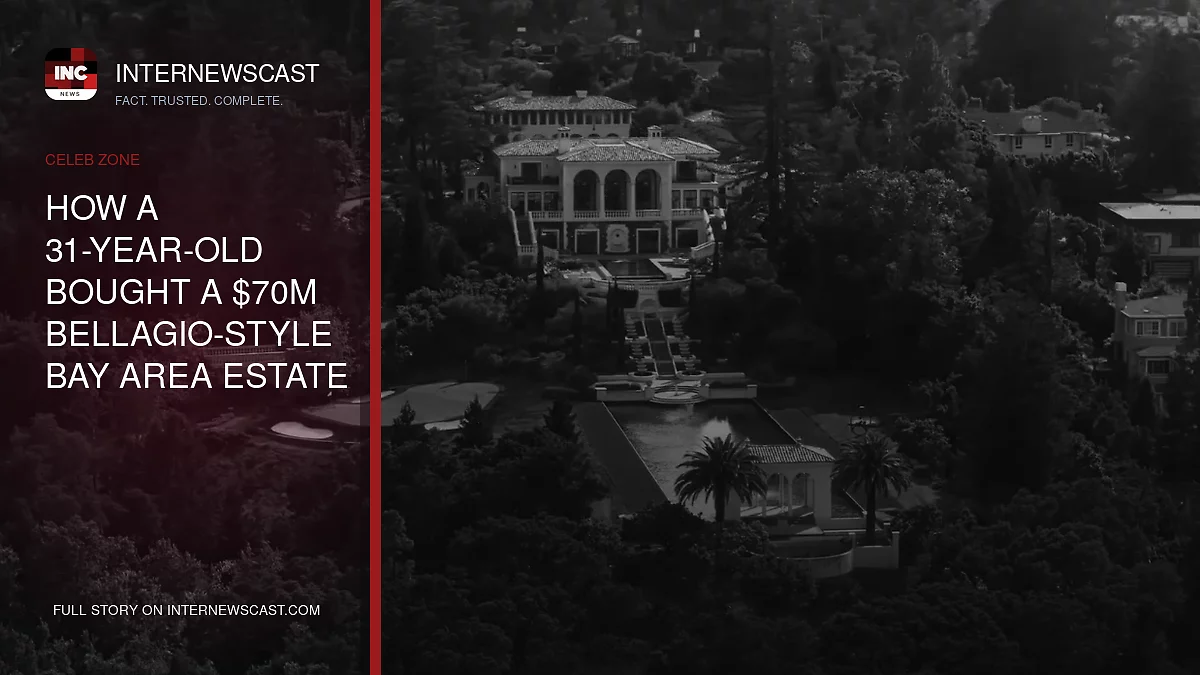

A standout Northern California estate changed hands on August 6 for $70 million, ranking among the region’s most eye-catching luxury real estate deals.
The mansion sits in Hillsborough, the famously affluent residential community on the San Francisco Peninsula, about 20 miles south of downtown San Francisco and just west of Burlingame and San Mateo.
Set on 12 acres, the property was created to feel like an Italian villa overlooking a lake. Its main home measures roughly 12,000 square feet and includes six bedrooms, seven full bathrooms, and an unusually generous 10 half bathrooms. Visitors also have access to a separate 4,600-square-foot guest house.
Still, the residences are only part of what makes the estate so extraordinary.
The grounds function almost like a private resort, complete with a sunken tennis court, nine-hole golf course, 18-hole putting green, pickleball court, volleyball court, bocce court, and horseshoe pit. There is also a 150-seat outdoor amphitheater and an event lawn, along with a reflection pool, koi pond, Bellagio-inspired fountains, and a 2,100-gallon saltwater aquarium.
Below are two video tours of the sprawling property, known as “Villa de Verano”:
The sellers, private equity investor Ted Kruttschnitt and his wife, Alexia, reportedly spent years bringing the estate to life. They first asked $88 million, later cut the price to $78 million, and ultimately agreed to a $70 million sale. Even with the reduction, it stood as Northern California’s largest home sale of 2026 at the time and one of the most significant residential transactions in Bay Area history.
So who paid $70 million for this insane estate?
You might assume it had to be one of the Bay Area’s familiar billionaires. Maybe Mark Zuckerberg. Marc Andreessen. Larry Ellison. Marc Benioff. Someone with a fortune measured in multiple billions, whose wealth has been tracked for years by publications like Forbes, Bloomberg, and CelebrityNetWorth.
Right? Nope.
The buyer was a 31-year-old no one has ever heard of.
Unmasking The Mystery Buyer
Technically, the buyer wasn’t a 31-year-old tech executive. According to property records, the $70 million estate was purchased by an entity called Daikon no Hana Capital LLC, a company that had been created less than a month earlier, on July 9.
That might have been where the trail ended. Wealthy buyers routinely use LLCs and trusts to keep their names off property records, particularly when they’re purchasing $70 million compounds with 12 acres of privacy.
But the San Francisco Standard did some digging and found several connections pointing to the person behind Daikon no Hana Capital.
The first clue was the buyer’s real estate agent, Jia Xu of J West Investments. Xu isn’t a familiar name among the brokers who regularly handle $50 million and $100 million Peninsula estates. In fact, according to the Standard, Xu appears to have participated in just one other major residential transaction in the area during the last five years.
That transaction was the $12 million purchase of a Los Altos Hills home by Yuhuai “Tony” Wu in 2025.
Then there was the LLC itself.
Daikon no Hana Capital is managed by Steven D. Anderson, a Burlingame attorney who specializes in estate planning. Property records show that Anderson was also involved with Wu’s Los Altos Hills property, transferring that home into a family trust roughly a week before the Hillsborough purchase closed.
Put it all together: The mysterious LLC buying the $70 million property was managed by an attorney already handling Wu’s real estate. The LLC used the same agent who had represented Wu on his previous $12 million home purchase. And the timing of the trust transfer and Hillsborough closing lined up within days.
The Standard concluded that Wu appears to be the buyer. The property’s listing agent, Jenn Gilson of Golden Gate Sotheby’s International Realty, didn’t identify him by name, but she did confirm one important detail: The buyer was a young person in artificial intelligence.
That certainly fits.
So who is Yuhuai Wu?
Better known as Tony Wu, he’s a 31-year-old computer scientist and AI researcher. Unless you’re deeply immersed in artificial intelligence, there’s a good chance you’ve never encountered his name.
But you’ve probably heard of the company he helped create.
In 2023, Tony Wu was one of the original cofounders of Elon Musk’s artificial intelligence company, xAI.
And that’s where the mystery of the $70 million mansion starts to make a lot more sense.
One Of The Original xAI Cofounders
Wu wasn’t a random programmer who happened to land an early job at xAI. Before joining Musk, he had already built an impressive résumé at the highest levels of artificial intelligence research. He worked at Google and conducted research at Stanford, with his work focusing heavily on machine reasoning and mathematical problem-solving. He contributed to projects including Minerva and AlphaGeometry, systems designed to push AI beyond simply predicting words and toward solving complex mathematical problems.
When Musk launched xAI in 2023, Wu was announced as one of its 12 original founders.
That’s a very important distinction when trying to figure out his wealth.
Wu wasn’t simply an employee receiving a salary and some stock options. He was there on day one as a cofounder of what would become one of the fastest-growing private companies in history. He eventually led xAI’s reasoning team and reportedly reported directly to Musk.
Then, in February 2026, something extraordinary happened.
SpaceX acquired xAI in a deal that valued Musk’s artificial intelligence company at an astonishing $250 billion.
And suddenly the question isn’t, “How can a 31-year-old computer scientist afford a $70 million mansion?”
The question becomes: How much of a $250 billion company did this particular 31-year-old computer scientist own?
How Much Was His xAI Stake Worth?
Unfortunately, xAI has never publicly disclosed Wu’s individual ownership stake. So we can’t simply look up how many shares he owned and calculate his fortune.
But at a $250 billion valuation, the math gets ridiculous very quickly.
- A 0.03% stake would be worth $75 million
- A 0.1% stake would be worth $250 million
- A 0.2% stake would be worth $500 million
- A 0.4% stake would be worth $1 billion
Think about that last number. Wu would have needed to retain just four-tenths of one percent of xAI at the merger valuation to hold $1 billion worth of equity.
Does that mean Tony Wu is a billionaire? Not necessarily. We don’t know what percentage he received when xAI was founded, how much dilution occurred during subsequent fundraising rounds, or whether he sold any shares along the way.
But he wouldn’t need to be a billionaire to explain the house. Even a 0.1% stake would have been worth $250 million.
There was still one potential problem: owning hundreds of millions of dollars worth of private-company stock doesn’t necessarily give you $70 million of spendable cash.
That’s where the SpaceX transaction gets even more interesting.
A $2.4 Billion Cash-Out
According to SEC filings related to the acquisition, eligible current and former xAI employees were given an opportunity to turn certain vested equity into cash rather than simply rolling everything into SpaceX shares.
And people took advantage of it.
SpaceX subsequently disclosed that during the first six months of 2026, it repurchased $2.413 billion worth of shares from eligible current and former xAI employees in connection with the merger.
That’s $2.4 billion of actual liquidity flowing to the relatively small universe of people who helped build xAI.
We have no evidence showing that Wu personally participated in the cash-out, and we certainly don’t know how much he may have sold.
But check out the timeline.
SpaceX acquired xAI in February. Wu resigned just days later, saying it was time for his “next chapter.” By the end of June, SpaceX had completed billions of dollars worth of employee stock repurchases. On July 9, Daikon no Hana Capital LLC was created. On August 6, the LLC closed on Villa de Verano for $70 million.
Again, that does not prove Wu cashed out xAI stock and used the proceeds to buy the estate. But it provides an extremely plausible explanation for how a 31-year-old computer scientist could suddenly have access to extraordinary amounts of liquid wealth.
So Is Tony Wu A Secret Billionaire?
We still can’t say Tony Wu is definitely a billionaire.
But we do have another useful clue: his real estate.
In 2025, Wu purchased a home in Los Altos Hills for roughly $12 million. Now he appears to have purchased Villa de Verano for another $70 million.
Assuming he still owns the first property, that’s more than $82 million worth of residential real estate purchased since 2025.
If Tony Wu were worth “just” $100 million, these two homes alone would represent 82% of his entire fortune based on their purchase prices. That would be an extraordinary concentration of wealth in personal residences, before accounting for taxes, maintenance, investments, cash or anything else he owns.
Of course, we don’t know how these homes were financed, so $82 million of purchase price does not necessarily mean Wu has $82 million of equity tied up in them. But even with significant financing, this is not the real estate portfolio of someone whose entire fortune is merely $100 million.
If $82 million of residential property represented 25% of his wealth, that would imply a net worth of roughly $330 million. At 20%, the implied fortune would be around $410 million. At 10%, he’d be worth more than $800 million.
Put that together with the xAI math and the $2.4 billion employee liquidity event, and a fortune somewhere in the several-hundred-million-dollar range starts to look very plausible. Billionaire status remains possible, particularly if Wu retained at least 0.4% of xAI through the SpaceX transaction, but we don’t have enough evidence to declare it.
What we can say with much more confidence is that Tony Wu appears to be vastly wealthier than his almost nonexistent public profile would suggest 🙂
Tony – Invite us to a party, please!


