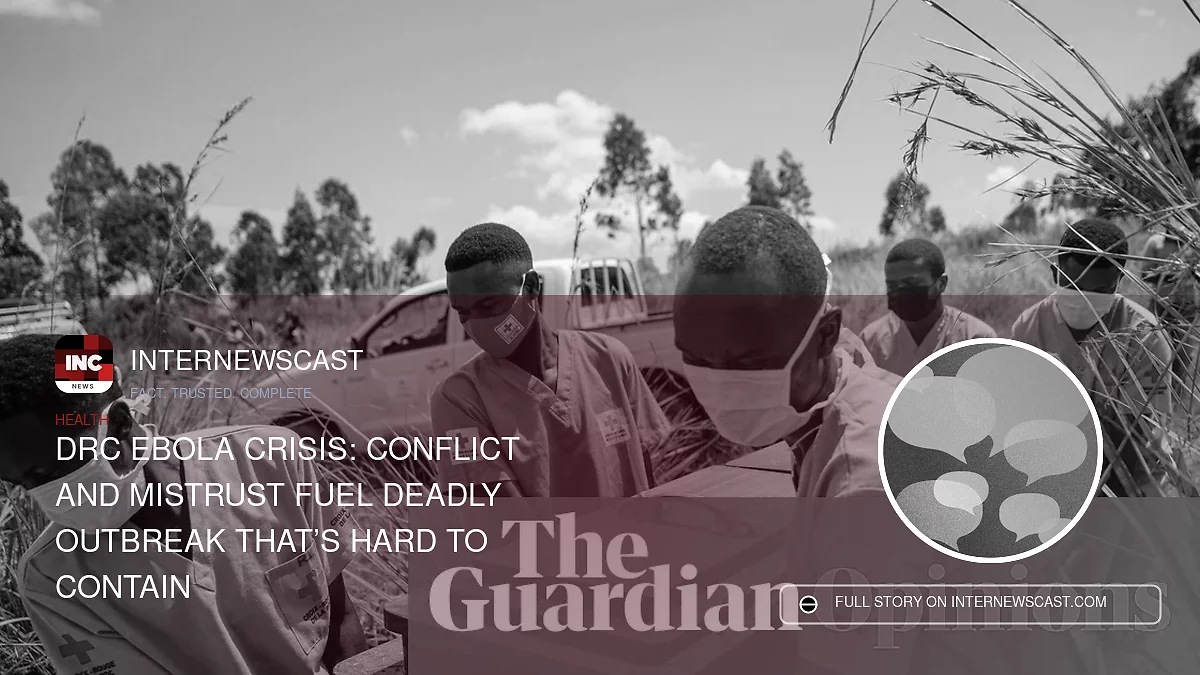

Despite the lack of global attention, the Democratic Republic of the Congo is facing a grave Ebola outbreak that is moving toward becoming the deadliest on record. It is already the second-largest Ebola outbreak in history, with community transmission spreading at a pace not seen before. At least 4,900 cases and more than 2,300 deaths have been estimated so far, putting the fatality rate at close to 50%. Among global health specialists, there is little disagreement: the situation is extremely serious.
Even so, this Ebola crisis has barely broken through in the media or the public conversation. Compared with the response to the 2014 Ebola outbreak, the silence today is striking. Back then, Ebola ranked among the world’s most searched terms on Google, led television news bulletins far beyond west Africa, and appeared across newspaper front pages and magazine covers. Perhaps the world is exhausted by disease after Covid-19 — the familiar pandemic fatigue. And, frankly, it is understandable that many people do not want to hear another warning about infectious disease.
But in the affected areas, the crisis is deepening. A dangerous mix of conditions is making Ebola harder to contain and even harder to slow, with devastating consequences for public health. One of the most alarming signs is that many infections and deaths are occurring in communities before patients ever reach a hospital. Local health workers are estimated to be reaching only about 30% of cases. Children are being hit especially hard, accounting for a quarter of confirmed infections and almost a third of deaths. Those figures capture only the direct toll of Ebola. Routine health services, including measles vaccination drives and basic child survival programmes, have also been disrupted, raising the risk of many more indirect deaths because care is no longer available.
The damage extends well beyond children. In Ituri, the province most severely affected, maternal deaths have doubled. The increase reflects complications in childbirth and shortages of trained health staff, but also the particular danger of Ebola infection during pregnancy, which is associated with foetal loss.
Why has this outbreak been so difficult to stop? The virus itself is part of the answer. This outbreak involves a new species, Bundibugyo, for which there is no effective vaccine or antiviral treatment. Earlier outbreaks involved the Zaire species. Scientists have also raised the possibility that viral mutation may be helping the outbreak outpace control efforts. If mutation has made this strain more transmissible, it would help explain the unusually rapid and extensive community spread.
Geography and insecurity are compounding the problem. Ituri province is unstable, with active militias, violence and continuing conflict. Before Ebola was confirmed, the virus appears to have circulated for three months, mistaken for malaria or typhoid. Health security depends on functioning government, trust, access and safe living conditions. At the moment, those foundations are largely absent.
The international landscape has also changed in ways that make a coordinated global health response far more difficult. During the 2014 west Africa Ebola outbreak, the governments of the US, UK and France worked alongside the World Health Organization to intensify the response, bringing military-style coordination, funding, logistics and trained personnel. Soon after, an Ebola commission I co-chaired examined the scientific lessons for the WHO’s health emergency response. What we could not foresee was the political shift that would follow over the next decade.
Since then, there have been two “America First” Trump presidencies. The United States is no longer part of the WHO and has stepped back from multilateral cooperation, preferring a go-it-alone approach. This comes alongside cuts to foreign aid, restrictions on scientists, the closure of USAID, the breakdown of the Centers for Disease Control and Prevention, and a “make America healthy again” movement that places more emphasis on press-ups and sauna visits than on the fundamentals of public health.
Britain has also stepped back from its responsibilities, cutting foreign aid. It makes sense that the current prime minister, Andy Burnham, is focused on domestic issues: when health inequalities and rising poverty mean British children are some of the unhealthiest in western Europe, it’s tricky politically to divert resources overseas. But those political choices have consequences for countries left with fewer resources to fight the spread of disease.
In a dire situation, a ray of hope is the vaccine and antiviral work under way. Using the same technology as the Oxford-AstraZeneca Covid vaccine, Oxford University has started human trials of the Bundibugyo vaccine, while the WHO is sponsoring a clinical trial in the DRC on two existing antiviral therapies. It’s not just lab science. Social science and the humanities have been engaged to understand how to reach people in remote communities and how to build trust in public health campaigns: given the history of colonial health interventions and residents being used as “guinea pigs”, any health response must understand why people are fearful of external “help”.
after newsletter promotion
Budget cuts to higher education have also been consequential. Outbreaks such as this one demonstrate yet again why knowledge, education and research matter, and why political decisions taken in one part of the world have major ramifications for the lives of those in another.