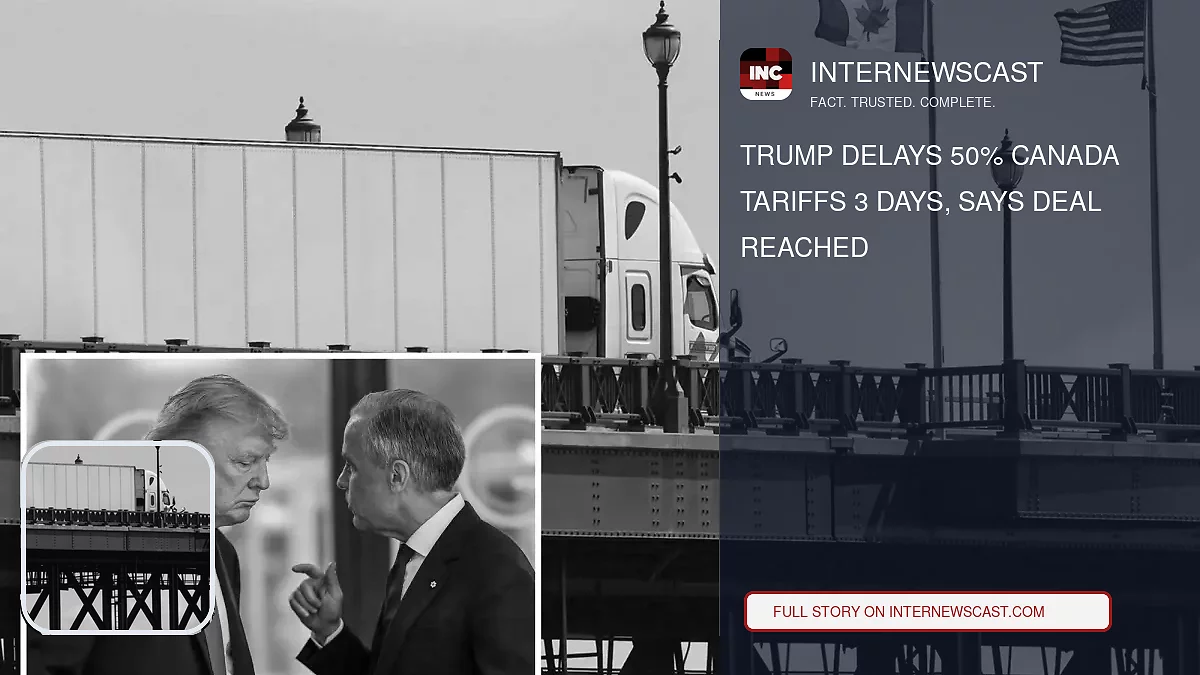

President Trump said Tuesday evening that he would postpone the launch of planned 50% tariffs on most Canadian imports for three days, while hinting that the U.S. and Canada may be close to reviving the long-stalled Keystone XL pipeline project.
“I have paused the 50% Tariffs against Canada, that were scheduled to kick in tomorrow morning for a three day period,” Trump wrote on Truth Social, saying the delay was “based on the fact that Canada and the U.S.A., subject to the finalization of documents, have a DEAL!”

Trump added that “The great Keystone XL Pipeline, long ago killed by Sleepy Joe Biden, may be awoken from the grave!” He later shared an AI-generated image showing himself pulling a pipeline labeled “Keystone” from the ground beside a cracked tombstone that read: “Buried by Biden.”
The last-minute announcement came less than two hours before the tariffs were set to begin and followed a full day of discussions between Trump and Canadian Prime Minister Mark Carney.
First proposed in 2008, the Keystone XL pipeline was designed to carry as much as 830,000 barrels, or roughly 35 million gallons, of crude oil per day across about 1,200 miles from Alberta, Canada, to Nebraska. From there, it would connect to existing pipelines supplying refineries along the Gulf Coast.
The project was slowed during the Obama administration amid fierce opposition from environmental groups, then revived by Trump near the end of his first term. In January 2021, then-President Joe Biden revoked a key cross-border permit, and TC Energy, the Calgary-based company behind the proposal, officially abandoned the project that July.
The threatened 50% tariff would have covered roughly $20 billion in Canadian goods, representing about 5% of Canada’s annual exports to the United States. Products such as wine, hockey sticks and cement were expected to be hit, while critical minerals, fish, potash and energy products were among the items slated for exemptions.
Canada had warned it would answer any new U.S. tariffs with countermeasures, raising the stakes in a trade dispute between two deeply linked economies that exchanged about $880 billion in goods and services last year.
In a sign of deepending resentment north of the border, a petition to expel US Ambassador Pete Hoekstra, a former Michigan congressman and Trump ally, has collected nearly 218,000 signatures since July 21
″We are negotiating,” Carney told reporters Monday, speaking in French. “The negotiations are very intense and delicate. This is not the time to talk about negotiations in public.”
Trump announced the tariffs last month, shortly after he was spotted chatting with Carney at the World Cup Final between Spain and Argentina, invoked Section 338 of the Tariff Act of 1930.
That law, enacted at the height of the Great Depression and widely blamed by economists for making the global crisis worse, authorizes the president to impose tariffs of up to 50% on imports from countries that have discriminated against US businesses.
Trump has claimed that Canada discriminates against American exports of cars, alcohol and cheese. Canada and China were the only countries that issued retaliatory tariffs against the US in response to Trump’s so-called “Liberation Day” levies last year.
With Post wires


