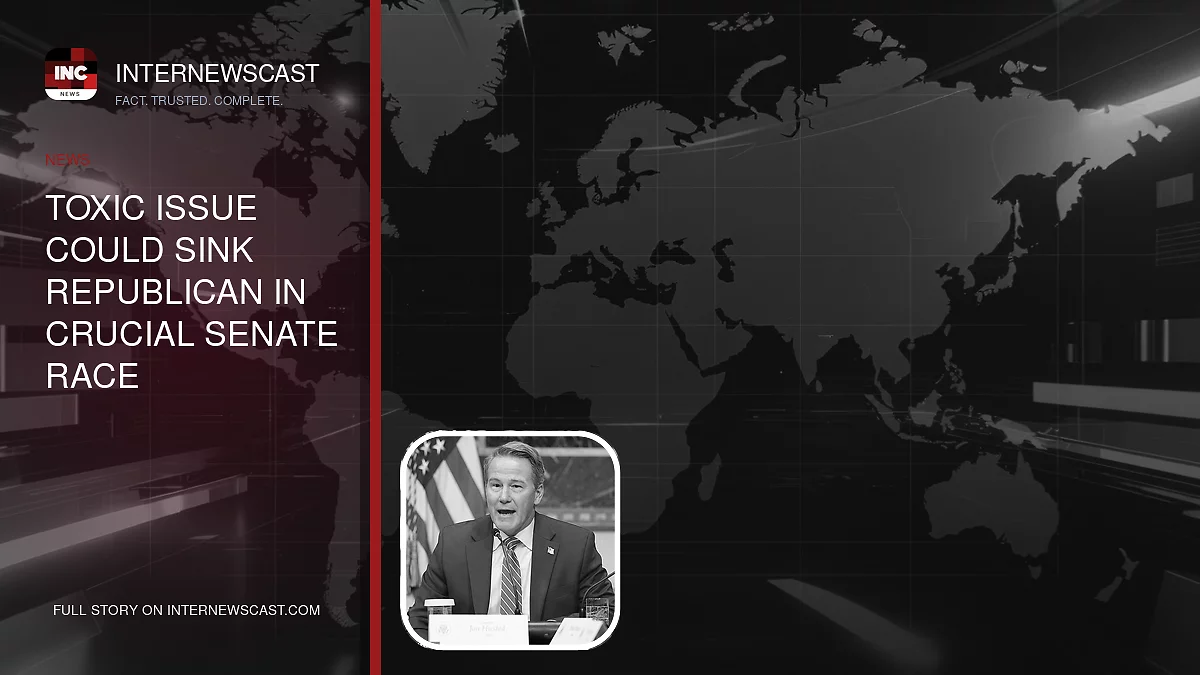

As frustration over AI data centers grows across Ohio, Democrats have found a clear campaign target — Republicans who have backed or embraced the booming tech infrastructure.
A National Republican Senatorial Committee memo, first obtained by Axios, cautions that mounting voter resistance to large-scale data center projects could become a serious problem for Senator Jon Husted’s reelection bid.
The political stakes are significant. Husted’s Ohio Senate race against former Democratic Senator Sherrod Brown is among the most closely watched contests in the country and may help determine which party controls the Senate.
A new Fox News poll shows Brown still ahead in the race for Ohio’s Senate seat, leading Husted 53% to 45% — the same eight-point advantage he held in June.
With Republicans holding only a slim majority in the Senate, battleground races such as Ohio’s carry outsized importance in the fight for control of Congress.
The NRSC memo frames data centers as an emerging political vulnerability, warning that if Husted loses, the result could reverberate far beyond Ohio and shape how elected officials and tech companies approach future projects.
“If he loses and data centers get the blame, politicians across the country will take notice — and they will not go near the next one,” the memo states. “This has become a sleeper issue for the entire election cycle.”
Brown has seized on the controversy as a central theme of his campaign, with Democrats reportedly pouring millions into ads that cast Husted as “the face of data centers in Ohio.”
There’s a reason Brown has been able to attach Husted so closely to the industry.

In July, Husted introduced the Ratepayer Protection Act, legislation designed to establish standards ensuring that large electricity users such as data centers pay for the additional generation, transmission and grid infrastructure needed to serve them

In 2015, while serving in the Senate, Brown praised the construction of a third data center in central Ohio, calling the Amazon project ‘great news for New Albany and central Ohio’

The industry has attracted major companies including Meta, Vantage and QTS, while Nvidia and OpenAI have announced major projects in Ohio
As Ohio’s lieutenant governor, Husted was a prominent public champion of the state’s effort to attract technology companies. Ohio has more than 200 data centers, making it the fifth-highest state in the country for the number of data centers.
In 2019, he appeared at the groundbreaking of Google’s $600 million data center in New Albany and touted the project as evidence that Columbus could become the ‘tech hub of the Midwest.’
The Google project received a 15-year state sales-tax exemption estimated at $43.5 million, plus a local property-tax abatement.
Husted defended the incentives, arguing the economic benefits outweighed the tax breaks and that additional taxes could have driven Google elsewhere.
That history has given Brown an opening.
Brown now argues Ohio’s political establishment handed large technology companies generous incentives while ordinary Ohioans are asked to foot the bill for the industry’s enormous electricity demand. In one recent campaign video, he said major corporations are ‘gobbling up energy to feed their data centers’ while Ohio families face higher electricity costs.
He has also attacked the state’s data-center tax breaks as too generous for too few jobs — and made Husted the central character in that argument.

In 2019 Husted appeared at the groundbreaking of Google’s $600 million data center in New Albany and touted the project as evidence that Columbus could become the ‘tech hub of the Midwest’

Ohio’s data-center tax exemption became a major controversy after the state reported its cost reached nearly $1.6 billion in 2025, far above earlier projections

On Tuesday, Pennsylvania Governor Josh Shapiro signed an executive order imposing new guardrails on data-center development
But Brown himself once celebrated data-center development.
In 2015, while serving in the Senate, Brown praised construction of a third data center in central Ohio, calling the Amazon project ‘great news for New Albany and central Ohio’ and saying the expansion showed the region was a place where businesses wanted to invest and families wanted to live.
Nearly a decade later, he is campaigning against the uncontrolled expansion of the same industry. The Daily Mail reached out to Brown’s campaign regarding his 2015 comments.
Husted is no longer defending data-center expansion either. He has increasingly focused on making the companies building the facilities, rather than ordinary ratepayers, bear the cost of the electricity and infrastructure they require.
In July, he introduced the Ratepayer Protection Act, designed to ensure large electricity users pay for the additional generation, transmission and grid infrastructure needed to serve them.
‘Data centers are, and should remain, a local decision,’ Husted’s campaign says, adding that communities should decide whether projects suit their residents. The campaign points to tax revenue, property-tax relief and construction and skilled-trades jobs.
Husted spokesperson Amy Natoce accused Brown of suddenly embracing the issue in an election year after three decades in Congress to address it.
The fight comes as Ohio has become one of the country’s major data-center hubs. Google says it has invested more than $20 billion in the state since breaking ground in New Albany in 2019. Meta, Vantage and QTS have followed, while Nvidia and OpenAI have announced major projects.
But the scale of that growth is now creating a political problem. Ohio’s data-center tax exemption became a major controversy after the state reported its cost reached nearly $1.6 billion in 2025 — far above earlier projections — fueling questions about whether the benefits justify the incentives.
The issue is spreading rapidly across the country, and Ohio’s neighbor could lead by example.
On Tuesday, Pennsylvania Governor Josh Shapiro signed an executive order imposing new guardrails on data-center development.
It requires developers seeking certain state permitting advantages to meet standards on energy costs, environmental impacts, water use and transparency, and to win local approval before receiving state approval.
Data centers were also removed from Pennsylvania’s fast-track permitting program.
The order stops short of an outright ban, but the local-approval requirement could effectively prevent some projects from moving forward.
For years, states competed to attract the enormous investments tied to AI and cloud computing. Now they are competing over something else: how much of the industry’s cost their residents should bear.


