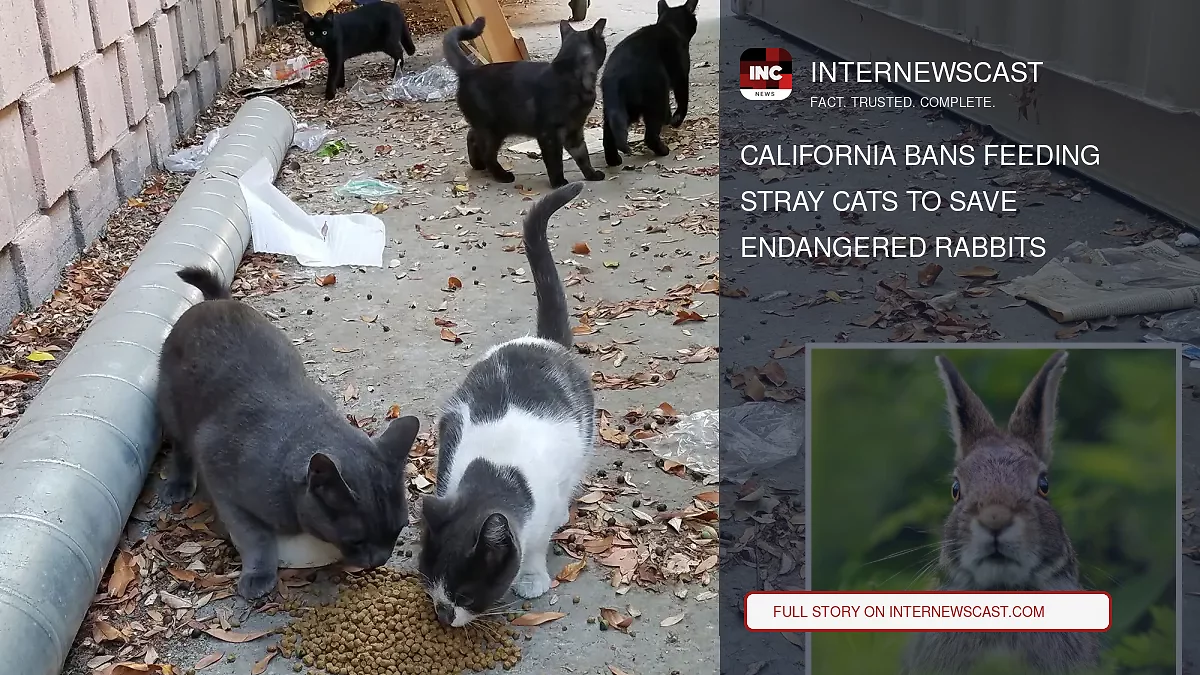

A Central Valley community is moving to stop people from feeding stray cats in public areas, citing concerns that a rising feral feline population could put added pressure on an endangered rabbit species found nowhere else on Earth.
The Ripon City Council voted unanimously Tuesday to advance an ordinance amendment that would prohibit feeding feral cats and other stray animals on city-owned property, the Manteca Bulletin reported.
Before the rule can become law, it must return for a second reading at the council’s September meeting. City leaders say the proposal is partly intended to help protect the endangered riparian brush rabbit, whose remaining habitat is limited to stretches along the lower Stanislaus and San Joaquin rivers.
Local officials say abandoned cats have become increasingly visible in Ripon parks, including Marvis Stouffer Park near the Stanislaus River, as well as in smaller neighborhood green spaces.
According to city officials, those stray colonies are often kept going by residents who regularly leave food for the animals in public places.
Under the proposed ordinance, people would be barred from feeding animals or leaving food, seed or other edible material on public property, including parks, streets, sidewalks and city facilities. The restriction would not apply to animal control officers conducting official trapping operations.
Ripon Police Chief Daniel Sauer said police and city staff would begin by issuing warnings and explaining the new rules to anyone found feeding stray cats, according to the Bulletin.
Repeat violations, however, could result in a $100 citation.
The cats have raised concerns not only because they prey on wildlife but because unvaccinated and unsterilized stray populations can spread disease to other animals.
The riparian brush rabbit, a smaller relative of the desert cottontail with a dark, grassy-brown coat, was already pushed to the brink after devastating floods swept through the region in January 1997, per the outlet.
The rabbits grow to about 11 to 14 inches long and weigh between 1 and 1.8 pounds as adults.
Some wildlife advocates said the feeding ban may not go far enough to address Ripon’s feral cat problem.
Susan Manning, president of Tri-County Wildlife Care, told People that residents determined to feed the animals could simply do so out of sight and said trapping and neutering the cats would be necessary to control the existing population.
She said protecting the rabbit is about more than saving one endangered species.
“When we lose this rabbit, we lose something that’s really critical to us, which is biodiversity,” she told the outlet.
“Biodiversity helps create clean air and water, which is necessary for all of us to survive and thrive.”


