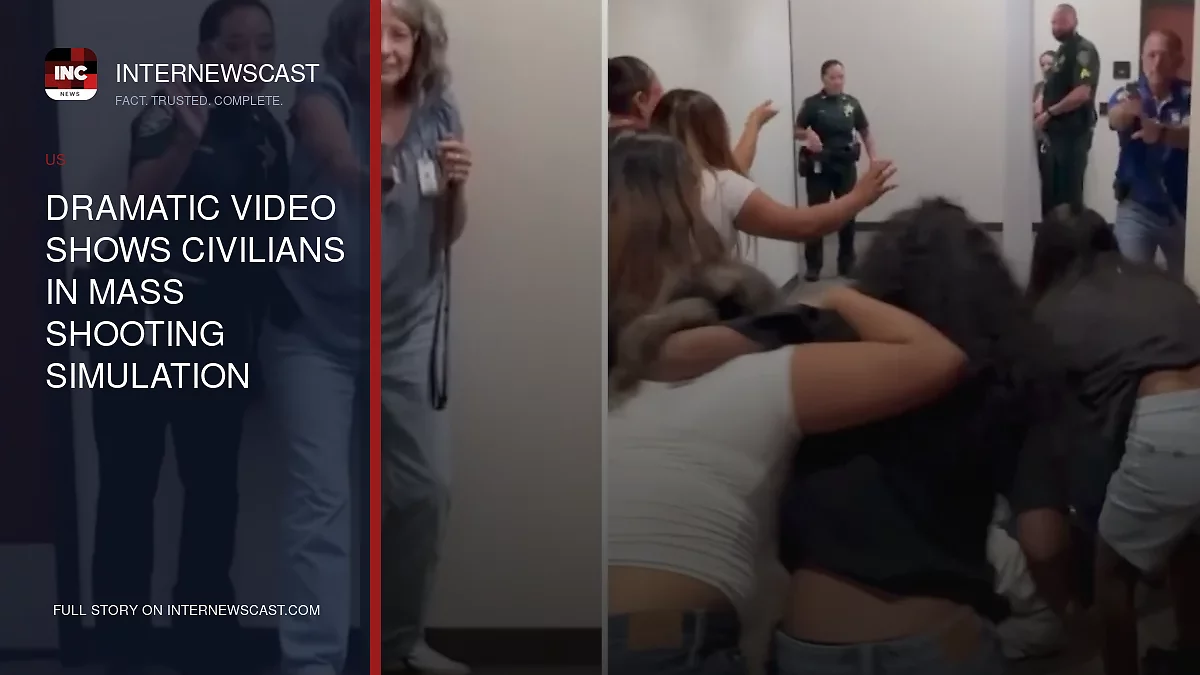
The training exercise quickly took a chaotic turn.
A Florida sheriff’s office shared startling video from last Tuesday showing civilian academy participants taking part in a simulated mass shooting drill, as people screamed and fired blanks at one another in a frantic, disorganized scene.
The unsettling footage, edited to pounding rock music, captured a portion of a six-week civilian academy run by the Highlands County Sheriff’s Office, a program intended to give local residents a behind-the-scenes look at the demands and realities of modern policing.
“Every year they’re surprised at how nervous they got, how much their heart rate got up, how much their adrenaline went up,” a sheriff’s office spokesperson said, describing the intensity of the active shooter simulation. “And that’s a lot of what you see with the smiles, that’s like a nervous laughter.
“You know, when you don’t know what to do, sometimes you’re just kind of laughing at yourself. They know there’s no real danger, but still.”
The civilian academy class is made up of a varied group of community members, including retired teachers and public sector employees, though none are seeking careers in law enforcement.
In the program’s second week, organizers turned their attention to the school resource unit, placing unsuspecting participants inside a high-pressure mass shooting threat scenario.
A real school resource officer portrayed the active shooter, while local Explorer Cadets — young people interested in law enforcement careers — played the role of terrified students, screaming as the drill unfolded.
It was up to the unsuspecting civilian academy to navigate the chaos and neutralize the threat with training pistols that fired blanks.
To dial up the terror, the department rigged the area with “shot boxes” — devices that blast blinding strobe lights and the deafening crack of simulated gunfire.
Participants even had to fumble with keys to unlock “classroom” doors under extreme duress.
The sheriff’s office noted that a person loses 30% of their fine motor control during a high-stress, life-or-death situation.
“That’s part of why we have them unlock the door, because when you get in a situation like that, 30% of your fine motor control goes away,” the spokesperson said.
“So trying to unlock that door with all that noise and all that chaos is part of the exercise. When our school resource deputies train, they also have to unlock a door to get to where the practice threat is.”
Some participants were caught on camera nervously laughing as their bodies went into full fight-or-flight mode.
Gloria Rabynski, 49, told The Post that “obviously I knew that it was an exercise, but I was just thinking like, ‘wow, if this is me knowing that it’s an exercise, I cannot even begin to imagine what our deputies go through in a situation similar.’”
A member of the Highlands County Board of County Commissioners, Rabynski joined the civilian academy to better understand the role of law enforcement in the community.
“I decided to get involved because, obviously, most of us think that we know what law enforcement do. But I wanted to see the other side of the story,” she said.
“I wanted to see really what takes everything for them to be able to do what they do.”
What shocked her the most was the process behind what happens.
“The decision-making process — It’s unbelievable,” she added.
The ultimate goal of the civilian academy isn’t to recruit residents, but to show them exactly the kind of split-second, life-saving decisions that are required to protect a school.
“Our deputies are not trained to wait for backup,” the sheriff’s office rep said.
“They go. When they hear gunfire, they go to the gunfire.”


