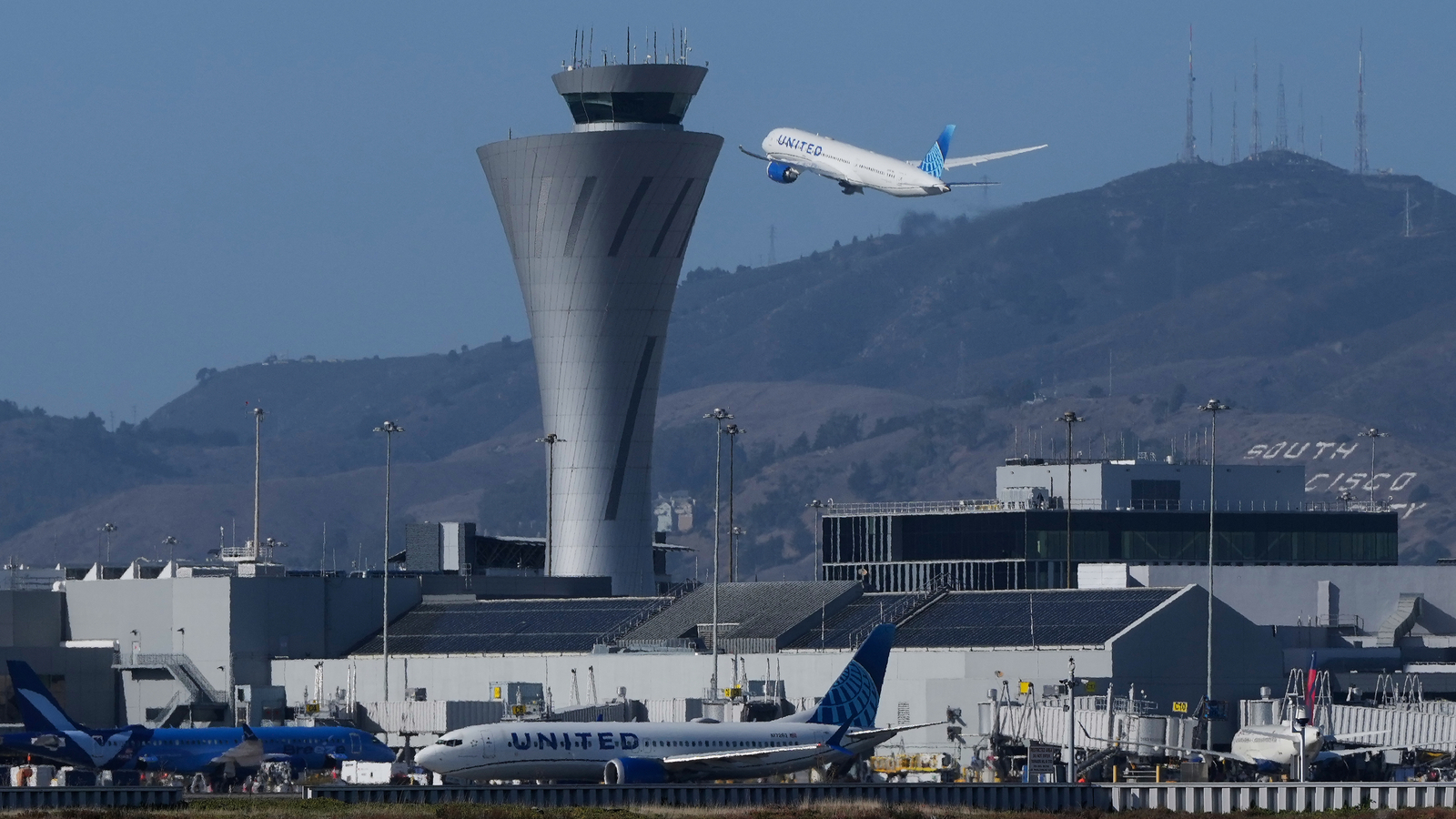

The Federal Aviation Administration lifted a rare nationwide ground stop late Friday after more than four hours, but not before the disruption sent U.S. air travel into turmoil, with thousands of canceled flights and travelers stranded at airports.
At a White House briefing Friday night, Transportation Secretary Sean Duffy attributed the crisis to outdated technology that became overloaded, causing “instability” and “inconsistency” in the radar and communications systems used for air traffic control.
Duffy urged Congress to approve billions of dollars in funding to modernize the nation’s critical aviation infrastructure, describing the situation as an “emergency.”
When reporters asked whether the disruption was caused by a cyberattack, Homeland Security Secretary Markwayne Mullin said there was no evidence of one so far. “There’s nothing completely certain right now,” he said, adding, “It doesn’t appear that way.”
Thousands of flights were canceled in the hours after the FAA imposed the ground stop, and officials cautioned that restoring normal operations would take time.
“It’s going to take us some time to unwind what’s happened this afternoon,” Duffy said, adding that “hopefully tomorrow we are going to start to see far better movement.”
Duffy said he expected the system to be “back up and operational” as the country moved toward Thanksgiving travel.
What happened?
Shortly after 3:30 p.m. ET Friday, the FAA began experiencing “instability for our radar and communications” at Air Traffic Control Centers and Terminal Radar Approach Control facilities, Duffy said.
The agency issued the nationwide ground stop at 3:54 p.m., halting departures across the country. Duffy said approximately 3,500 planes were in the air at the time.
The FAA said the order was issued “due to extraordinary circumstances and for reasons of safety.”
It was only the second nationwide ground stop since the Sept. 11 attacks. The previous one came in 2023, when the FAA’s NOTAM system failed, leaving pilots without required pre-departure information.
According to Duffy, the ground stop was lifted at 8:15 p.m. ET.
During the White House briefing, Duffy blamed “an incredibly old air traffic control system” that relies on what he described as “analog telecom.”
“Our switches, our routers, actually got overloaded with data … and started to give us inconsistency in the data from those routers. And because of that, we shut the system down,” he said.
Press for funding
Much of Duffy’s briefing focused on his call for Congress to fund an overhaul of the aging U.S. air traffic control system.
He asked lawmakers to approve billions of dollars for what he called a “complete overhaul” of the system.
CONTINUE READING: HOA Ordered to Pay $153K After Losing Legal Battle With Homeowner
Duffy maintained that the United States has the “safest airspace in the world,” but warned that disruptions like Friday’s could happen again. He also suggested that flying would become “less safe” without congressional funding to advance the nation’s flight systems.
“We didn’t think we would have this kind of outage,” Duffy said. “The systems that were deployed kept everybody safe — everyone landed. We’re able to review what went wrong and then reboot the system and go. But you will have more of these. You will have more of them unless the American people and the Congress tell us to build.”
Shortly after the FAA ordered the ground stop, Mullin said the federal government was examining every possibility behind the communications failure. Asked whether a cyberattack might be involved, he said investigators were not ruling anything out.
“As we investigate what caused this, you always got to assume that, as many cyber attacks that take place, that you make that assumption,” Mullin said. “But as of right now, that’s not known.”
AirSpace Intel, the contractor behind the SMART AI system being deployed at facilities nationwide, said in a statement on X that “The current ground stop is not based on or a result of the SMART system, any product of ASI or our integration with FAA and ATC.”
When asked whether the system’s rollout could be connected to the disruption, Mullin said, “we’re looking at that.”
At the late-night briefing, however, Duffy said the failure involved “old legacy equipment.”
“So there was no possible way SMART would have impacted what happened today,” Duffy said.
Congressional response
Several members of Congress called for answers and accountability after the disruption Friday evening.
House Democratic Leader Rep. Hakeem Jeffries described the outage as an “unprecedented breakdown.”
“American travelers deserve timely answers from the Trump Administration about how and why this happened and assurances that steps are being taken to ensure that our air travel system remains safe and functional,” he said in a statement.
Sen. Tammy Duckworth, an Illinois Democrat, wrote on X that the “safety of our skies is built on redundancies.”
“Whatever led to the nationwide ground stop will warrant a thorough and complete investigation,” she wrote. “As Aviation Subcommittee Ranking Member, I’ll be demanding answers from the FAA.”
Senate Transportation Committee Ranking Member Maria Cantwell said her office was in contact with the FAA about the ground stoppage.
“Technology issues related to how planes communicate through primary frequencies, backup frequencies, and other issues will be something the Commerce Committee will be reviewing,” the Washington Democrat said.
Copyright © 2026 ABC News Internet Ventures.


