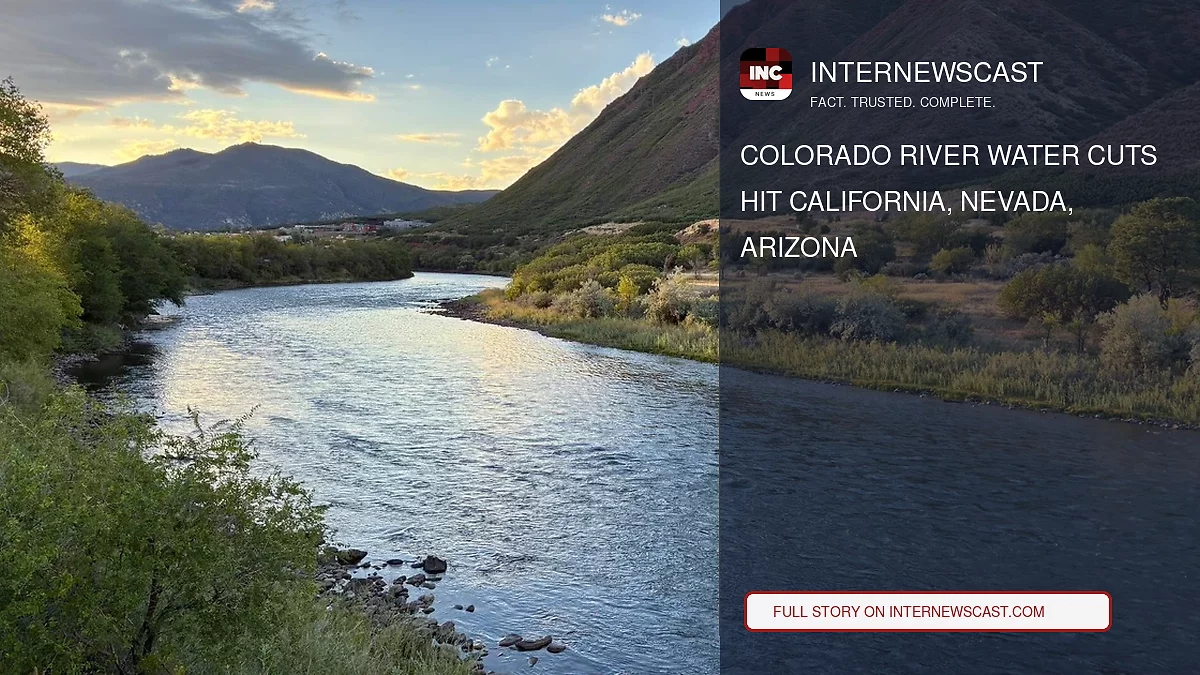

Federal officials on Friday unveiled steep Colorado River water reductions for the next two years, affecting three Western states that depend heavily on the stressed waterway.
The Bureau of Reclamation’s plan calls for California, Nevada and Arizona to cut their combined water use by 1.25 million acre-feet each year during that period, with deeper reductions possible if conditions worsen.
Arizona is expected to absorb the largest share of the cuts, while the upstream states of Colorado, Utah, Wyoming and New Mexico will not face reductions at this time.
Mexico, which also receives Colorado River water under a treaty with the United States, will reduce its allocation by 250,000 acre-feet.
“We’ve been in this 26-year prolonged drought period,” said Andrea Travnicek, the Interior Department’s assistant secretary for water and science. “We continue to see a prolonged drought in our future. So continuing to work together as a whole within the basin is going to be extremely important.”
The Colorado River provides water for an estimated 35 million to 40 million people, according to the Bureau of Reclamation.
Rules now governing how the river’s water is divided are scheduled to expire in October, and the seven states have been unable to agree on a long-term framework for sharing the supply.
The decision follows the worst recorded winter snowpack in the Colorado River Basin, intensifying pressure on farmers, businesses, wildlife and hydropower producers, along with tens of millions of people who rely on the river across the region, including members of dozens of Native American tribes and communities in two Mexican states.
Years of overuse combined with drought and rising temperatures due to climate change have depleted the country’s two largest reservoirs, which are both fed by the Colorado. Lake Mead recently plummeted to its lowest level since it began filling nine decades ago, and Lake Powell did the same about a week later. Their combined storage is the lowest it has been in nearly seven decades.
If the water in Lake Powell falls just 33 more feet, the reservoir will no longer meet the water levels needed to generate hydroelectric power, meaning the water can’t move through the dam into the Colorado River.
Negotiators in Arizona thanked California and Nevada for their collaboration on sharing the cuts.
“For 2027 and 2028, the reductions that are now memorialized here will provide substantial stability for folks,” said Tom Buschatzke, Arizona Department of Water Resources director. “We’ll continue to negotiate and figure out how we’re going to operate over a longer-term period, which is what we all want.”
JB Hamby, California’s chief Colorado River negotiator, said the plan brings “some badly needed near-term certainty at a moment of extraordinary risk,” though he called it “a bridge, not a permanent solution.”
Officials in Nevada applauded their collaboration with Arizona and California and said a seven-state consensus remains their preferred path for the river.
In Southern Nevada, Kyle Roerink, senior adviser at the conservation group Great Basin Water Network, said efforts to build a new airport and shopping malls and some public land sales have not progressed, reflecting the dire hydrology inked in the federal documents. Further cuts could slow real estate development in metro Las Vegas, he said.
“When the Hoover Dam, a symbol of American fortitude and American power, drops and loses its shine, it can be scary,” Roerink said. “But it can also pose itself as a great opportunity for us to prepare for the next hundred years in a meaningful way.”


