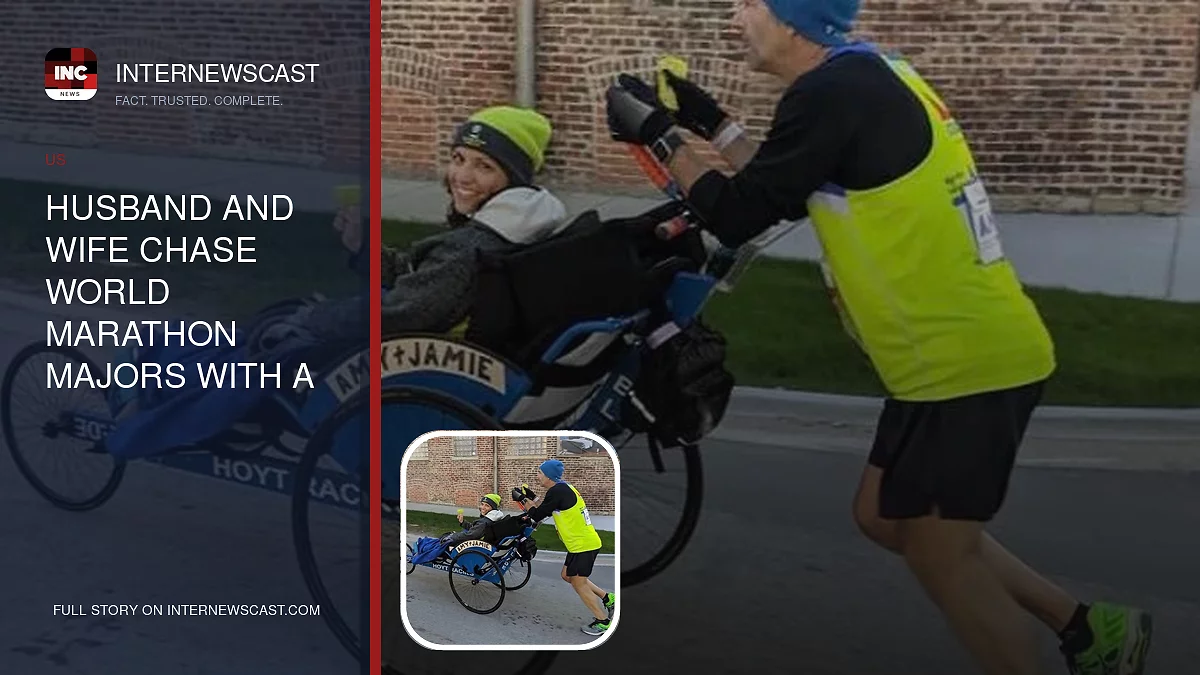

Before marathon runner Jamie Shinneman heads out for a demanding training day, he fuels up with a carb-loaded breakfast, ties his running shoes and rolls out with something most endurance athletes never bring along — his favorite teammate.
On long runs that can stretch up to 20 miles around Noblesville, Indiana, the 53-year-old pushes his wife, Amy Shinneman, in a sleek three-wheeled racing wheelchair the couple affectionately refers to as their “duo bike.”
Jamie provides the power, while Amy helps guide the journey. Together, the former high school sweethearts have competed as a Duo Team and completed four marathons since 2019 — a milestone that would be meaningful for any athlete, and especially profound for Amy, who has never been able to run on her own.
“My duo partner helps me to see beyond, sometimes, my limited vision of myself. And I think it’s a good lesson,” Amy said.
Amy was born with a neuromuscular condition that doctors formally identified in 2018 as Bethlem myopathy, a rare type of muscular dystrophy that gradually weakens muscles and can significantly limit mobility.
Now 52, Amy relies primarily on a wheelchair in daily life. But during marathons and training runs, that same need for mobility support has transformed into something far bigger: a gateway to movement, adventure and independence.
“She’s seeing parts of the world she’s never seen before on a trail,” Jamie said. “It just filled me, inspired me to keep pushing and just be with her more and more.”
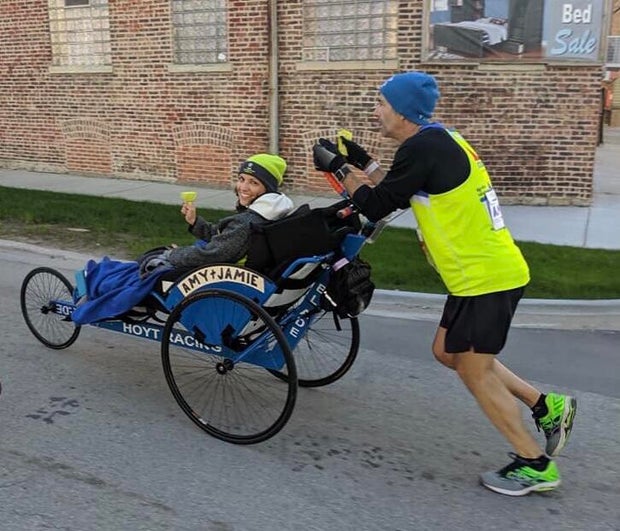
The Shinnemans
Amy admitted she was hesitant at first when Jamie suggested stepping away from his solo marathon goals in 2019 so they could begin racing together. The idea took shape after the couple spotted a racing wheelchair at the Boston Marathon Expo that year.
Jamie was eight years into his running journey at the time and was fast enough to qualify for the prestigious Boston Marathon not just once, but twice.
“Being honest, in the beginning, I really had no interest. I always felt like everywhere I went, I was on display because of the way that I walk. And so my like, first just gut reaction was, ‘no way, no thank you. I’ll enjoy cheering you on, on the sidelines.’ That was the role that I only ever knew how to do,” Amy said.
For Amy, being a spectator was familiar. Being an athlete — and having people cheer for her — was something she never imagined for herself.
“So I think that was kind of part of it too,” she said. “Just even, wrapping my brain around that I could be someone that other people are cheering on at a sporting event.”
Now, the cheers only get louder for the Shinnemans at each race, as they chase their dream of conquering all eight Abbott World Marathon Majors, the premier series of marathon races.
They’ve already completed Berlin, Boston, Chicago and New York. Next up is the 2026 Sydney Marathon on Aug. 30, leaving three more — London, Tokyo and Cape Town — to meet their goal. The reward, they say, will be much more than the medals.
“I’ve been through a lot of ups and downs and doubt because of my disability. But now I’m kind of transforming that … self-doubt into self-belief,” Amy said. “Each finish line we cross, the more confident I become that I am going to be able to get through this life, living well and still doing exciting things.”
The Shinnemans hope their story can help other people with disabilities see what’s possible for themselves, too. That mission helped inspire the name of their team and nonprofit, Team Humbly Courageous.
“The goal of Humbly Courageous is to help encourage people to live life with humble courage,” Jamie said. “They might see a husband and wife Duo Team working together like this and achieving goals that maybe they didn’t think that they could do together.”
To honor their fifth World Marathon Major in Sydney, the duo has set a goal of raising $26,000 for their nonprofit. Ten percent will be donated to the Muscular Dystrophy Association, while the remainder will be used to purchase a racing wheelchair for a Duo Team that otherwise couldn’t afford one.
What started as a joint adventure has become something much greater than 26.2 miles — a journey defined not by pace or personal bests, but by purpose.
“I hope, and Amy hopes, to inspire other people to use their God-given gifts, get out there — just help encourage each other,” Jamie said. “Be humbly courageous to do something maybe you didn’t think that you could do.”


