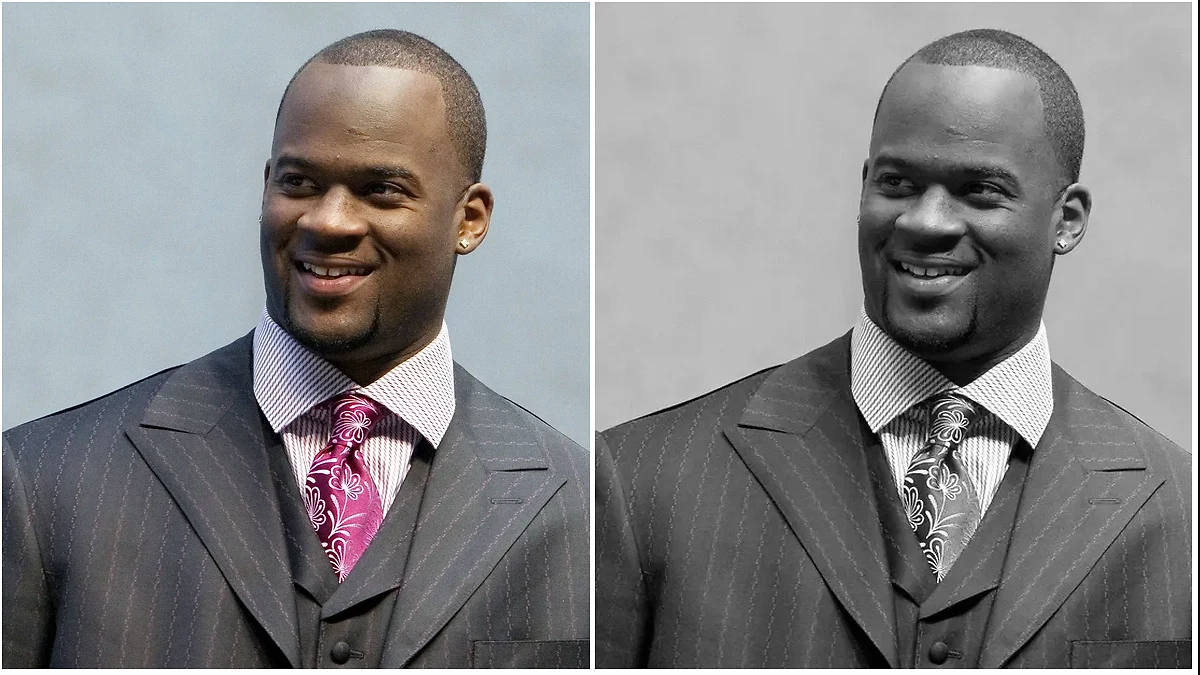
In January 2006, Vince Young stood at the center of the college football universe. The Texas Longhorns quarterback had just authored an unforgettable Rose Bowl masterpiece, passing for 267 yards and adding 200 more on the ground against a loaded USC team powered by Heisman Trophy winners Matt Leinart and Reggie Bush. With 19 seconds left and the national title hanging in the balance, Young sprinted into the end zone on fourth down, sealing a 41-38 Texas victory and one of the most iconic championships in the sport’s history.
By April, his professional future looked just as bright. The Tennessee Titans made Young the No. 3 overall pick in the 2006 NFL Draft, and a massive rookie deal soon followed. The contract was widely reported as a six-year agreement worth $58 million. Endorsement opportunities poured in as well, with his off-field portfolio at one stage reportedly valued at roughly $30 million. Young landed on the cover of “Madden NFL 08,” earned NFL Offensive Rookie of the Year honors and appeared set to become one of the league’s defining stars.
But the rise was followed by a stunning financial collapse. In January 2014, less than eight years after entering the NFL, Vince Young filed for Chapter 11 bankruptcy protection. The filing listed assets between $500,000 and $1 million, while his liabilities were estimated at anywhere from $1 million to $10 million.
So how did a player associated with a “$58 million NFL contract” end up in bankruptcy before his 31st birthday? The reality is more nuanced than the standard cautionary tale of a professional athlete burning through every dollar.
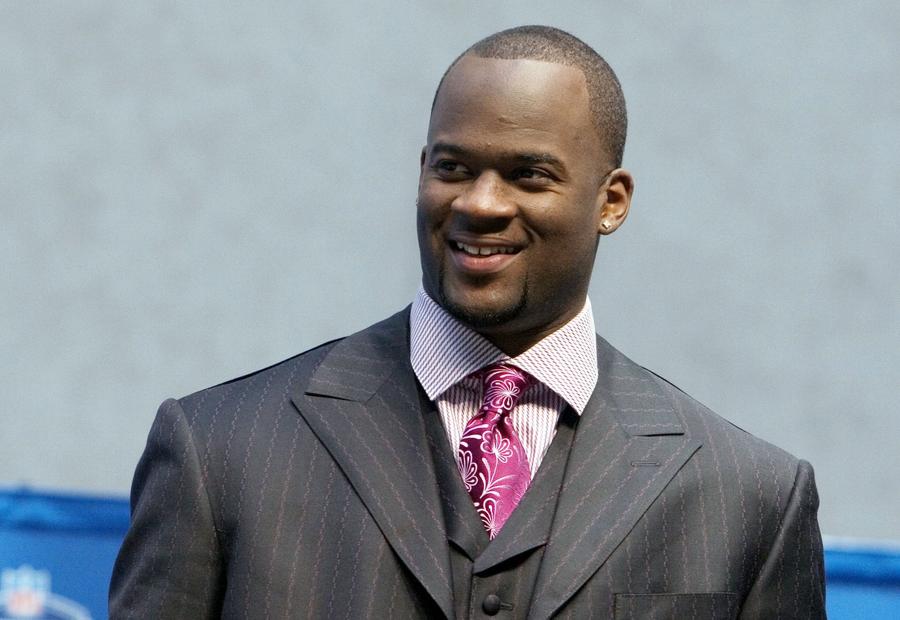
(Photo by Michael Brown/Getty Images)
The $58 Million Contract Wasn’t Really $58 Million
The key detail in Young’s financial history is that he never actually pocketed $58 million from Tennessee. His rookie contract was structured as a five-year deal with an option that could have pushed it to a sixth season. While the headline value approached $58 million, only about $25.7 million was guaranteed.
That distinction matters in any discussion of blockbuster sports contracts. The biggest number attached to a deal often includes future base salaries, roster bonuses, performance incentives and option years that can disappear if a player is cut or the contract is never fully realized.
Still, Young earned life-changing money. Across his time with the Titans and a later season with the Philadelphia Eagles, he collected approximately $35 million in NFL salary and bonuses. At his peak, he also signed endorsement deals with major brands such as Reebok, Campbell’s Soup and Vizio, while his appearance on the cover of “Madden NFL 08” cemented his celebrity status. Altogether, the potential value of those endorsement arrangements was reportedly about $30 million.
Again, that doesn’t necessarily mean another $30 million landed in Young’s bank account. Endorsement contracts can run for multiple years and contain performance requirements and other conditions, while taxes, agent commissions and management expenses consume a significant share of gross income. But there is no question that Young was earning extraordinary amounts of money at an extraordinarily young age.
His NFL Career Ended Much Faster Than Anyone Expected
Young’s financial trajectory might have looked very different if his NFL career had lasted 12 or 15 years. Instead, his prime earning window essentially lasted five.
Titans owner Bud Adams had strongly pushed for Tennessee to draft the Houston-born University of Texas star. Young also had a special connection to the franchise through former Titans quarterback Steve McNair, who had become a mentor and father figure to him.
Young’s rookie season seemed to validate the selection. He took over as Tennessee’s starter after an 0-3 start, helped the Titans win six consecutive games, made the Pro Bowl and was named AP NFL Offensive Rookie of the Year. But his relationship with head coach Jeff Fisher deteriorated over the following seasons, with disagreements involving meetings, team rules, preparation and Fisher’s handling of his quarterback.
Young eventually lost his starting job to Kerry Collins before reclaiming it during the 2009 season. He responded with one of the strongest stretches of his professional career, going 8-2 as a starter while teammate Chris Johnson rushed for 2,006 yards. Young earned his second Pro Bowl selection.
The final break came in November 2010. After injuring his throwing thumb against Washington, Young wanted to return to the game, but Fisher refused. Following an overtime loss, Young threw part of his uniform into the stands, argued with Fisher and left the stadium. He never played for the Titans again.
Tennessee released Young in July 2011. He signed with Philadelphia and earned roughly $4 million while backing up Michael Vick, but he made only three starts. That was his final NFL regular season. Young later signed offseason contracts with Buffalo, Green Bay and Cleveland but failed to make any of those teams’ regular-season rosters.
He had gone from the #3 pick in the NFL Draft to effectively being out of the league before his 30th birthday.
Spending At A Superstar Level
At the same time Young’s football income was disappearing, his lifestyle had been calibrated for the salary of an NFL star. He bought a home for his mother, purchased vehicles for relatives and became associated with one particularly famous story involving a roughly $15,000 bill at the Cheesecake Factory for a large group.
Obviously, a $15,000 restaurant bill does not explain the disappearance of tens of millions of dollars. A much more revealing figure emerged during Young’s later financial litigation, when one of his former advisers testified that Young’s expenses could sometimes approach $200,000 per month.
At that pace, annual spending could reach $2.4 million. Maintaining that lifestyle becomes dramatically more difficult when an NFL paycheck suddenly stops arriving.
There’s another factor that gets overlooked whenever an athlete’s career earnings are compared with his eventual net worth: gross salary is not personal wealth. Federal and state taxes, agent commissions, financial-management fees and other professional expenses can consume a huge portion of an athlete’s earnings before the athlete spends a dollar. Someone who earns $35 million during an NFL career never actually has $35 million available to spend.
The $1.8 Million Loan
Young’s finances became considerably more complicated because of a loan obtained during the 2011 NFL lockout. Pro Player Funding provided roughly $1.8 million in financing connected to Young, and the debt subsequently became the center of a major legal battle.
Young argued that he had not knowingly authorized the loan and alleged that documents bearing his signature had been forged. The lender disputed his account, and payments on the debt had at one point been made directly from Young’s Philadelphia Eagles compensation. Interest and other charges pushed the disputed obligation significantly higher.
By 2012, Young was confronting a judgment approaching $1.7 million related to the loan at precisely the moment his NFL career had effectively ended.
Vince Young Sued His Agent And Financial Adviser
Young was simultaneously fighting another financial battle. He sued former agent Major Adams II and financial adviser Ronnie Peoples, accusing them of mishandling his money and alleging that millions of dollars had been improperly taken or committed without his authorization.
Young claimed the losses totaled at least $5.5 million. His allegations included forged signatures, falsified documents and financial transactions he said he had never approved. The defendants disputed allegations against them, and the case ultimately ended in a confidential settlement in December 2013 without a public finding or admission of wrongdoing.
Young later portrayed himself as a young athlete who concentrated on football while trusting other people to monitor his finances. Whatever portion of his losses resulted from personal spending versus disputed financial management, by late 2013 he was in a dangerous position: his football income was gone, significant debts remained and money he expected from settlements had not yet arrived.
January 2014: Bankruptcy
In January 2014, Vince Young filed for Chapter 11 bankruptcy protection in Houston. The numbers were extraordinary considering where he had been just a few years earlier.
- Assets: $500,000 to $1 million
- Liabilities: $1 million to $10 million
This was a player who had entered the NFL with $25.7 million guaranteed and ultimately earned roughly $35 million in NFL salary and bonuses.
Young’s bankruptcy was not a traditional liquidation in which everything he owned was immediately sold. Chapter 11 generally allows a debtor to reorganize financial obligations while retaining control of assets, and Young’s case was relatively short-lived. After resolving disputes with his former advisers and reaching an agreement involving Pro Player Funding, he asked the court to dismiss the bankruptcy proceeding.
Years later, Young said it took roughly three years to eliminate his debts and put his finances back in order.
A Very Different Financial Life
Young officially announced his NFL retirement in 2014 and gradually returned to the University of Texas, where his football career had first made him a national star. He had re-enrolled years earlier and completed his degree in youth and community studies in 2013, then joined the university’s Division of Diversity and Community Engagement after leaving professional football.
His relationship with Texas later evolved into a more permanent role. In 2021, Texas Athletics hired Young as a special assistant, working with athletic director Chris Del Conte, the athletics department and the broader university community. His employment agreement provided a $100,000 annual salary.
For Young, the job represented a full-circle return to the institution most closely associated with the greatest moments of his playing career. Long removed from the enormous contracts and financial turmoil of his NFL years, he found a new professional role at the University of Texas, where he remains one of the most recognizable figures in Longhorns history.


