
It may be the defining economic issue of our age, yet it remains one that many people have scarcely encountered. The media has not given it the attention it deserves, and politicians across the ideological spectrum have too often looked elsewhere, consumed by smaller disputes while a serious threat to our economy, prosperity and way of life grows stronger.
The danger is becoming impossible to miss: China is methodically expanding its industrial base to a point where it could supply the world with nearly every major manufactured good it needs.
Beijing already has far more production capacity than its domestic market can absorb. Even so, it continues to build at speed, with much of that additional output clearly aimed at overseas buyers.
President Xi Jinping’s strategy appears unmistakable: deepen global reliance on Chinese exports and, in doing so, weaken large parts of Western industry.
That amounts to an attempt at economic dominance on a global scale, carrying with it immense geopolitical influence — achieved not through military conflict, but through control of production and supply.
So far, helped by short-sighted political leadership on both sides of the Atlantic, this campaign has advanced with remarkably little resistance.
Some may ask what is new about this. After all, the West has already lived through what is now known as China Shock 1.0, the period that began roughly 25 years ago when Beijing gained broad access to global markets.
That shift unleashed a wave of low-cost Chinese goods across the world, cutting prices for consumers but also forcing many Western firms to close and leaving countless workers without jobs.

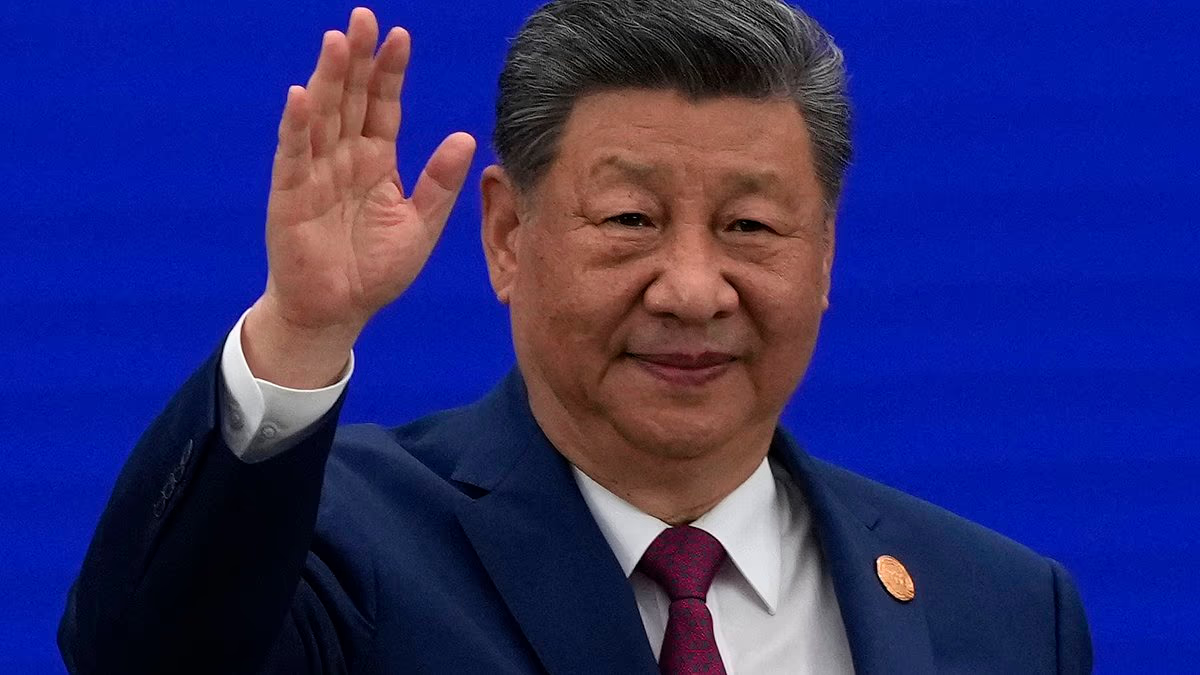
It is the clear policy of President Xi Jinping to make the rest of the world dependent on Chinese exports, writes Andrew Neil

China Shock 1.0 – which involved exports of clothes, toys, furniture and household appliances – is being superseded by China Shock 2.0, which will deal with sophisticated, high-end manufacturing of goods such as precision machine tools
Well, yes, we have and, despite all the pain and disruption it caused, there was never much pushback from the West. True, there were losers, from America’s mid-West to the textile towns of northern England, where blue-collar communities suffered.
But there were more winners from the lower prices and our political masters on both sides of the Atlantic thought what China was exporting – clothes, toys, furniture, household appliances – were not the sort of goods advanced economies in the 21st century should be involved in making anyway. So we just grew to live with it. China Shock 1.0 became the status quo.
It’s now being superseded by China Shock 2.0, an even bigger disruption and far more of a threat because it targets the advanced industries in which the West thought its future lay.
We’re talking the sort of sophisticated, high-end manufacturing of goods such as precision machine tools, robotic arms for assembly lines, electric vehicles (EVs), the new breed of batteries they require and a new generation of pharmaceuticals.
China is long past the stage of contenting itself by creating the capacity to supply its own needs for these products. It’s building enough to supply the world. A pipe dream? Far from it – it’s already happening.
China can already build enough EVs to supply the entire European market. That’s ten million cars a year. It will soon have enough capacity to meet the global demand for EVs – and the batteries that make up so much of their value.
Indeed, such is the size of Chinese capacity in EVs and their batteries, not to mention their competitive edge, there is really no scope for anybody else to enter the market at scale. We are approaching an age in which the vast majority of EVs and nearly all the key components in them will be Chinese.
That’s already true of solar panels. Fifteen years ago Europe – especially Germany – had a thriving solar panel industry. Then China entered the fray. There is now no European solar panel industry worth talking about. Wind turbines will be next.
Perhaps most concerning of all, China is building up an unbeatable lead in the market for precision machine tools and advanced industrial robotics. That’s what makes the threat of China Shock 2.0 so monumental, so much more existential than China Shock 1.0. We’re no longer talking about cheap clothes for teenagers or toys for kids. We’re talking about the industries of tomorrow.
To understand what’s happening more clearly, let me take you, briefly, to two places.
First, Dongguan in Guangdong Province, just north of Hong Kong. This town used to be full of factories churning out cheap toys, shoes, clothes and appliances for Western markets. No longer.
Now it’s a ‘factory for factories’ making high-value capital goods for global industry from machine tools to robotic arms and microchips – exactly the sort of advanced manufacturing Germany and Japan used to dominate.
Now let’s go to Dresden in Germany, home to Volkswagen’s showcase plant known as the Transparent Factory, so called because it was designed with glass walls to let the public watch workers and machines put together VW’s world-beating cars.
Except there’s no point going there – because car production ceased last December. Reeling from China Shock 2.0, VW is now slashing tens of thousands of jobs in Germany, closing plants and, irony of ironies, opening an export hub in China from which to supply global markets.
The plight of VW is the plight of German industry. Last year, Germany lost 150,000 skilled, well-paid industrial jobs. This year, it’s still losing them at a rate of 10,000 a month.
Politicians in Baden-Wurttemberg, Germany’s hitherto prosperous manufacturing heartland, now speak openly of it becoming the ‘Detroit of Europe’. This is a reference to the US city nicknamed ‘Motown’ thanks to its domination of car manufacturing, which saw its population decline from close to two million in the 1950s to just over 600,000 in 2020 as the car giants moved out.
That prospect tells us something else about China Shock 2.0. Whereas the first shock took more of a toll in America, where there was more low-end manufacturing than in Europe, it is advanced manufacturing in Europe that will bear the brunt of the second Chinese wave.
We can date the start of China Shock 2.0 to 2021 when, in the wake of the world’s biggest ever property crash, President Xi decided it was time to move resources out of property and into advanced manufacturing. That was only five years ago. And yet there’s already been an explosion of Chinese exports to Europe.
The European Union runs a trade deficit with China of one billion euros per day. It’s heading for an annual deficit of half a trillion euros next year – twice the pre-Covid deficit. And, even though we’re only in the early days of the shock, it’s already exacting a grim economic toll.
Bankruptcies in the EU are at a ten-year high. European growth is sluggish. Industrial production is actually declining. Germany now imports more sophisticated capital goods from China than it exports to China – Shock 2.0 in action.
America erected trade barriers to China Shock 2.0, including a 100 per cent tariff on Chinese EVs. Other Chinese products face tariffs of around 25 per cent, far higher than European tariffs where, par for the course, the EU has dithered in its response to China. It’s still dithering, making Europe a much softer target.
It’s not as if the EU hasn’t been warned. France’s official planning agency starkly reported earlier this summer that, without action, Europe was heading for ‘industrial devastation’.
Entire chunks of European industry – cars, machine tools, wind turbines – would go the way of European solar panels. ‘Rapid industrial wipeout in under a decade’ beckoned, with 55 per cent of European manufacturing at risk (60 per cent in Germany).
But what of dear old Blighty? The good news (I suppose) is that because we don’t have that much advanced manufacturing we are less exposed than the EU in general and Germany in particular.
The bad news is that we’re governed by politicians who have no idea there is any kind of threat or, if they do, simply ignore it.
In fact, it’s worse than that. Far from even modestly protecting our interests, we’ve reduced tariffs on imports from China to facilitate the Government’s mad dash for Net Zero.
Yes, as energy secretary, Ed Miliband actually embraced China Shock 2.0 to further his green goals. We stuck with a standard 10 per cent tariff on cheap Chinese EVs because he wanted people to buy them.
And, not content with making it easy for Chinese EVs, the Government decided to penalise our own carmakers for not selling enough EVs.
Last month, British vehicle output was a mere 64,000 units, down 12 per cent on the year. A decade ago we produced 1.5 million vehicles a year.
This year we’ll be lucky to produce half of that. In 2025, we managed under 720,000, down 8 per cent on the year before. Thanks to China Shock 2.0 and our own Government’s folly, we probably won’t have a car industry at all in ten years’ time.
As for so-called ‘green jobs’, we already have precious few of them. Thanks to Miliband’s Net Zero obsession, our green supply chains for all manner of stuff (batteries, cathodes, anodes, solar/wind turbine components, critical minerals) are already China-dominated.
If we’d taken our time, we could have fostered more domestic suppliers. Instead, the Government decided to embrace cheap Chinese green tech to meet its artificial climate targets, which have taken precedence over everything else.
There is no coming back from this. We have favoured China and sacrificed any hope of a new industrial base, while jeopardising our security. So much for industrial policy, despite all the talk of it in Labour circles. Not so in China, where industrial policy is paramount. The scale of the commitment is breathtaking – even frightening. There was a time when Chinese industrial policy was confined to backing a few favoured sectors.
No longer. The whole might of Chinese Communism – state-owned banks, state-owned companies, local government – has been mobilised in pursuit of what’s being called ‘the industrial policy of everything’. China’s economic growth, which secures the continued dominance of the Communist Party, is increasingly dependent on exports.
China’s currency, the yuan, is manipulated down against other currencies to make these exports even more competitive – and to make goods that China imports more expensive.
There you have another key feature of China’s second shock: it isn’t just the biggest export drive the world has ever seen, it’s a strategy to reduce China’s dependence on imports. Investment has been showered on those parts of advanced manufacturing which Beijing perceives to be over-dependent on imports.
Replace imports with homegrown production, keep the currency cheap to favour exports and, hey presto, you have a modern mercantilism – an ancient economic doctrine which promotes exports above all else and which fell out of favour years ago.
President Xi has revived it and combined it with autarky, a policy of national self-sufficiency. Those who think we can live with China Shock 2.0 because China’s massive domestic market will still be open to our exporters really have no idea what they’re talking about.
First, it was never that open in the first place. Second, the shutters are coming down. Third, President Xi thinks autarky works.
China now runs a traded goods surplus of $1.2trillion (£900million) with the rest of the world, with bigger surpluses to come. President Xi isn’t doing this just because he can. He’s doing it because with economic dominance comes global political power.
When you dominate global trade the way China envisages, you dominate global supply chains. Just as America has projected its power and influence through its effective control of the global financial system so China aims to do the same through its control of global supply chains.
It’s already flexed its muscles. Japan learned how vulnerable it was to Chinese supply chains when it recently had the temerity to stand up for Taiwan.
The EU fears retaliation if it takes a tough line against China. Even America has backed off confronting China on trade. Say hello to the shape of things to come.
We are in no position to deal with it. The EU is rudderless. America is run by a President who prefers to pick fights with allies rather than build the united front needed to confront China Shock 2.0. Our own political leadership could not be less equipped to rise to the challenge.
By the time they grasp the implications of 2.0, we’ll be on to China Shock 3.0. It’s already stacking up. This won’t involve Chinese exports of EVs or robotic arms. Not a single container ship will be involved.
It will be the export of the operating system itself: Chinese-built AI models embedded in the software running Western factories, Chinese-standard batteries and chips wired into the next generation of Western infrastructure and EVs. Chinese firms setting the technical rules the rest of us will have to follow because, by then, there will be no alternative supplier left standing.
Beijing will own the plumbing of the modern global economy, while our wet-behind-the-ears Prime Minister will still be talking about cowboy builders, digital subscriptions, No10 North and buses. Always buses.