
An unusual pattern among thousands of reported Bigfoot sightings across the US has prompted fresh questions about whether the legendary creature may sometimes venture surprisingly close to human communities.
Independent researcher and retired police officer Bruce Champagne reviewed 5,834 reports from 14 states before selecting 25 cases he considered the strongest examples of an unknown animal moving through towns and cities at night.
Champagne found that witnesses most commonly described seeing Bigfoot along secluded routes, with some reports placing the creature as far as a mile inside towns and cities during winter nights.
Rather than viewing the encounters as isolated accidents near woodland borders, the study characterized them as cautious and repeated movements through developed areas.
Champagne described the alleged behavior as “a pattern of rare, apparently intentional, largely solitary, nocturnal, corridor-based incursions that may be consistent with flexible decision-making.”
Bigfoot is commonly described as a massive, hairy, ape-like creature—or possibly a group of creatures—that walks upright and is said to inhabit remote forests throughout North America.
The first widely publicized modern Bigfoot report emerged in 1958, when Humboldt Times journalist Andrew Genzoli published a reader’s letter about enormous, unexplained footprints discovered near a logging site at Bluff Creek, California.
Although the US has produced thousands of alleged sightings, witness accounts, photographs and footprint discoveries, no physical evidence has been publicly presented that scientists accept as proof of Bigfoot’s existence.

The reported Bigfoot incursions were spread across 14 US states, with the highest concentrations in Illinois, Ohio, Utah, New Jersey and Colorado

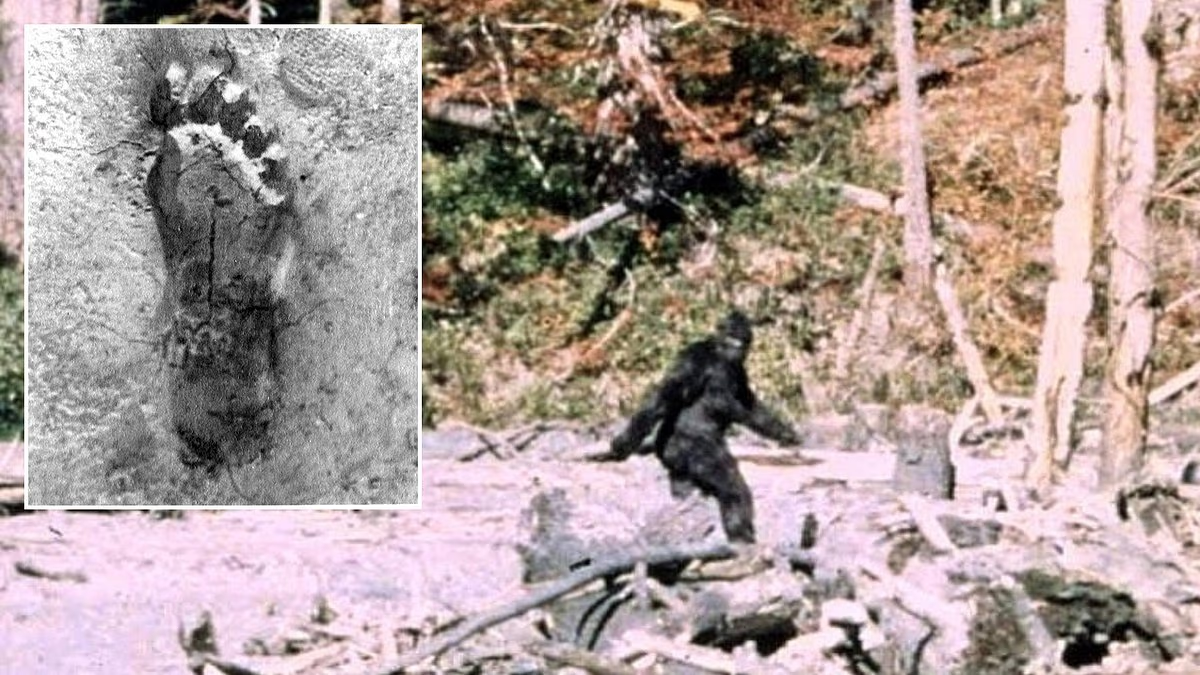
A line of 35–45 clear, pristine footprints discovered in Washington in 1996 and shared by Jeff Meldrum, a Bigfoot expert and author of Sasquatch: Legend Meets Science
Champagne narrowed his analysis to reports placing Bigfoot at least a quarter of a mile inside densely populated areas, defined as locations with at least 1,600 residents per square kilometer (0.38 square miles).
The 25 selected accounts involved large, ape-like figures reportedly seen at least a quarter of a mile inside towns or cities. Champagne’s analysis classified the witnesses as highly credible.
The accounts came from 14 states, with Illinois, Ohio, Utah, New Jersey and Colorado recording the highest numbers. The reports were most frequent between 2006 and 2015.
Champagne compared the reported movements with the behavior of other intelligent animals, including great apes, when they encounter people.
He suggested that the alleged creatures’ preference for nighttime travel could indicate an awareness of the dangers posed by using urban routes during daylight hours.
EXPLORE MORE: LA Councilmember Ysabel Jurado Denounces Skid Row Sweep
“The patterning observed here suggests that urban incursions, while uncommon, are behaviorally structured events that merit further comparative and field-based investigation,” Champagne concluded.
According to the study, the creatures often appeared to move discreetly along drainage ditches and railway lines.
On average, the reported figures traveled 1.75 miles into the towns and cities they entered at night. One account placed an alleged Bigfoot nearly eight miles from the edge of town, although the report did not disclose the precise date or location.

Bigfoot as depicted in the 1967 Patterson-Gimlin Film, which shows a suspected Sasquatch reportedly seen at Bluff Creek, California

The study found that reported Bigfoot sightings were more common in winter and during the overnight period between midnight and 3am
Among other wildlife species, run-ins with humans often occur because of environmental stresses, such as animals searching for food in the winter when supplies become scarce.
Champagne suggested the same thing might be happening with Bigfoot sightings, as the creatures come out of hiding when their food sources run low during the cold, winter months.
Champagne’s research focused on accounts documented in three major databases, Oregonbigfoot.com, the Green Archive and the Bigfoot Field Researchers Organization (BFRO).
BFRO is the most widely cited and comprehensive public collection of Bigfoot reports in the US.
According to their records, which date back to 1904, Washington state has seen the most Bigfoot sightings, with more than 700 on record. California ranks second with nearly 500 sightings on record.
Champagne assessed reports on the basis of whether multiple witnesses were present, how credible the observers were, how close the witnesses allegedly got to the creature and how long the encounters lasted.
Champaign found that 36 percent of all Bigfoot encounters happened in winter, followed by autumn (27%), summer (23%) and spring (14%).
The creatures were described as ‘massive’ by 40 percent of witness accounts, however, one in five people called Bigfoot ‘lightly built.’
Typical Bigfoot sightings also described a creature that stood up to 15 feet tall, with footprints measuring up to 24 inches long and eight inches wide.
They were most often seen prowling between midnight and 3am local time.