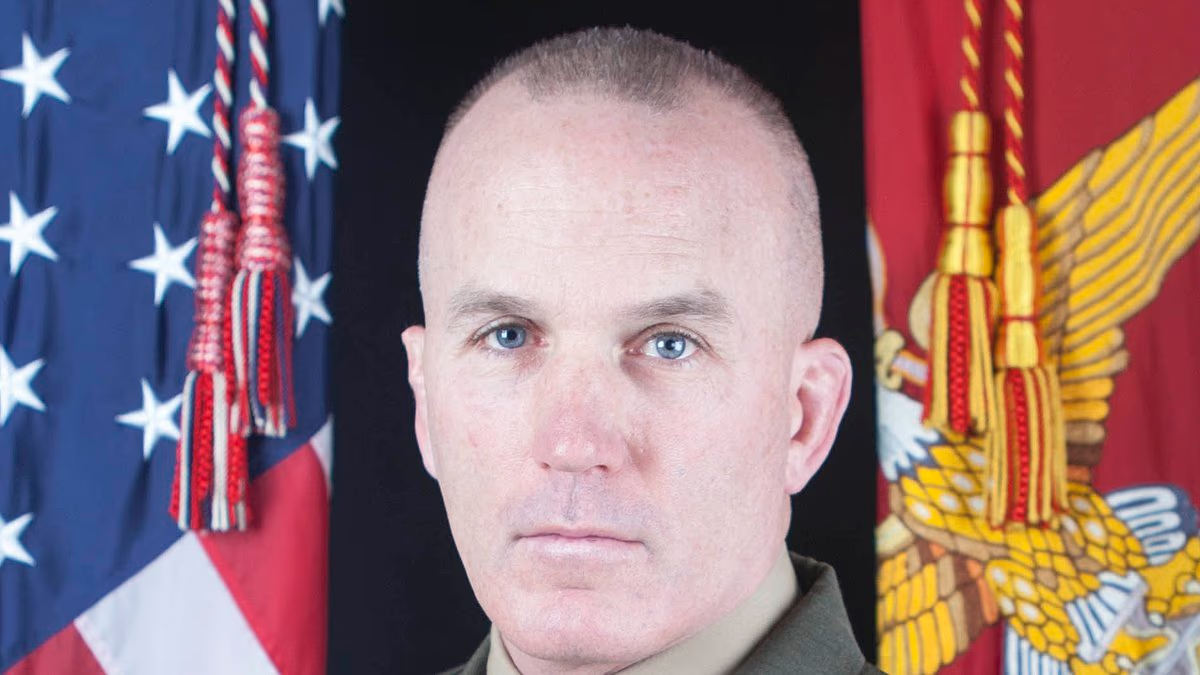
A celebrated Marine Corps veteran is reportedly the subject of a criminal investigation related to his conduct while training cadets as a high school instructor.
Retired Sergeant Major Bradley Kasal became widely known after a 2004 photograph showed him and another Marine carrying an injured comrade from the Second Battle of Fallujah during the Iraq War. The image later inspired two statues.
Kasal served in the Marine Corps for 34 years before retiring in 2018. He later worked as the Junior ROTC instructor at Basic Academy of International Studies, a public high school in Nevada, where he now faces unspecified allegations.
Cadets reportedly said Kasal frequently took a supportive interest in a group of female students, including driving them home, taking them to Starbucks and spending time with them outside official school activities.
Several students defended Kasal and praised his commitment to the program. One said he “genuinely cared about everybody and taught us incredible lessons,” while another said he “poured his heart and soul into the program.”
He also offered to adopt one of the students, CBS News reported.
The precise nature of the allegations remains unclear. JROTC instructors are prohibited from pursuing personal, intimate or sexual relationships with cadets.

Retired Sergeant Major Bradley Kasal, a celebrated Marine Corps veteran, is reportedly under criminal investigation over his conduct involving female cadets while working as a high school instructor

Marine Corps 1st Sgt. Brad Kasal is helped by Marine Pfc. Christopher Marquez and Lance Cpl. Dane Shafer as he escapes the notorious “House of Hell” in Fallujah
Kasal resigned from the school in August 2025 after spending seven years there, according to the county school district.
The Marine Corps told CBS News that it was “aware of the allegations against a retired Marine Sergeant Major which occurred while he was employed as a civilian JROTC instructor by the Basic Academy of International Studies.”
The Naval Criminal Investigative Service is also pursuing the case. NCIS said its Camp Pendleton office is leading the investigation.
The Henderson Police Department said the Clark County School District Police Department was responsible for handling the matter but declined to answer questions.
Officials later said they were not aware of any investigation into Kasal’s conduct being conducted under their jurisdiction.
Kasal has not publicly addressed the investigation.
Kasal’s name became permanently linked to one of the Iraq War’s most iconic episodes. On November 7, 2004, American, British and Iraqi forces launched a fierce campaign against insurgents in Fallujah, Iraq—a battle that would continue for two months and become known as the Second Battle of Fallujah.

Kasal became famous after a 2004 photograph showed him and another Marine carrying an injured comrade from the Second Battle of Fallujah, an image that later inspired two statues

Kasal served 34 years in the Marine Corps before retiring in 2018 and later worked as a Junior ROTC instructor at Nevada’s Basic Academy of International Studies

Basic Academy of International Studies
The fighting was intense from the outset, but the events of November 13 became especially infamous within the Marine Corps. That day came to be remembered as the “House of Hell.”
In southwestern Fallujah, two Marines on a search-and-destroy mission were ambushed inside a heavily defended building. They surprised and killed one concealed insurgent, but the gunfire revealed their position to others on the roof.
Bullets tore through a skylight, followed by grenades that wounded both Marines. US reinforcements arrived, only to come under fire and become trapped inside the building.
Kasal was outside the structure when he seized another Marine and entered to help the men under attack.
A veteran who had also fought in the first Gulf War, Kasal and his fellow Marine managed to take out another insurgent before gunfire struck them in the legs and left them surrounded.
When insurgents threw a grenade into the room, Kasal shielded his comrade with his own body. The blast caused additional injuries to his legs.
Despite his wounds, Kasal dragged the Marine to safety, drew his pistol and protected them for more than an hour while reinforcements battled their way into the building.
Chris Marquez and Dane Shafer were among the Marines who ultimately reached the room and carried Kasal out. Photographer Lucien Read captured the rescue, creating an image that would become an enduring symbol of the brutal fighting in Iraq.
A decade later, Wyoming artist John Phelps recreated the photograph as two statues. One was installed at Camp Pendleton in San Diego, and the other at Camp Lejeune in North Carolina.


