

Static Media
One of the most quoted bits from the “Armageddon” DVD commentary (via Newsweek) finds Ben Affleck recalling the question that has haunted viewers for years: Why would NASA teach oil drillers how to be astronauts instead of teaching trained astronauts how to drill? It was, on its face, the more practical plan. Michael Bay’s response was not a lengthy defense of blockbuster logic. He simply told Affleck to “shut the f*** up,” and somehow, that exchange became part of the movie’s enduring legend.
Affleck was hardly alone in poking at the wild premise. Critics had plenty of issues with “Armageddon” when it arrived, and its 42% critics score on Rotten Tomatoes still feels surprisingly harsh for a disaster movie that so fully understands its own absurd appeal. This is, after all, a film about a Texas-sized asteroid racing toward Earth, with Bruce Willis’ veteran driller Harry S. Stamper and his roughneck crew recruited to land on the rock, bury a nuclear bomb inside it, and save humanity. Around that mission, the movie piles on soap-opera stakes, including Harry’s disapproval of A.J. (Affleck), the cocky young worker who happens to be in love with his daughter, Grace (Liv Tyler).
Reviewers took aim at the film’s shaky science, its proudly anti-intellectual streak, and the fact that much of its plot collapses if you think about it for more than a few seconds. Then there is Bay’s full-throttle style, which hits like a fireworks finale across the movie’s 150-minute runtime. But some films deserve to be reappraised outside the expectations placed on them at release, and “Armageddon” is absolutely one of those big-screen spectacles worth revisiting.
Armageddon isn’t a thinking man’s movie
Buena Vista Pictures Distribution
Nobody gets on Space Mountain at Disneyland and complains that the ride has failed to provide a believable oxygen supply for interstellar travel. You accept the fantasy, strap in, and enjoy the rush. That is the best way to approach “Armageddon,” which plays less like a sober science-fiction drama and more like a cinematic rollercoaster. It is unapologetic popcorn entertainment, not a thoughtful meditation on humanity’s place in the cosmos or a realistic blueprint for stopping an asteroid impact.
That does not mean there is no value in smarter, more cerebral filmmaking. Sometimes you want a finely prepared dinner; sometimes you want fast food that hits exactly the spot. After a long, draining week, “Armageddon” is the kind of movie built for switching off the analytical part of your brain and letting the noise, emotion, and heroics wash over you. In an odd way, it may have even made audiences more curious about space travel, if only because scientists and experts have spent years explaining everything the movie gets wrong. Those real-world breakdowns have become their own form of entertainment, and they arguably make the film’s inaccuracies more memorable than a strictly accurate version ever could.
Massive spectacle has always been Michael Bay’s calling card, and that is a major reason “Armageddon” remains one of his most recognizable and effective movies. It never pretends to be something more refined than it is. It promises loud, glossy, emotionally supercharged blockbuster entertainment, complete with melodrama, one-liners, and patriotic bombast, and it delivers exactly that.
Armageddon has even entered the Criterion Collection

Buena Vista Pictures Distribution
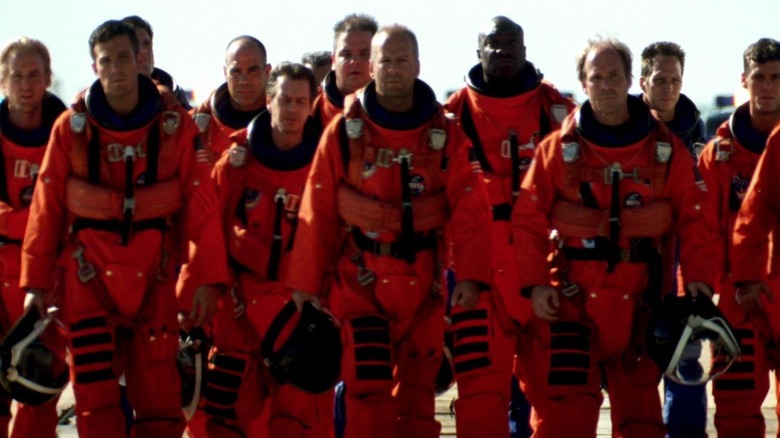
Still, “Armageddon” is not only a collection of explosions, slow-motion hero shots, and men striding dramatically toward danger. Beneath all the chaos is a surprisingly sturdy emotional engine, centered on A.J.’s desire to earn Harry’s respect and prove he is worthy of Grace. By the time Harry chooses to sacrifice himself on the asteroid and gives A.J. his blessing, the movie has spent enough time with these characters for the moment to land. It remains one of the most memorable deaths in mainstream sci-fi disaster cinema, a scene engineered to draw tears and largely successful at doing so. “Armageddon” is corny, yes, but it is sincerely corny. It does not wink at its big emotions or puncture them with ironic jokes; it commits completely.
No one needs to argue that “Armageddon” belongs beside “2001: A Space Odyssey” in the canon of serious science fiction. The point is that it should be judged on its own blockbuster terms. Audiences have long understood that distinction, which helps explain its 72% Popcornmeter score on Rotten Tomatoes. The film even found its way into the Criterion Collection, best known for preserving and restoring important classic and international cinema. “Armageddon” was never in serious danger of vanishing from pop culture, but its Criterion release speaks to its status as a major commercial artifact — and, perhaps, as a crowd-pleasing title capable of helping support the preservation of less widely known films.
“Armageddon” isn’t perfect, but it also represents a kind of blockbuster we don’t get anymore. The special effects team created real sets and utilized actual explosions. If nothing else, it’s easy to appreciate the artistry on display that’s becoming harder to come by in modern big-budget action movies.