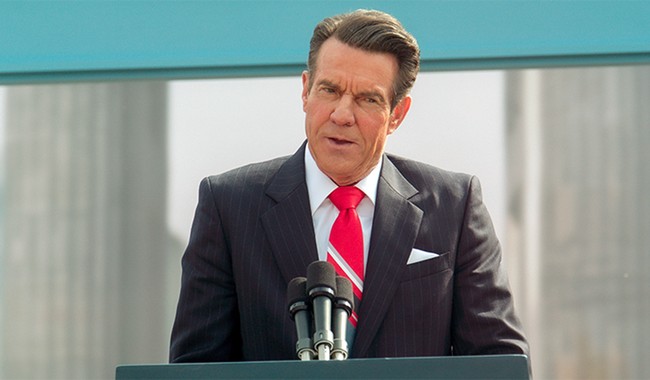
“Reagan,” the 2024 Dennis Quaid-led biographical drama that weathered a chilly Hollywood reception while still drawing respectable box office returns and earning a 98 percent audience approval rating on Rotten Tomatoes, is headed back to the big screen. The film will return to roughly 600 theaters on September 25, 2026, in a new director’s cut featuring three never-before-seen scenes that add about 10 minutes to the running time.
Ahead of the re-release, I spoke with producer Mark Joseph, whose film credits include “Max Rose” and “The Vessel.” Joseph was generous with both his time and his reflections on the long road to bringing Ronald Reagan’s life to film. The conversation will appear in three parts. The first installment follows.
When did the idea for “Reagan” first take shape?
The origins go back roughly two decades. At the time, Joseph was working at Walden Media when a drive through Dixon, Illinois — Reagan’s hometown — unexpectedly changed the course of the project. After being pulled over for speeding, he had to stay overnight and appear before a judge the next day. That delay gave Joseph and his family time to explore the local Reagan landmarks, from the future president’s boyhood home to the river where he once worked as a lifeguard. The experience, Joseph said, helped him see Reagan less as a political icon and more as a man shaped by a specific American place and era. Already familiar with Paul Kengor’s book “The Crusader,” which examined Reagan’s decades-long opposition to communism, Joseph reached out to Kengor. That phone call, he said, marked the beginning of a 20-year effort to get the film made — a journey he explores further in his book “Making Reagan.”
What was the creative spark behind the film?
Joseph said he was drawn to the sense that Reagan’s full story had never truly been captured on screen. Audiences knew the familiar chapters: the Hollywood actor, the California governor, the president, and the famous challenge, “Mr. Gorbachev, tear down this wall.” But Joseph believed those moments were connected by a larger, more personal narrative. What especially intrigued him was that Reagan’s concern about communism was not something he adopted after entering the White House; it had been part of his thinking and public life for many years. To Joseph, that lifelong thread made the story cinematic. Still, he said he never approached “Reagan” primarily as a political movie. Politics was Reagan’s profession, but the film, in Joseph’s view, was about the boy who became the man — his roots, the forces that shaped him, the setbacks he survived, and the purpose he ultimately found.
Was Dennis Quaid always the first choice to play Ronald Reagan?
Yes, Joseph said, although Quaid was not always available. Over the years, the production explored other possibilities, including Nicolas Cage, who was attached to the project for a period, and conversations with actors such as Jim Caviezel. Even so, Quaid remained Joseph’s preferred choice. The reason, he explained, went beyond physical resemblance. Quaid carried a similar sense of openness and optimism, and the more Joseph learned about him, the more parallels he saw between the actor and Reagan: strong Christian mothers, alcoholic fathers, acting careers, complicated marriages involving wives who often commanded the spotlight, and seasons in life when both men had to reinvent themselves. Quaid, Joseph noted, was initially intimidated by the role. Reagan is a figure many people feel they already know, and neither Quaid nor Joseph wanted a mere impersonation. The goal was to find the person beneath the recognizable voice and gestures — and Joseph believes Quaid ultimately did exactly that.
What kind of pushback did you get within the entertainment industry?
There were people who simply didn’t believe a movie about Ronald Reagan should be made, and others who assumed that if Hollywood made one, the purpose should be to tear him down. We also encountered people who thought the project was impossible commercially. Then there were all the normal filmmaking problems multiplied by twenty years — financing that appeared and disappeared, people who weren’t what they claimed to be, COVID shutting us down, and later the actors’ strike affecting our release plans. But there was another kind of skepticism that was interesting. When I began interviewing people who knew Reagan, some were suspicious of me because I was coming from Hollywood. They assumed, “Here comes Hollywood to destroy Ronald Reagan.” We had to earn their trust. Once one Reagan associate trusted us, that opened the door to another and another. Eventually I interviewed more than 50 people who knew him. I spent time with George Schulz, Ed Meese, Dick Allen, Justices Scalia and Kennedy, and dozens of others.
Editor’s Note: The mainstream media continues to gaslight, spin, and lie about President Trump, his administration, and conservatives.
Help us continue to expose their left-wing bias by reading news you can trust. Join RedState VIP and use promo code FIGHT to receive 60% off your membership.