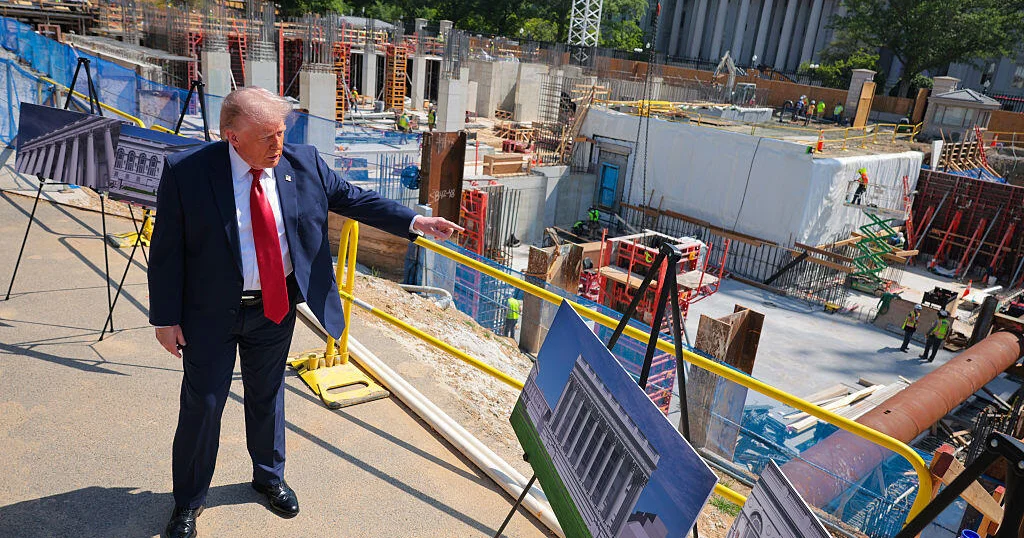

Washington — The Supreme Court on Monday left construction moving forward on a new White House ballroom, allowing President Trump’s large-scale project to continue for now.
By a 5-4 decision, the justices paused lower court orders that would have temporarily stopped work on the new 90,000-square-foot ballroom planned for the site where the East Wing previously stood.
In an unsigned opinion, the court said the National Trust for Historic Preservation, which sued in an effort to block the White House construction project, lacked the legal standing required to bring the case. The justices did not rule on whether Mr. Trump’s East Wing project itself is lawful.
Chief Justice John Roberts sided with the court’s three liberal justices in dissent.
Earlier this month, Roberts had temporarily allowed construction on the ballroom to proceed while giving the Supreme Court additional time to consider the Trump administration’s emergency request.
The unsigned opinion said the lower court judges “likely exceeded” their authority when they moved to block the ballroom project. The majority cited sworn statements from senior administration officials, including the director of National Intelligence and the heads of the Secret Service, the Army and the State Department. Those officials said the ballroom was needed and cautioned that any substantial delay in construction would damage the government’s interests because national security facilities are being built beneath the site.
“Today, we do not pass upon the legality of the government’s East Wing project,” the court said. “We conclude only that, based on the submissions before us, the government is likely to prevail in showing that the Trust lacks Article III standing to challenge the project in federal court and that the remaining stay factors favor relief.”
Roberts, however, wrote in dissent that construction of the ballroom is “likely unlawful.” Joined by Justices Sonia Sotomayor, Elena Kagan and Ketanji Brown Jackson, the chief justice said Congress has not authorized the East Wing project.
Roberts also said the injuries asserted by Alison Hoagland, one of the Trust’s members, are sufficient to allow the lawsuit to go forward.
“The White House is not just any building, and — when it comes to historic preservation — Hoagland is not just any person,” he wrote. “In failing to appreciate as much, the Court misconceives the plaintiff’s injury, allowing the Executive’s likely infringement of the Legislature’s power of the purse and authority to regulate federal property in the District of Columbia to continue. Today’s decision is no victory for the separation of powers.”
The Trump administration requested emergency relief from the court earlier this month after a federal appeals court ruled the White House lacked authority to build the $400 million project without congressional approval.
The divided U.S. Court of Appeals for the D.C. Circuit concluded that Congress — not Mr. Trump or the White House — has “full constitutional control over federal property and the funding of its maintenance and development,” and noted an “absence of any express or implied authorization” that grants Mr. Trump the ability to construct the ballroom.
In a filing with the court, Solicitor General D. John Sauer asked the justices to pause the lower court ruling that blocked above-ground construction while the legal battle over the project plays out. The overhaul also includes an underground bunker, medical facilities and other features, and judges have allowed that work to continue.
“This case involves an extraordinary and unlawful injunction that will halt the ongoing construction of the integrated military complex, including a totally secure ballroom space, at the East Wing of the White House, which is vitally required by national security,” Sauer wrote.
Sauer wrote that the renovations are “absolutely required and should not be enjoined” because any delay threatens Mr. Trump’s safety after recent domestic and international assassination plots against him.
Construction on the project is 65% done, Sauer wrote in the filing, because the initial district court order halting the construction has never gone into effect. He revealed that a 250-person crew is working “20 hours a day, 7 days a week.”
Described as a “superstructure” made of concrete and steel, Sauer told the high court that it rises up to 70 feet high in some places, stretches five stories deep and has a footprint of nearly 50,000 square feet. The ballroom is funded by private donations, and $335 million of an expected $400 million has been raised, Joshua Fisher, director for White House Management and Administration, said in a declaration.
“Given the current progress, the superstructure is beyond the point of return,” he said.
The White House anticipates the structure will be “substantially” completed by November, and the full project is expected to be wrapped by August 2028, when Mr. Trump will have just five months left in his term.
In April, the appellate panel granted an administrative stay sought by the Justice Department that allowed all White House ballroom construction to continue while the court considered briefs and heard arguments. Below-ground work on the presidential bunker and other security upgrades has continued as well during the legal back-and-forth. The D.C. Circuit then upheld the district court’s injunction.
Attorneys for the National Trust for Historic Preservation, which filed suit to block the ballroom project late last year, argued in their response to the Trump administration that the organization would be irreparably harmed if the ballroom construction is permitted and accused the White House of attempting to “outrun judicial review.”
“In the end, the question is not ‘whether the proposed ballroom is desirable, or not, as a matter of policy.’ Nor is it even whether Petitioners may ultimately construct the ballroom,” they wrote in a filing. “The question is simply who decides whether a ballroom can be built on federal property. Our constitutional system and federal law commits that choice to Congress.”
Lawyers for the Trust accused the White House of shifting positions regarding the nature of the project, including its stance that the ballroom was necessary for national security, when previously it said the ballroom could be built independent of the below-ground facilities. They reiterated that the lower court orders allow work on the subterranean bunker to continue.
Mr. Trump has been deeply involved in the project, frequently raising the ballroom during public events and in posts on Truth Social. In a social media post Friday, the president called the Trust “treasonists” and accused them of revealing “top military secrets.”
Portions of some legal filings submitted by the Justice Department to lower courts have been written in the style of the president’s social media postings, including with misplaced capital letters and exclamation points, raising questions as to whether Mr. Trump himself participated in the brief-writing process.