
Erika Kirk, the widow of Charlie Kirk, shared an emotional message after a Utah judge ruled that Tyler Robinson must face trial in the killing of her husband.
Robinson, 23, is accused of shooting Kirk once in the neck, fatally wounding the 31-year-old father of two during a Turning Point USA event at Utah Valley University nearly a year ago.
The case could now carry the death penalty after a judge determined on Tuesday that Utah County prosecutors had presented sufficient evidence to move forward with an aggravated murder charge. Robinson has pleaded not guilty.
In a statement shared online, Kirk’s family said the ruling, coming almost one year after Charlie was killed, represented a meaningful step in their ongoing fight for justice.
The family said each stage of the legal process has underscored the devastating loss caused by Kirk’s death, particularly for his children, who will now grow up without their father. They also thanked supporters for their prayers, encouragement and solidarity during what they described as a year of overwhelming grief.
Judge Tony Graf ruled that prosecutors had shown probable cause to support an allegation that Kirk was targeted, a finding that allows the state to pursue capital punishment against Robinson.
Graf cautioned, however, that prosecutors will still have to prove that aggravating factor beyond a reasonable doubt when the case goes before a jury.
Kirk’s parents, Robert and Kathryn, appeared at the courthouse on Tuesday walking arm-in-arm, both wearing somber expressions as the proceedings moved forward.

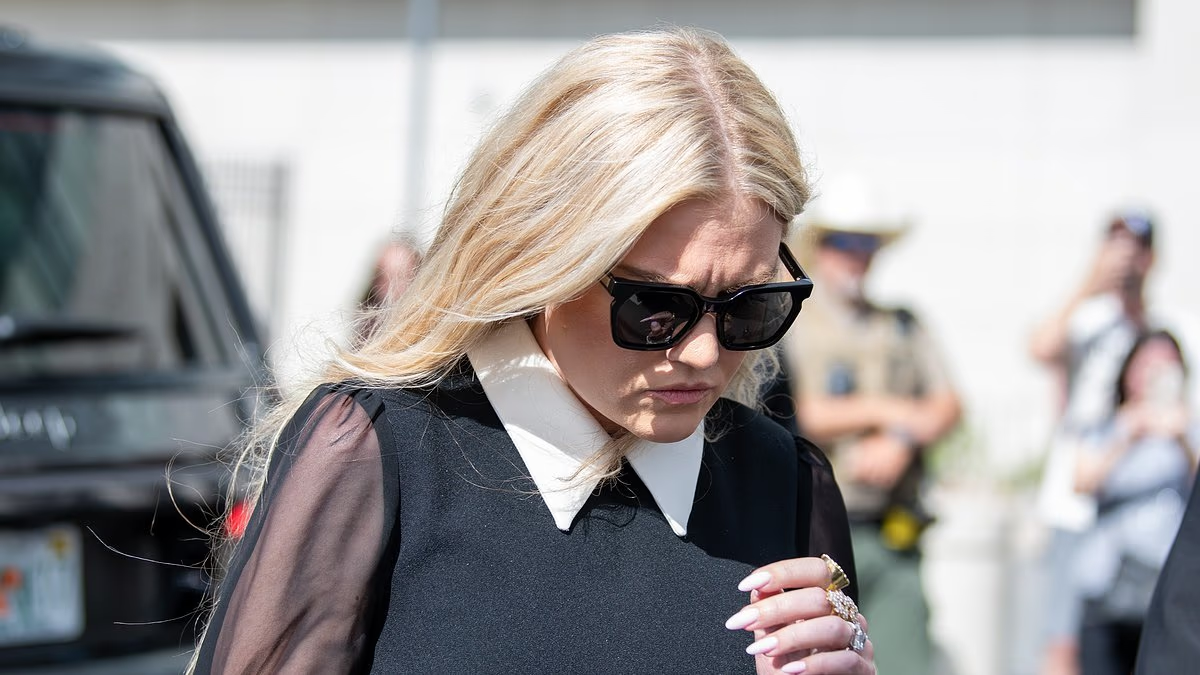
Charlie Kirk’s widow, Erika Kirk, released a hearbreaking statement after a judge ruled that her husband’s alleged killer would stand trial. She is pictured leaving court in July
![The Kirk family released a statement online that said: 'Today¿s decision... marks an important step in our family¿s pursuit of justice for [Charlie]'](https://i.dailymail.com/1s/2026/09/02/06/110977115-16098055-The_Kirk_family_released_a_statement_online_that_said_Today_s_de-a-9_1788327438386.jpg)
The Kirk family released a statement online that said: ‘Today’s decision… marks an important step in our family’s pursuit of justice for [Charlie]’

Kirk’s parents were seen arriving at the courthouse arm-in-arm, their faces grim as they awaited the decision

Tyler Robinson, 23, will go to trial for the assassination of conservative activist Charlie Kirk, Judge Tony Graf ruled on Tuesday
Inside, Erika Kirk sat beside them, briefly burying her face in her hands as the judge considered whether still frames from the shooting would be shown.
Towards the end of the hearing, Erika’s attorney addressed the court and insisted Charlie dedicated life to building community. The lawyer said Charlie was the opposite of hate – firing a bullet into a crowd to kill someone is hate.
Erika’s eyes were closed and tears ran down her face as she nodded in agreement with the statement.
The key question in charging Robinson with aggravated murder was whether he endangered others when he allegedly opened fire on Kirk in a crowded area.
Prosecutors argued Robinson knowingly put more than 3,000 people in danger by allegedly firing into the crowd, creating the ‘great risk of death’ they say is required to keep execution in play.
His lawyers countered that the state had failed to meet the legal threshold, arguing he had a specific target and a plan to hit him – not put the crowd in the crosshairs.
District Judge Tony Graf gave both sides up to two hours each for closing arguments, followed by a one-hour break before announcing his decision from the bench.
The sealed proceeding finally brought months of fiery courtroom battles – and an unusually long preliminary hearing – to an end.

Robinson is accused of firing a single shot into Kirk’s neck, killing the 31-year-old father-of-two during a Turning Point USA event at Utah Valley University nearly a year ago

The key question in charging Robinson with aggravated murder was whether he endangered others when he allegedly opened fire on Kirk in a crowded area


Video shown to the court allegedly showed Robinson on a rooftop overlooking the amphitheater where Kirk was speaking and later fleeing on foot after the shot was fired
Join the discussion
What does true justice look like for families devastated by public acts of violence like this?
As closing arguments got underway, with cameras allowed in the courtroom by the judge, Deputy Utah County Attorney Ryan McBride told the court the evidence points directly to Robinson as the gunman who shot Kirk dead last September.
He declared that ‘it’s not difficult to understand motive here,’ alleging he pulled the trigger because he opposed Kirk’s conservative views, including his stances on Catholicism and ‘traditional’ marriage.
Kirk’s positions on same-sex marriage and transgender surgeries were sharply at odds with those of Robinson, who was reportedly in a romantic relationship with his roommate, Lance Twiggs, the state argued.
McBride told the judge Robinson returned to the UVU campus ‘dressed to kill’ after scouting vantage points, allegedly changing into a black shirt and long pants to conceal the rifle he had hidden down his pants.
Cameras allegedly caught him studying the area earlier that day before he returned armed with a rifle, McBride said.
He allegedly used a screwdriver he had left behind to reassemble part of the weapon before climbing onto the roof.
‘There, he lay down in a prone position, and he would have seen this mass of people of 3,000 plus people there for the event, took aim, put his crosshairs on Charlie Kirk, and fired,’ McBride said.
McBride then got into the aggravating factors, rejecting the defense’s claim that one shot and no second victim meant the charge could not apply, arguing that interpretation twisted the law.

Prosecutor Ryan McBride told the judge Robinson returned to the UVU campus ‘dressed to kill’ after scouting vantage points, allegedly changing into a black shirt and long pants

McBride also pointed to the Trump rally shooting in Pennsylvania as a chilling reminder of the danger of firing into a crowded public event. Kirks is pictured with the president
‘You can’t shoot a rifle into a crowd of 3,000 people without knowing that you create a great risk of death to all those around your target,’ he said.
McBride said testimony showed Robinson fired from just a football field away, arguing it was a matter of ‘millimeters’ between the bullet hitting Kirk and striking someone else.
‘He came on a mission to kill Charlie Kirk, and if he missed, so be it. He was prepared to take other shots and let the casualties be what they may,’ he said.
McBride pointed to the Trump rally shooting in Pennsylvania as a chilling reminder of the danger of firing into a crowded public event.
He said the president narrowly escaped death when he turned his head, sending the bullet through his ear, while errant rounds struck three other people, killing one.
‘Not only is there common sense, but there’s recent precedent,’ the prosecutor said.
The attorney asked the judge to find probable cause that Robinson knowingly put others at grave risk of death – the aggravating factor that could keep execution on the table.
Defense attorney Staci Visser then took the floor, arguing that prosecutors had failed to present evidence showing Robinson knowingly created the ‘risk of death.’

McBride said Robinson fired this rifle from just a football field away, arguing it was a matter of ‘millimeters’ between the bullet hitting Kirk and striking someone else
She said previous cases lay out three factors for establishing the circumstance: the link between the killing and the danger to others, how close those people were to the victim and how seriously they were threatened.
‘There were no actual threats by the assailant to the third party. There was no evidence that would suggest that anyone else was threatened,’ Visser said.
She tore into the state’s case, accusing prosecutors of building key parts of their argument on speculation and pointing to the screwdriver found on the roof as one example.
But despite her efforts, the arguments were not enough for Judge Graf to rule that Robinson’s case would not go to trial.