Economists are tipping another interest rate rise before the end of the month, a move that would take borrowing costs to their highest point in 15 years.
Macquarie Bank issued its forecast on Wednesday, ahead of the Reserve Bank of Australia’s next board meeting scheduled for September 28 and 29.
The call comes after NAB also predicted the cash rate would increase by 25 basis points at the upcoming meeting.
Macquarie chief economist Ric Deverell said the central bank was likely to remain firmly focused on bringing inflation down, Nine News reported.
‘With unemployment still around three quarters of a percentage point below the level it was pre-Covid, the RBA seems to feel that output remains above the economy’s potential, suggesting more needs to be done to bring inflation back to target,’ he said.
RBA assistant governor Sarah Hunter added to expectations of a possible hike on Tuesday, warning the board ‘may well have to raise interest rates to tackle [high inflation]’.
‘I’m certainly myself pretty clear that inflation is top priority right now,’ she told a summit in Sydney.
‘Inflation is above target and has been for some time.

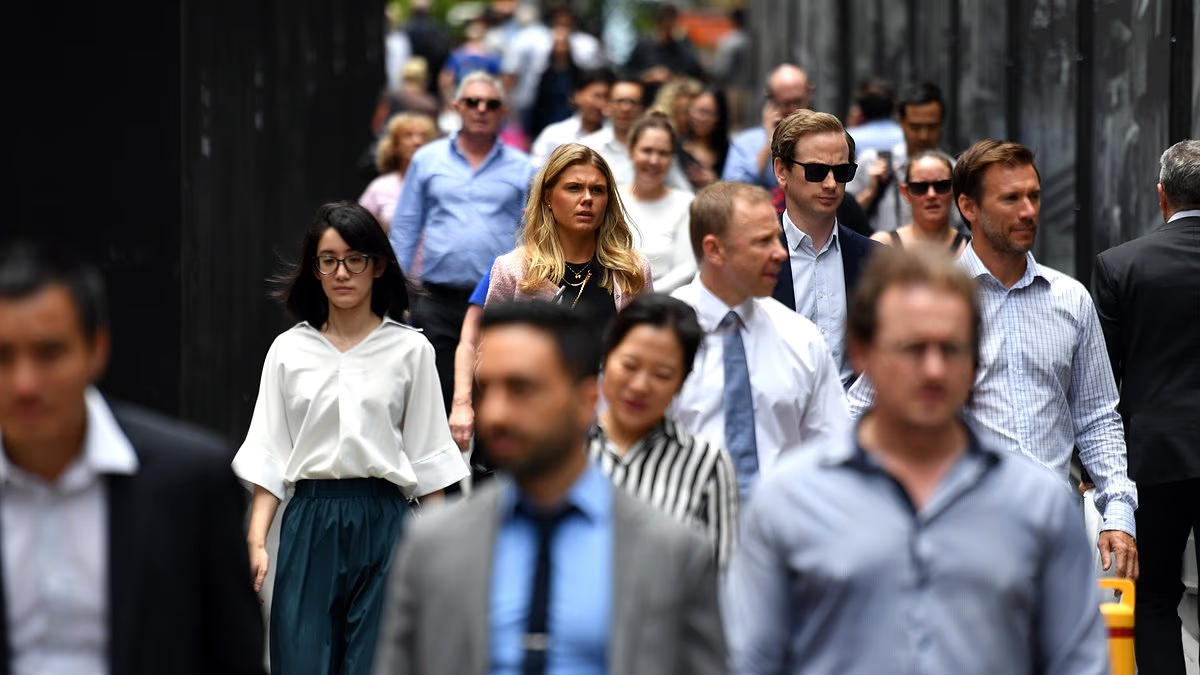
Australians have been warned another interest rate hike could be delivered by the end of the month

Several RBA figures highlighted high inflation, triggering concern another rate rise would be handed down on September 29
‘We are concerned about inflation and if there is a sense that inflation is going to be stronger than we think in the context of our forecast, then the board may well have to raise interest rates to tackle that.’
Deputy governor Andrew Hauser similarly told ABC’s 7.30 the RBA would consider another rate hike.
‘We are very, very clear we have to hit that two to three per cent [inflation] range, aiming at the midpoint,’ he said.
‘We are doing it, as you say, over a longer period than some other central banks have done.
‘We’re doing it in order to try to protect the jobs gains that happened during Covid.
‘If at some point it becomes clear that that is not a feasible path, we’ll take another path.’
However, Dr Hauser conceded the RBA was aware Australians were ‘furious about inflation’.
‘Everywhere I go, I hear cost, cost, cost, inflation, inflation, inflation, and that’s our responsibility. We have to put that right,’ he said.

RBA assistant governor Sarah Hunter (above) on Tuesday warned the RBA board ‘may well have to raise interest rates to tackle’ high inflation
‘I understand why. It’s unfair. It hits people. It hits people on low incomes. It damages price signals. It makes the job of companies difficult.’
The RBA has a target band of two to three per cent for inflation, which it expects to reach by the end of next year.
Headline and trimmed mean inflation came in above the RBA’s forecasts in July at 3.5 per cent and 3.6 per cent respectively.
Dr Hauser said falling house prices weren’t a key factor in the bank’s forecasts for inflation, noting house prices were still 3 per cent higher than a year ago and almost 50 per cent higher than the beginning of this decade.
‘While house prices play a role in the economy, they’re not really as big as … global growth trends, productivity, the risk environment globally,’ he said.
Confidence plummeted 14 per cent among mortgage holders in the month, compared to a 0.9 per cent fall among renters.
‘Interest rate concerns had a clear negative impact on consumers with a mortgage,’ Westpac’s head of Australian macro-forecasting Matthew Hassan said.
Overall, the consumer sentiment index declined 5.2 per cent to 84.4, as interest rate expectations climbed 7.3 per cent.

Mortgage holders’ confidence in the economy dropped 14 per cent in the last month
Despite economists forecasting the housing downturn to deepen as high interest rates combine with federal budget tax changes, only 32 per cent of consumers expected prices to decline over the next 12 months, with 42 per cent expecting a rise.
HSBC chief economist Paul Bloxham expects nationwide house prices to fall 13 per cent peak to trough, which would be ‘the largest housing price correction in modern history’.
Already, $34.1billion has been wiped off Australian property values in the three months ended June, the Australian Bureau of Statistics reported.
The 0.3 per cent decline pales in comparison to the 12.3 per cent increase since the start of 2025.
The total value of Australian dwellings is still a whopping $12.7trillion, following decades of strong growth.
As Housing Minister Clare O’Neil points out, a low-income young couple is half as likely to own their own home in Australia than they were 45 years earlier.
‘That tells us that what’s going on with housing in Australia is not just about a roof over people’s heads,’ she told the AFR Property Summit.
‘This is fundamentally changing what aspiration means in our country.’
If the RBA did raise the cash rate by 25 points it would jump to 4.6 per cent, the highest since November 2011.