
Rows of brightly painted wooden boats have been stacked in a vast maritime graveyard, their perilous Atlantic crossings ending on the shores of a tiny Spanish island.
Some are large fishing vessels never designed to carry hundreds of people across open water. Others are smaller and battered, their worn hulls bearing witness to voyages that lasted as long as 12 days in brutal conditions.
Together, they offer a stark image of the latest development in Europe’s migration crisis: how El Hierro, a Canary Island home to only around 12,000 people, was overwhelmed by nearly 100 boats carrying close to 11,000 West Africans in just a matter of weeks.
Known locally as cayucos, the wooden boats have been removed from El Hierro’s ports and taken to a recycling yard. The abandoned vessels evoke the compounds in Kent filled with inflatable dinghies used by migrants crossing the English Channel.
The route from West African nations including Senegal, The Gambia and Mauritania to the Canary Islands is considerably longer — and more hazardous — than the Channel crossing.
For those who make it to El Hierro, the island is rarely the ultimate destination. It is the first European territory they have reached, a temporary stopping point before continuing towards mainland Europe and, in some cases, attempting another small-boat journey to Britain.
That next phase was already unfolding this week at a temporary migrant processing centre in San Andrés, high in El Hierro’s interior, when Our News Outlet visited.
Young men congregated outside the accommodation buildings. Some sat along a low wall using their mobile phones to call relatives, send messages and take photographs, while others played football to pass the time.

New arrivals on El Hierro, the small Canary Island, use their phones to make calls and send messages

Colourful boats used during the Atlantic crossing have been abandoned along the island’s coastline
Among those waiting were brothers Amarah, 22, and Abaraka, 17, who had travelled from The Gambia and were already planning their lives in mainland Europe.
“I have come here to find work. I can drive, so I could become a delivery driver or taxi driver. But he came for school, to study,” Amarah said, pointing to his younger brother.
He knew where he wanted to go next. “I want to go to France. We all want to go to France,” he said. Asked whether he might eventually travel to Britain, he replied: “Yes, maybe.” Others at the centre hoped to reach Germany.
Yamusa, 24, from Guinea, endured eight days at sea before arriving on El Hierro. He has no relatives in Europe but had heard that Germany offered strong employment prospects.
When asked about the crossing, he shook his head. “Never again,” he said.
Nearby, another group of migrants described the dangers they had faced during the exhausting voyage.
Cheikh, 24, from Senegal, said he paid $500 for the journey. The trip became a tragedy when several passengers were lost at sea.
One of them, he said, was a woman who became so weak that she fell overboard and vanished into the Atlantic. She was never seen again. El Hierro is the smallest of the Canary Islands, better known for volcanic scenery, fishing communities and world-class diving than for its sudden role on the frontline of Europe’s migration crisis.
During the first half of November alone, almost 100 overcrowded wooden fishing boats carrying nearly 11,000 people reached the island. In the previous ten months combined, just 66 boats had arrived.
The sudden rise in crossings from Africa’s western coast has placed El Hierro’s limited infrastructure under severe strain. The scale of the arrivals is difficult to grasp on an island so small; in some periods, more people have landed within days than live in entire local villages.
Most migrants are later transferred to larger islands or mainland Spain. Yet the boats, emergency shelters and mounting demands on public services have left a visible and lasting impact on the island.
Although the Canary Islands are roughly 60 miles from Africa at their nearest point, migrants often travel much farther to avoid patrols and security forces. Crossings also tend to increase in autumn, when sea conditions are generally calmer.
Many boats arriving at El Hierro set out from Senegal or The Gambia, covering as much as 1,000 miles. Passengers can spend days exposed to heavy Atlantic swells, dehydration and extreme exhaustion.
The UN refugee agency, UNHCR, estimated that about 600 people had died or disappeared while attempting to reach the Canary Islands by sea between the beginning of the year and November 16.
The actual death toll is thought to be higher, as there is no dependable way to count boats that disappear across the enormous stretch of ocean between West Africa and Europe.

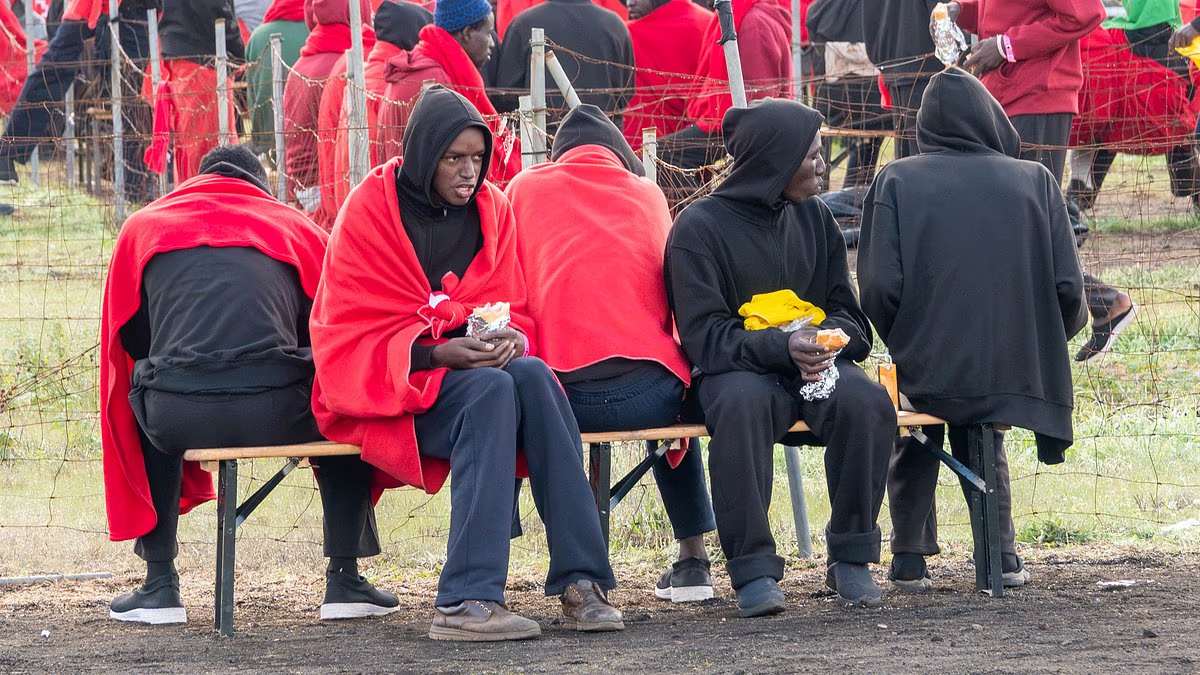
West African migrants wrapped in blankets after arriving in the Canary Islands

Lettice Bromovsky reports from El Hierro, where migrants often stop before continuing towards mainland Europe
The crisis intensified last weekend, when 3,047 migrants reached the Canary Islands in 23 boats. El Hierro received the largest share: 1,354 people arrived on Sunday alone, including 1,030 at the small fishing harbour of La Restinga and a further 324 at La Estaca, the island’s main ferry terminal.
MUST READ: Defense Lawyer Alan Jackson Returns on Crutches in Bohm Murder Case
Local officials said Spain’s Guardia Civil was continuing to search for four missing boats. Their fear was that the vessels had sailed past the island and disappeared at sea.
With emergency accommodation already full, hundreds of new arrivals were forced to sleep at the ports while authorities searched for additional shelter.
The temporary processing centre at San Andrés was built for approximately 500 people but at one stage was accommodating around 1,300. Hundreds more were placed in a sports hall and a former convent. Set among the island’s rolling inland hills, the centre was intended to process arrivals before they were moved elsewhere. The unprecedented numbers, however, have repeatedly pushed it far beyond capacity.
By Wednesday, the population at San Andrés had dropped to between 400 and 500 after roughly 1,000 people were transferred off the island over two days, providing limited relief for overstretched officials.
At La Estaca yesterday morning, the Mail watched as hundreds of male migrants were escorted onto a passenger ferry bound for Tenerife.
The island’s only hospital, Nuestra Señora de los Reyes, has also come under pressure. A temporary field hospital was installed at the processing centre this week, while extra doctors and nurses were brought in from mainland Spain.
Canary Islands president Fernando Clavijo visited the centre on Thursday and warned that arrivals were unlikely to stop. He cited the islands’ location, the vast economic gap between Africa and Europe and instability in the countries from which many boats depart.
Mr Clavijo called for closer cooperation with African governments to prevent departures, while accepting that the islands must prepare for further arrivals. Spanish Prime Minister Pedro Sanchez is facing pressure from the EU and increasingly frustrated voters to address the crisis as he prepares for a snap election on November 29.
Mr Sánchez has also faced fierce criticism from right-wing politicians over his controversial amnesty for as many as half a million undocumented migrants already living in Spain.
That political anger was visible yesterday in La Restinga, where Alberto Núñez Feijóo, leader of Spain’s opposition Popular Party, joined residents protesting about the arrivals.
Speaking at the port, he said: “Spain is experiencing one of the greatest illegal immigration crises in Europe.”
He added: “Our immigration policy has been a complete failure. There is no justification for bodies being found in the sea, in ports or on beaches.
“There is no justification for the human tragedy of people trying to reach the Spanish coast. There is no justification for failing to dismantle the criminal trafficking networks and mafias supplying fuel and provisions to the small boats making these crossings.
“There is no justification for human life being used in this way.”

The crisis worsened last weekend as 3,047 migrants arrived in the Canary Islands on 23 boats, with El Hierro receiving most of them

Canary Islands president Fernando Clavijo visited the centre and cautioned that further arrivals were likely
The developments come as Ceuta, the small Spanish territory in North Africa, continues to deal with its own migration emergency. In July, an estimated 72,000 people swam, climbed or forced their way into the enclave from neighbouring Morocco.
Mr Feijóo warned: “What happened in Ceuta cannot be allowed to happen again in El Hierro.”
Away from the political dispute, the effect on daily life is most visible in La Restinga, the fishing village on El Hierro’s southern coast that has become the centre of the rescue response.
Its normally quiet harbour, used by fishing boats and diving operators taking tourists into the Atlantic, has repeatedly become an emergency reception point as rescue vessels arrive with hundreds of migrants.
Residents at yesterday’s protest expressed growing anger over the continued arrivals. Some shouted: “We’re going to end up like Ceuta!” and “It’s not immigration, it’s an invasion.”
Lorena Machín, who runs a restaurant in La Restinga, described the unease among some residents and business owners. “I’m afraid. The word is fear,” she said.
Loli Hernández, president of the La Restinga residents’ association, said the harbour had effectively become an accommodation centre: “The harbour is a camp.”
For some older residents, however, the main frustration is not the presence of migrants but the length of time the village has been left to manage the pressure.
Pedro González, 85, who lives in La Restinga, said: “We have always welcomed people here and understood how to live alongside those who arrive. La Restinga is a small village, we all know one another and we always end up helping. But this has been happening for too long.”
He added: “Year after year, it is gradually taking away the tranquillity of the place.”
The latest figures indicate that the pressure is continuing. Canary Islands police said 12,181 migrants arrived across the archipelago between November 1 and 17 on 120 vessels, with 99 landing at El Hierro. That was more than nine times the figure recorded during the same period last year.
With favourable weather potentially prompting more departures from Africa, El Hierro’s residents and workers are preparing for the possibility that more boats will soon appear on the horizon.


