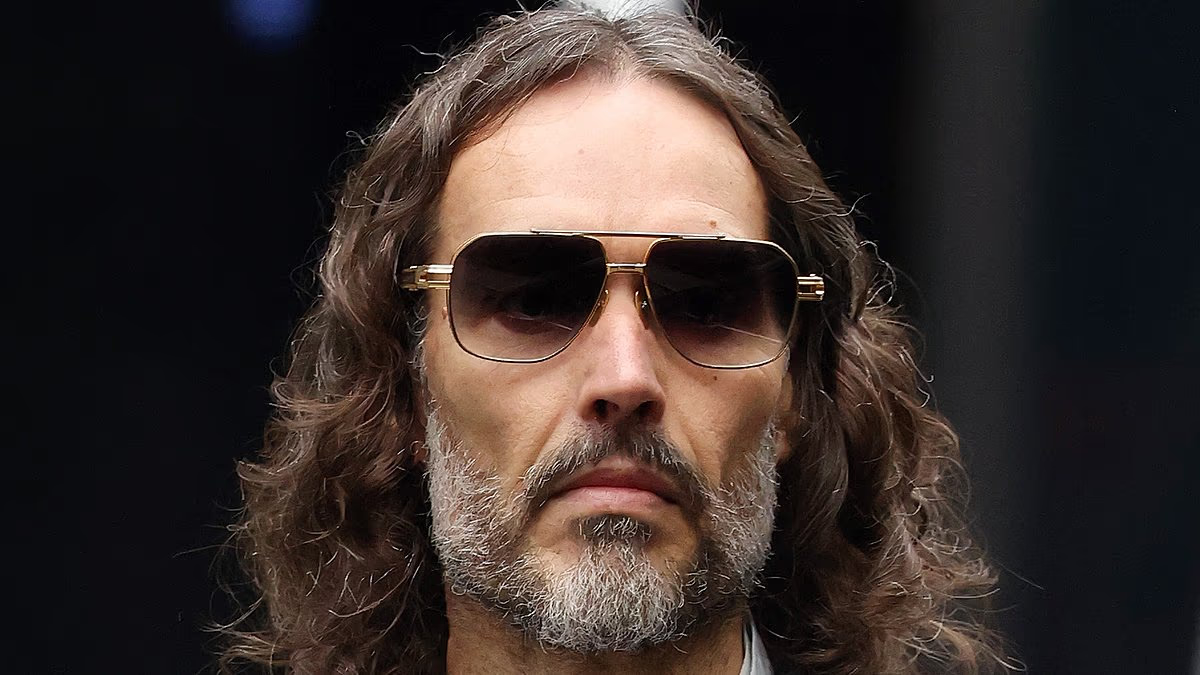

Even from behind bars, Russell Brand continues to command attention—and provoke outrage.
On last weekend’s YouTube podcast, Sunday Sermon, Brand’s wife, Laura Gallacher, read out a message from the imprisoned sex offender in which he maintained that he was innocent of the offences for which he is serving a ten-and-a-half-year sentence.
‘As you know, I am not guilty of the offences I have been jailed for, so something strange is happening,’ she quoted him as saying. The reaction was predictably furious.
Yet Google, which owns YouTube, has so far rejected calls from UK government ministers and the prison service to remove Brand’s account. X has likewise declined to close his profiles.
Both platforms maintain that the broadcast does not violate their rules. Google has also argued that stopping prisoners from expressing concerns about their convictions would be undemocratic—and on that point, it is right.
Brand has been convicted of serious sexual offences and is now behind bars. But freedom of expression sometimes requires us to hear views we find repellent, particularly when they come from someone we fundamentally distrust.

Behind prison bars, where Russell Brand is serving a ten-and-a-half-year term, he continues to haunt and taunt

Last weekend on their YouTube podcast Sunday Service, Brand’s wife Laura Gallacher shared a message from the imprisoned sex offender, in which he insisted he was innocent of his crimes
Justice Secretary Alex Norris has called the broadcast ‘unacceptable’, pointing out that prisoners are prohibited from making statements that cause distress to victims. They are also barred from using social media or accessing the internet without supervision. However, no rule appears to prevent a compliant spouse from delivering those messages for them.
Morally questionable, perhaps. Criminal, no. Under British law, most prisoners lose the right to vote, but they do not surrender their entire voice. In a civilised society, that distinction is neither unreasonable nor unfair.
Indeed, deplatforming Brand could merely reinforce his belief that he is a figure of enormous importance—and that his evasive pronouncements are somehow powerful.
It would feed the grand conspiracy theories embraced by his most devoted followers: the idea that he is a persecuted martyr and a social rebel feared by governments around the world.
So let this self-dramatising figure carry on. Let him deliver his quasi-religious, God-bothering, scripture-soaked rants. The supply of righteous indignation will eventually run dry.
The real concern is not simply that Brand continues to deny wrongdoing. It is that millions still follow him online—6.6 million on YouTube alone—giving him an extraordinary potential audience from inside prison. And standing ready to amplify him is a devoted wife who can put aside her tears, tie back her hair and carry out his wishes.
Gallacher’s role as her husband’s public mouthpiece is therefore significant. Is she complicit in his campaign, or has love left her unable to see clearly? Perhaps beneath the woolly jumper is a fiercely pragmatic woman doing whatever she can to survive. Or perhaps she is simply trying to cope with the devastation of her family life.
I watched her during the trial, sitting stoically in the public gallery as the court heard graphic evidence, including allegations of forced oral sex, anal and oral rape, torn rectums and genital exposure. If she was distressed, she showed little of it, breaking down only at the end when the guilty verdicts were delivered.
At some point, surely, Gallacher must recognise that continuing this campaign on Brand’s behalf is, at the very least, misguided—even if she remains convinced of his innocence.
Prisoners protesting that they have been wrongly convicted is hardly unusual. Documentaries have been made, podcasts produced and books written about such cases. Jeremy Bamber has continued to deny his guilt for four decades, while Luke Mitchell and Michael Stone still campaign against their convictions for the murders of Jodi Jones and Lin and Megan Russell respectively.
Brand is following the same familiar path: attempting to clear his name and persuade his supporters that he is not merely a disgraced celebrity, but a misunderstood messianic figure.
Rather than silence him, I would let him continue. After watching him appear to buckle under pressure in the witness box, I repeat: let him proclaim his innocence from the rooftops. Who, ultimately, cares?
The reality is that Brand is not the enigmatic prophet he imagines himself to be. He is a man who appears far less formidable when circumstances become difficult.
Once the full weight of prison life settles in—and he understands the consequences of continuing to broadcast such claims—he may stop without any government intervention being necessary.
It is no secret that refusing to accept guilt or show remorse can affect a prisoner’s progress. It may complicate parole or early-release reviews and place restrictions on valuable family visits.
It can also mean being transferred from a relatively comfortable prison to a harsher one, turning an already difficult sentence into an even more punishing experience.
Brand does not possess the endurance of Pontius Pilate or the Pharisees, figures who protested their innocence for years despite being, well, guilty as sin.
He should look it up in his beloved Bible. When difficult choices arise, the self-styled martyr will, I suspect, put himself first and choose the path of least resistance. He will keep his head down, play the system and stay out of trouble. Eventually, he will tell Laura that he loves her but no longer needs her as a spokeswoman. It may not happen straight away, but it will happen.
In the meantime, victims may understandably find it distressing to hear a convicted sex offender insist that he is innocent, implying that they are liars.
SEE ALSO: Japan Core Inflation Hits 2026 High as Energy Subsidies Expire
But if they can endure the noise, he may eventually fall silent by himself—deflating like a punctured balloon.
I would not bet against it.
If Cher could turn back time…

Cher (pictured in 1978) will be 81 when she headlines Glastonbury in 2027 and said: ‘I hate ageing’
There comes an age when anyone older than you—a steadily shrinking group—doing anything more strenuous than putting on slippers feels worthy of celebration.
So raise a glass to Cher, who will be 81 when she headlines Glastonbury in 2027. What an inspiration she has been to generations of fans: a successful singer, accomplished actress and committed realist with little enthusiasm for growing older.
‘I hate ageing,’ she admitted. ‘And I’m stupid, I’m not wiser.’
Perhaps that is precisely why she agreed to play Glasto.
Time Harry showed some humility

Prince Harry, who is so concerned about the safety of his wife and children, announced he is ready to fight if Britain goes to war with Russia
Permission to speak, sir. In the spirit of Corporal Jones charging around Walmington-on-Sea insisting that nobody panic, Prince Harry has announced that he is prepared to fight if Britain goes to war with Russia. Cry God for Harry, England and St George—we can apparently stop worrying about the next world war.
But is that really a sensible thing for a prince so concerned about the safety of his wife and children to say publicly? A little caution would not go amiss.
Harry’s enthusiasm for joining an armed conflict with a brutal superpower sits awkwardly beside his demands for round-the-clock security for his family. If he believes they may be targets, why make statements that could place himself more visibly on the international stage?
Then again, careful reflection has never appeared to be his greatest strength. This week, he went further, claiming that before he launched his Invictus charity, people in Britain crossed the road to avoid wounded veterans. According to Harry, the public and the media viewed these often-limb-injured soldiers as damaged, sad or even mad.
What an insult. Has Harry never heard of the British Legion or SSAFA, the Armed Forces charity? Has he failed to notice Britain’s long tradition of supporting military personnel through volunteers, charities and national days of remembrance?
His suggestion that wounded veterans were ignored and shunned before Invictus is an affront. It is another example of how he turns almost everything into evidence of his own importance—and another prop for his preferred personal narrative.
Make Rayner a Bond villain

British actor Robert Pattinson was announced as the new James Bond this week
Robert Pattinson as the new James Bond is a bold and intriguing choice. I feel for my preferred candidate, Jack Lowden, but Pattinson is a strong actor and has the slightly unsettling edge the role demands. Harrison Ford as the next Bond villain would also be appealing. Even so, if Angela Rayner put herself forward, she would surely be a contender. Mad, bad and dangerous to know? She has the full package.
£2billion divorce? It’s War!
A divorce case unfolding in London makes even the vast fortunes and bitter financial battles in War, the Sky Atlantic drama starring Dominic West and Sienna Miller as a wealthy divorcing couple, look modest by comparison.
Potanin v Potanina pits Russian nickel billionaire Vladimir Potanin against his former wife, Natalia. Both are 65.
Natalia is seeking £2.17 billion from her former husband, who is currently ranked the 74th-richest person in the world.
She is also requesting £600 million for what she describes as her ‘reasonable needs’, including £150 million for a London home, £441 million in maintenance and a further £10 million in capital expenditure.
One has to wonder what, exactly, requires £441 million in maintenance. The Taj Mahal?
And no, I am not referring to the kebab shop on the high street.
The Rise Of The Rock Star Chef, available on BBC iPlayer and featuring Marco Pierre White, Gordon Ramsay and Heston Blumenthal, has been widely praised. I cannot join the chorus.
After decades of hard work and culinary brilliance, what have these men ultimately been left with? Marco appears washed-up and exhausted, with little to show for the effort.
Gordon is enormously wealthy, presiding over a global chain of Ramsay-branded restaurants that often seem more focused on commercial returns than exceptional food. Like many bullies, he is also sentimental and quick to cry, as he did in this programme.
Neither man appears to have mellowed, while Heston, beset by mental illness, has become a diminished version of his former self.
What a soufflé of self-importance and nonsense. The more accurate title would have been The Rise—and Fall—Of The Rock Star Chef. At least that would have been honest.


