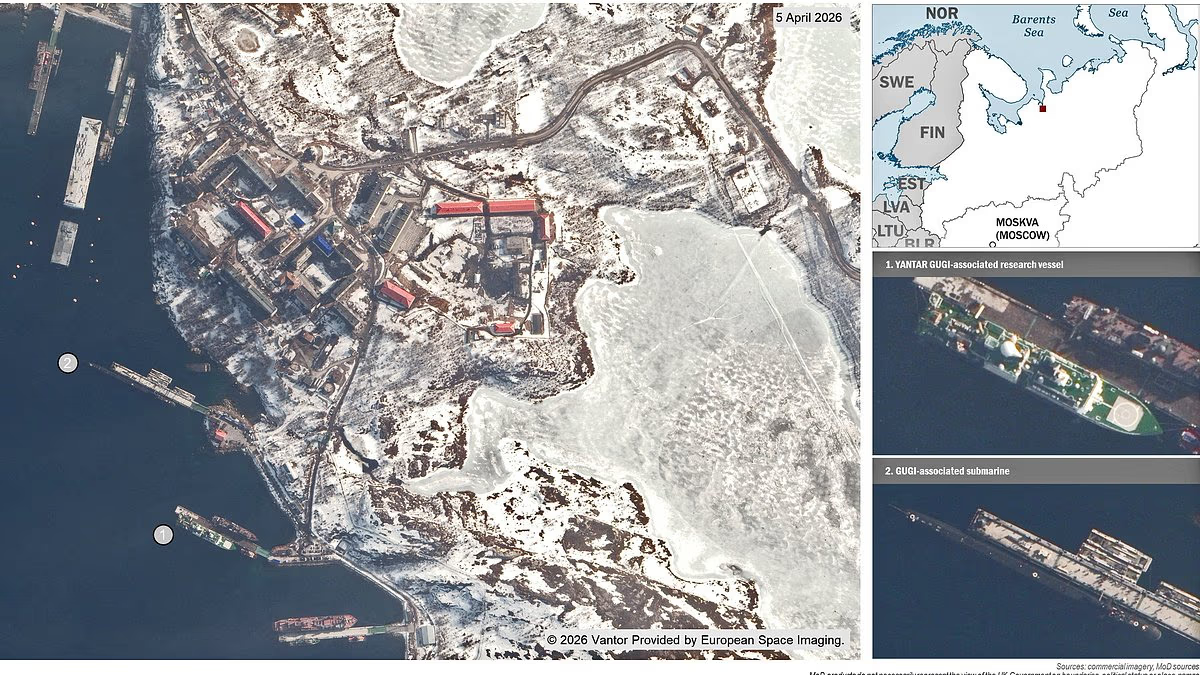

In the icy waters near the isolated Svalbard archipelago this spring, NATO allies detected Russian submarines conducting drills involving a covert weapon believed to be designed to cripple vital undersea cables while leaving no clear trace behind.
Two Western officials told Reuters the secret operation was run by Moscow’s GUGI undersea warfare directorate, with deep-sea submersibles used to rehearse the deployment of the advanced and potentially destructive system.
According to the officials, who spoke on condition of anonymity, Britain, Norway and the United States carried out a joint mission to track the Russian vessels and confront them at sea.
The intervention stopped the vessels from finishing the exercise, and they later departed the area.
Britain and Norway revealed in April that they had exposed a covert Russian operation in Arctic waters. However, the discovery of the new weapon, the precise location of the activity and the role of the United States had not previously been reported.
The undersea confrontation unfolded as some Western intelligence officials warn that the Kremlin may be intensifying sabotage activity across Europe and positioning itself for a possible clash with NATO.
Three U.S. officials said some American intelligence analysts are increasingly worried that Russia could seek to test NATO’s collective defence commitment, known as Article 5. Western officials said that, in such a scenario, attacks on subsea cables could play a crucial role.
Those cables, often no wider than a garden hose and laid across the seabed or buried just beneath it, are essential to global internet traffic and international financial transactions.

Pictured: A surface and sub-surface satellite imagery of Russia’s Main Directorate for Deep Sea Research (GUGI) associated vessels based at Olenya Guba in Russia

Russian President Vladimir Putin gestures during Russian-Vietnamese meeting at the Grand Kremlin Palace, on September 9, 2026, in Moscow, Russia
Their economic and strategic importance has made them targets in past conflicts, including in the First and Second World Wars, when they were critical to delivering orders by telegraph or telephone.
Two 1,400 km subsea fiber-optic cables linking Svalbard to mainland Norway lie as deep as 2,700 metres below the sea’s surface.
They carry vast amounts of satellite data downloaded at the SvalSat satellite ground station, the world’s largest and part of NASA’s Near Space Network.
Russia’s Defence Ministry didn’t respond to a request for comment on the incident. The Kremlin consistently denies conducting sabotage operations in NATO countries or plotting any confrontation.
Some Western officials argue that Moscow’s targeting of European states has increased in recent months as the front line in Ukraine has become largely static.
Countries including Poland, Lithuania, and Romania have confirmed various violations.
Most recently, an attempted drone attack on the Leipzig/Halle Airport in August triggered a series of responses from Germany, including the closure of a Russian consulate in Bonn and a cultural centre in Berlin.
In August, Central Intelligence Agency Director John Ratcliffe visited intelligence counterparts in Moscow, in part to warn Russia against escalating sabotage operations in Europe, said two people familiar with the matter.
Reuters couldn’t determine if Ratcliffe raised Russia’s covert subsea operations. The Kremlin declined to say what had been discussed or to provide any further details.
At the same time as the confrontations at sea, British and Norwegian officials took their findings to Moscow to show they were aware of the new technology – hoping it might make Russia hesitate to use it, the two Western officials said.
Russia didn’t damage any cables. The exercise focused on simulating the deployment of the technology in the event of a conflict with NATO, the officials said. They declined to detail how the technology works.
Asked for comment, NATO referred Reuters to Norwegian and UK authorities.
‘Through our joint operation, we sent a clear message to Russia that they cannot operate covertly,’ Norway’s Defence Minister Tore Sandvik said in a statement.
‘We have made it unequivocally clear to Russian authorities that any attempt to target our critical infrastructure will be detected and met with consequences,’ he said. ‘It is in no one’s interest to escalate tensions in the High North.’
Britain’s Defence Ministry pointed to April 9 statements acknowledging attempted covert activities in and near Norwegian and British waters by Russia’s Main Directorate of Deep-Sea Research, known by its Russian acronym GUGI. Washington and London have both imposed sanctions on the secretive directorate.
The White House didn’t respond to a comment request. The CIA declined to comment.
Any escalation between Russia and NATO could quickly underscore the strategic importance of an icy expanse of water between the southern tip of the Svalbard archipelago and mainland Norway known as the Bear Gap, one of the Western officials said.
To reach the Atlantic, Russian nuclear submarines based in the Kola Peninsula would cross the 400-mile-wide stretch of water before passing Norway’s remote volcanic island Jan Mayen.
Britain said this week it deployed forces to Jan Mayen in August alongside Norwegian and U.S. allies for an exercise to demonstrate NATO’s ability to operate jointly in the High North.
Norway plans to have new fiber-optic cable linking Svalbard and Jan Mayen to the mainland by 2028.
NATO allies have focused on subsea infrastructure security since the 2022 destruction of three of the four Nord Stream subsea pipelines supplying Germany with Russian gas.
German prosecutors have indicted a Ukrainian man who was a special forces officer at the time of the attack.
Ukraine denies any role in the sabotage.
And since 2023, more ships have sailed slowly over or near sensitive subsea infrastructure including pipelines, power cables and telecoms cables to map their location, an activity known as drifting.
Last year, drifting in the North Sea rose 52% to 13,079 vessels from the previous year, data from maritime risk analytics firm Windward showed, while activity in the South China Sea region jumped 88% to 18,401 vessels.
It’s not illegal to survey infrastructure in international waters but security experts see such extensive mapping as preparation for sabotage.
The activity and suspected interference with some cables prompted new initiatives launched in January last year, including NATO’s Baltic Sentry monitoring system and the UK-led Nordic Warden, bringing navies together for increased patrols of critical infrastructure.
In the Baltic Sea – one focus area for monitoring – 2025 drifting activity was down 5% to 526 vessels from a year earlier, Windward data showed. It said at least 11 subsea cables had been damaged or cut in the Baltic from October 2023 through the end of last year.
‘The current thinking is that Russia and China are probably the most active and critical underwater threats,’ said Windward Chief Executive Ami Daniel.
The global network of power and telecoms cables running across seabeds is expanding each year, supported by increases in demand for data and electricity, partly driven by artificial intelligence, and some analysts say Europe remains vulnerable.
‘In the last 25 years, Europe did two things simultaneously. It dramatically expanded the extent to which it relies on seabed infrastructure, and it dramatically shrunk its capacity to protect that infrastructure,’ said Bruce Jones, a senior fellow with the Brookings Institution.
‘It’s belatedly rebuilding now, in the face of a burgeoning Russian threat.’