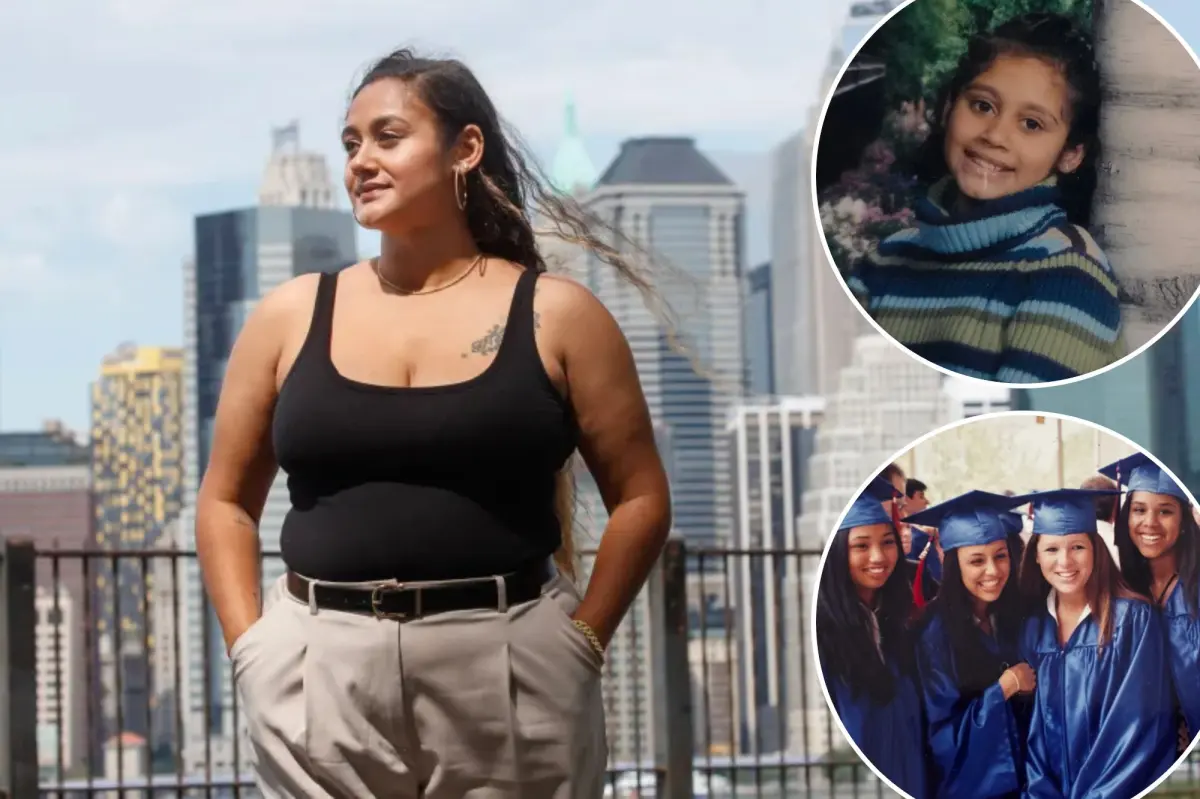

When a thick wave of white smoke rushed toward Alexandra Minaya on Sept. 11, 2001, the 10-year-old froze in terror, her small body trembling as chaos swallowed the morning.
“It was terrifying,” Minaya, now 35, told The Post. “We all ran screaming into the school building.”
Minaya can still hear the panic that erupted among her classmates at P.S. 19 — and, she said, among the teachers as well — as children bolted from the outdoor playground and rushed indoors, unaware that only a few blocks away, the Twin Towers were collapsing.
She remembers being “covered in white ash” and the sharp, unsettling odor in the air, which she described as “burning chemicals.” Although Minaya, now a Brooklyn mother of one, has never received a formal diagnosis for any 9/11-related health condition, the trauma of that day still follows her 25 years later.
“You know, as a kid, you look to the adults for support in times of chaos,” explained Minaya. “But the adults surrounding me were crying and just as confused as us kids.”
“I was so scared something bad had happened to my mom, but had no way to contact her,” Minaya said. “I didn’t have a cell phone and landline phone service was down. I was helpless.”
Minaya was among thousands of New York City children caught in the confusion of the Sept. 11 attacks — separated from their parents, unable to reach loved ones and forced to navigate fear they could not yet understand as the ground shook beneath them. For many, the scars left behind were not visible, but they were lasting.
They are not counted among the nearly 3,000 people killed that day, nor among the 6,000 who have since died from 9/11-related illnesses, including lung cancer.
But by witnessing the biggest terrorist attack in the world, these millennials now cope with anxiety, survivors’ guilt and insomnia, even years after the disaster.
On 9/11, Diana Bejasa was a senior at the prestigious Stuyvesant High School in Lower Manhattan — mere blocks from the WTC.
Now 42, she says the tragedy still impacts her mental health, as she can still feel the concrete quaking as the first tower crumbled.
“It was a full-body experience. Everything was shaking, lights flickering, then the electricity went out completely,” said the Queens native, who now lives in Hawaii with her three-year-old daughter.
“The administrators told us to leave the school. They sent us out onto the West Side Highway, and just yelled ‘Walk!’”
“I remember looking around, seeing people covered in ash. As I was walking, I looked back and saw the second tower fall,” she recalled. “And I had this sudden feeling of ‘Oh, f–k! What’s going on?’”
“I was in a weird world. I knew I was on the West Side Highway, I walked it every day, but it was unfamiliar. Everything was so different,” she sighed. “People were walking around looking like ghosts, their faces pale with shock and their bodies in white dust.”
Like many New York teens before that fateful day, Bejasa was excitedly reuniting with her friends after summer vacation and looking forward to a senior year filled with crushes, parties and college acceptance letters.
But on her hours-long trek from Manhattan to her home in Forest Hills — a roughly 10-mile hike she made on foot alone among a crowd of weeping locals — the gravity of the turmoil began to sink in.
“I couldn’t reach my parents on the phone. I couldn’t find any of my friends. I dissociated. I completely shut down,” said a tearful Bejasa, who admits she is still reeling from the ordeal.
“I have a spotty memory of certain things. I don’t remember getting home. I know that hugging my parents and seeing my family was an important moment once I got home, but somehow I don’t remember it.”
She was ultimately diagnosed with complex post-traumatic stress disorder (C-PTSD) and depression.
The conditions contributed, in part, to her making multiple career changes and only exacerbated the pangs of enduring a highly contentious divorce during pregnancy.
She’s also spent most of her adulthood grappling with survivor’s remorse — especially when her status as a 9/11 survivor gets challenged online.
“For a long time, I didn’t even identify as a survivor because there were people who’d been through so much worse than I had,” said Bejasa, who noted that some of her teachers and classmates were stricken with 9/11-related cancers in later years.
But she told The Post that after witnessing the horror firsthand, plus seeing her teachers and classmates battle 9/11-related cancers in the aftermath, she’s no longer afraid to own her story.
“It wasn’t until I was much older that I even felt like it was OK to identify as a survivor,” said Bejasa, now a public speaker. “I can honor and remember those who died that day, and still consider myself a survivor without discrediting anyone’s experience.”
The tragic events left mental health scars on children across all five boroughs.
Vanessa Collazos was a 10-year-old student just starting middle school at I.S. 73 in Maspeth when she peered out her classroom window and saw the towers engulfed in flames.
“I was so young and innocent. I thought someone had set off fireworks in the buildings,” said Collazos, 35, who works in brand marketing. “But I realized something serious had happened when I turned and looked at my teacher. His face went pale and he walked right out of the room, left us alone, didn’t say a word, and we never saw him again.”
Alone and confused in a room full of her peers, Collazos sat in stunned silence until her great-grandmother arrived at the main office to pick her up.
“We waited hours and hours for my mom and uncle to come home from Midtown,” Collazos told The Post. “I turned on the TV and watched repeated footage of those people jumping to their deaths all day. I couldn’t believe my eyes. I couldn’t process it. I was in a state of shock.”
That shock hasn’t completely worn off in the decades since.
“I have anxiety and an elevated state of hypervigilance,” said Collazos, attributing her condition largely to witnessing the horror as a child. She and her family temporarily relocated to Los Angeles following the disaster, desperate for distance from the trauma.
Now 35 and back in Queens, Collazos still experiences pangs of anxiety that she believes stem directly from experiencing 9/11.
“I walk around wondering, ‘Is everything going to be OK today? What can I control? Is that an abandoned bag in my subway car? Is it going to explode?’” she confessed. “I didn’t have airplane anxiety before 9/11, but I do now.”
Lesley Koeppel, a NYC psychotherapist, told The Post that it’s not uncommon for youngsters with eyewitness 9/11 accounts to begin experiencing mental health woes as adults.
“When something catastrophic happens, especially without warning, a child or adolescent can learn that the world is not predictable or safe. That’s destabilizing.”
“Years later, that can show up as anxiety, hypervigilance, a need for control, difficulty tolerating uncertainty or a more intense sensitivity to loss and danger,” Koeppel continued. “The event may be long over, but a sense of stability can take much longer to catch up.”
To thousands of 9/11 victims, witnesses and mourners, that sense of stability would be a welcomed luxury. For some, the lingering trauma, grief and unshakeable memory of the unprecedented pandemonium is just as palpable as it was on the day the world changed forever.
But as the New York millennials who experienced 9/11 as children continue to grapple with a painful past, some are dedicated to giving back to the city as adults.
In Hawaii, Bejasa volunteers to help victims of natural disasters, including the recent wildfires in Oahu.
Meanwhile, the selflessness of the first responders and everyday heroes at the epicenter of the chaos inspired Minaya to pursue a 14-year career in emergency healthcare services.
“I didn’t always want to be an emergency responder, but I just knew that I wanted to help others in the same way those men and women did during and after 9/11,” she said.
“It was an absolute tragedy that I’ll never forget, but it also united us as New Yorkers in a way I’ll never forget, too.”