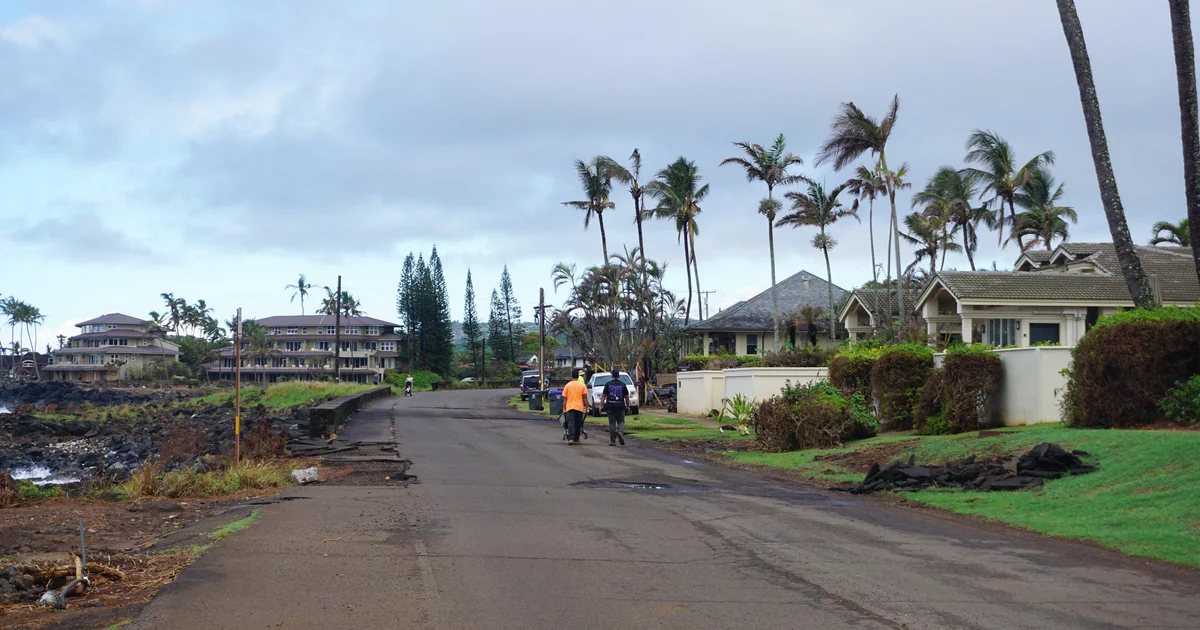
PO’IPŪ, Hawai’i — One month after Hurricane Lowell swept across Kauaʻi, the storm’s aftermath remained visible across the island: uprooted trees lined roads, construction crews worked through damaged neighborhoods, and homes still showed signs of destruction. At the Sheraton Kauaʻi Resort, where more than 100 employees were laid off, piles of sand covered the property. The resort’s emptied pool had left a section of its concrete deck collapsing toward the beach just a few steps from the shoreline.
Unemployment claims on Kauaʻi surged from 69 before the September hurricane to roughly 1,800 less than two weeks later. Tourism businesses announced widespread layoffs as the island experienced a steep drop in visitors. Applications for Medicaid from Kauaʻi residents also climbed by approximately 50% the following month, according to the Hawaiʻi Department of Human Services.
Medicaid often serves as an essential lifeline after a disaster, helping displaced or unemployed residents retain access to medical care. But new work requirements included in the One Big Beautiful Bill Act, signed by President Trump last year, could threaten coverage for Medicaid recipients in areas hit by disasters. Beginning in January, the law requires many nondisabled adults enrolled in Medicaid across 43 states and Washington, D.C., to work, volunteer, or attend school for at least 80 hours each month.
Most states can provide people affected by a disaster with a temporary exemption from the Medicaid work rules. That protection generally depends on federal law allowing the president to issue a disaster or emergency declaration and approve federal assistance. But those declarations can take months — or never be issued.
Residents of counties affected by natural disasters may be excused from the work requirement under one of several limited, short-term exceptions. It remains uncertain, however, whether people who lost their jobs following Hurricane Lowell would qualify months after the storm. The Trump administration has not clearly explained how long states may use the natural disaster exemption for Medicaid enrollees.
Rochelle Ganotisi, a mother of five, and her boyfriend were among the Sheraton employees laid off after the hurricane. They are relying on unemployment benefits and part-time jobs to get by. Their hospitality workers’ union arranged three months of health insurance coverage. If Ganotisi is not recalled to her housekeeping position before that coverage ends, she plans to seek Medicaid, the federal-state program for people with low incomes or disabilities.
Ashley Mizuo/KFF Health News 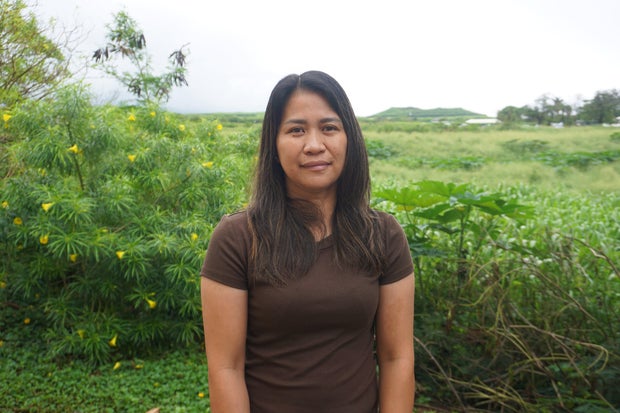
Hawaiʻi Gov. Josh Green, a Democrat and practicing physician, said disaster declarations must be issued quickly, particularly with the Medicaid changes approaching. The Centers for Medicare & Medicaid Services permitted states to postpone enforcement of the work rules until next July, although states are still expected to begin eligibility reviews on Jan. 1.
“It would be devastating if suddenly 40,000 or 50,000 people didn’t have their Medicaid benefits,” he said. “It could affect our rural hospitals, our nurse practitioners, our doctors, so timeliness is key.”
Hawaiʻi officials said residents who fail to meet the new work standards will remain enrolled in Medicaid through July.
Ashley Mizuo/KFF Health News 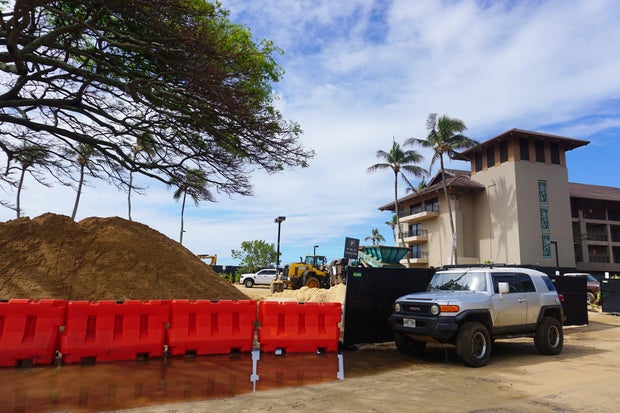
At least 34 states and Washington, D.C., intend to use the optional hardship exemptions. KFF, a health policy organization that includes KFF Health News, reports that Indiana, Iowa, Missouri, and Ohio are the only four states that currently do not plan to adopt them. Each of those states received disaster declarations this summer after severe storms and flooding.
CMS spokesperson Timothy Foster told KFF Health News in a statement that states may seek a longer hardship exemption if they can demonstrate that disaster-related obstacles to meeting the work rules remain in place.
Tom Cotter, chief executive of Health Response Alliance, a nonprofit that works to expand healthcare access during disasters, said uninsured people often turn to hospital emergency departments and charitable clinics. Those facilities are among the few providers that treat patients regardless of whether they can pay.
“All of these are really stretched thin during an emergency because their patient load goes way up,” he said. “That makes it even more expensive for the healthcare system that is being otherwise also burdened for the disaster.”
Additional work requirements, Cotter added, “is going to slow the economic recovery of any particular community.” He said they force people recovering from a disaster to worry about healthcare costs while dealing with housing, employment, and other urgent needs.
Nebraska work requirements begin
When the president declares a disaster or emergency, the temporary hardship protection covers the entire month in which the disaster occurred. The exemption may be applied retroactively after the declaration, allowing enrollees to recover expenses from earlier months.
Nebraska began enforcing Medicaid work requirements in May, giving other states an early look at how disaster exemptions could offer relief. For many Nebraskans, however, that relief did not arrive quickly.
President Trump took three months to declare a federal disaster linked to wildfires in March and April. For the severe storms, tornadoes, and flooding that struck in May, he did not issue a federal disaster declaration until August.
Six Nebraskans affected by the disasters lost Medicaid coverage after failing to meet the work requirements. In October, the Nebraska Department of Health and Human Services said it was reviewing their cases again because they now qualified for hardship exemptions.
Sarah Maresh, who directs the Health Care Access program for the nonprofit Nebraska Appleseed, said the early implementation of the requirements has been clouded by uncertainty.
“This is part of the confusion that comes with the Medicaid work requirements, because it applies differently depending on your situation,” she said. “I think it’ll be very challenging for new applicants.”
Natural disasters can set back local businesses and economies for years. The U.S. Small Business Administration estimates that about 90% of businesses fail within two years of being hit by a disaster. A lack of housing can further delay recovery as workers repair damaged homes or relocate farther from their jobs. Three years after the 2023 Maui wildfires killed more than 100 people, the recovery remains unfinished, and most storefronts in the once-busy area are still closed.
After CMS issued regulations outlining the work requirement exemptions, several Democratic-led states sued the agency. Their lawsuit challenged what they described as a narrow window for obtaining natural disaster exemptions and argued that the lack of clear direction places an unfair burden on state Medicaid agencies responsible for determining eligibility.
In its response filing, CMS said the limits are designed to ensure that exemptions are granted only when a disaster interferes with Medicaid enrollees’ ability to satisfy the work rules.
Disaster delays, denials
White House spokesperson Lauren Bis rejected claims that President Trump’s disaster-relief decisions were politically motivated. She said the administration’s responses to state requests are intended to ensure taxpayer dollars are used appropriately and that federal aid “supplement — not substitute” state disaster-response responsibilities.
The presidential major disaster declaration for Kauaʻi marked Hawaiʻi’s sixth disaster or emergency declaration of 2026. By November, Hawaiʻi had received more such declarations than any other state that year. A federal declaration for a 6.0-magnitude earthquake that damaged more than 300 homes on Hawaiʻi Island took approximately three months.
Ashley Mizuo/KFF Health News 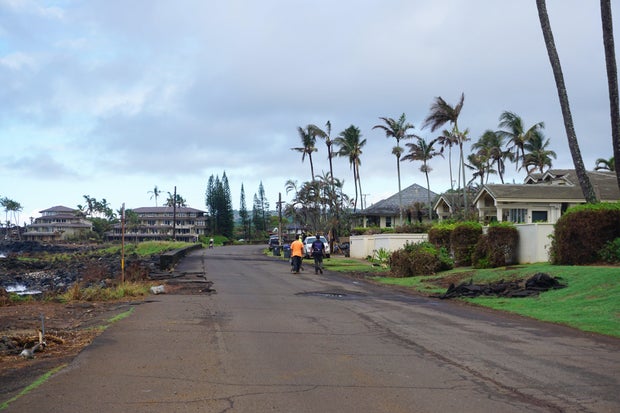
Other states have faced even longer waits. New Mexico, where Democrats control the governor’s office and both legislative chambers, waited nine months for a decision on a presidential disaster declaration for severe storms and flooding that occurred in September 2025. Illinois, which also has a Democratic trifecta, waited more than seven months and was denied. The state has not received a major disaster declaration during President Trump’s second term, despite making several requests.
For people who lose their jobs but do not qualify for Medicaid, the available safety net can be extremely limited.
Oscar Cardova worked at The Terrace Hanalei, a restaurant on Kauaʻi’s North Shore that suffered major hurricane damage. When the business shut down, he lost the health insurance provided through his job. Although he holds a work-permit visa from Peru, he was denied Medicaid because of his immigration status.
Cardova and his wife, Yesenia, have been living in their van. Yesenia has astigmatism and needs glasses, but without insurance the couple will have to pay the estimated $500 cost themselves, Cardova said.
The couple had planned to work in the United States for two more years before returning to Peru. A month after the hurricane, they were still unable to find steady employment. They began considering a move to Honolulu in hopes of finding more opportunities.
“Right now, we’re just surviving,” Cardova said. “We’re waiting to see what happens before making other decisions, because we can’t keep living like this.”
Have you tried to prove your eligibility for Medicaid under new rules that require people to show they are working, going to school, or participating in another qualifying activity? Click here to contact KFF Health News.
KFF Health News is a national newsroom that produces in-depth journalism about health issues and is one of the core operating programs at KFF — the independent source for health policy research, polling, and journalism.