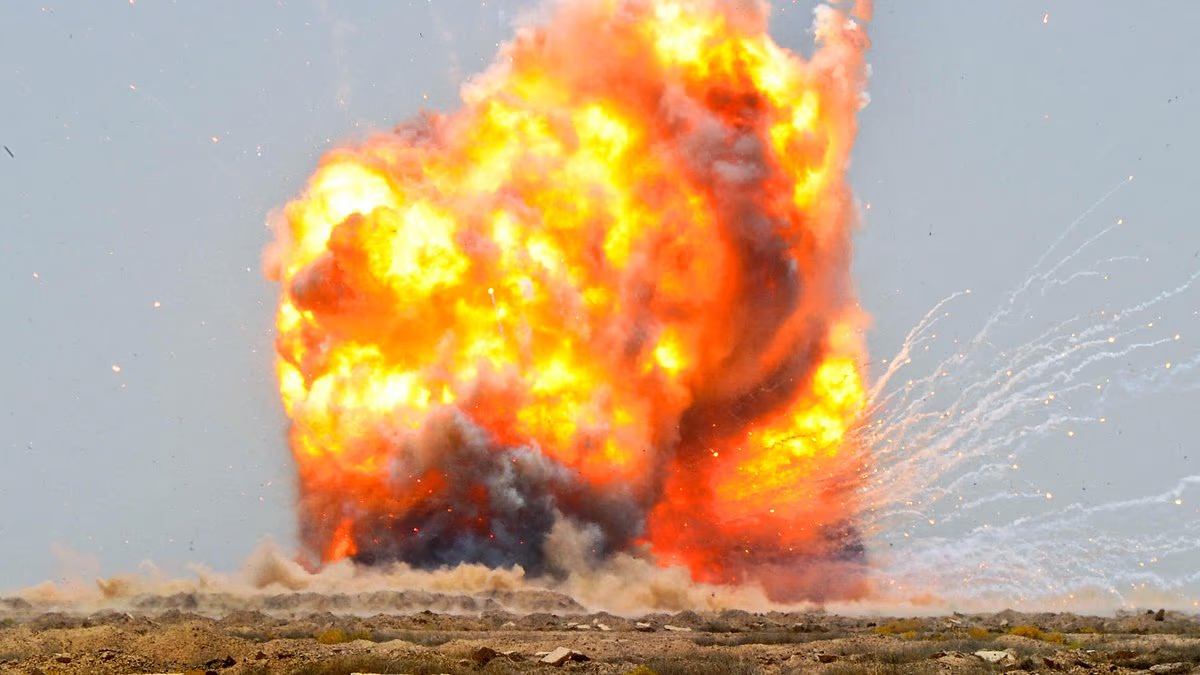

President Donald Trump has directed the US Army to pause plans to detonate nearly 10,000 pounds of lead-based explosives in Iowa until a federal appeals court authorizes the operation.
In a Monday statement, Trump made the proposed blast contingent on approval from Iowa Governor-elect Rob Sand and said he would hold the incoming governor responsible for “any and all death or destruction” if the detonation were blocked and the explosives later caused harm.
The Army had planned to destroy the material on Wednesday at the Iowa Army Ammunition Plant in Middletown. The stockpile consists of 68 barrels of deteriorating lead azide that officials have deemed too unstable to transport.
The controlled detonation could send a plume of toxic lead particles into the air, prompting warnings for communities as far as 100 miles from the plant.
People living closest to the facility had been told to evacuate before the explosions. Residents in potentially affected areas of Illinois were advised to remain indoors, keep windows closed and stay inside for 24 to 48 hours afterward.
AccuWeather meteorologists said possible downwind areas include parts of southeastern Iowa and northern Missouri. The distance and direction of the plume will depend on temperatures, winds higher in the atmosphere and other conditions at the time of the blast.
The US Court of Appeals for the 8th Circuit temporarily suspended the Army’s environmental permit on Thursday after environmental groups challenged the planned operation.
In a filing submitted Saturday, the government told the court that the Army planned to proceed without the permit by relying on an emergency exception in federal environmental protection law.

The US Army had scheduled the controlled detonation for Wednesday. The latest forecast shows the projected toxic plume and possible air-quality readings in the surrounding area

President Donald Trump has ordered the Army to pause plans for a blast involving nearly 10,000 pounds of lead-based explosives in Iowa until a federal appeals court approves the operation
Writing on Truth Social on Monday, Trump said the explosives had been improperly stored in 2009 under the Obama administration. He said experts who had studied the material for years believed there was a substantial chance it could detonate on its own “sometime in the near future.”
Trump said military specialists considered a controlled explosion much safer than leaving the deteriorating explosives in place, where they could unexpectedly ignite. He also said weather conditions were currently favorable for the operation.
“I feel the proper course is to get rid of this long-term problem,” Trump wrote, while adding that he had ordered the military to wait until the 8th Circuit approved the plan. He also made the operation dependent on Sand, the incoming governor, agreeing to it.
Trump said the blast would not go ahead if Sand or the courts withheld approval, but warned that he would hold the incoming governor responsible for any deaths or destruction that followed.
The Federal Aviation Administration has restricted flights near Middletown from Monday through Wednesday. Iowa Governor Kim Reynolds activated the state’s emergency operations center on November 20.
Officials in neighboring Illinois also warned that lead particles carried by the air could endanger residents.
READ MORE: Landowner Made Over £200,000 Selling Land to Incoming Travellers
Illinois Governor JB Pritzker said Sunday that he had discussed the planned detonation with the Army, the Environmental Protection Agency and other agencies. He said he was “continuing to press for the release of more public information to help keep Illinoisans safe.”
Wally Taylor, an attorney for the Iowa chapter of the Sierra Club, which is among the petitioners challenging the EPA, said the Army had “clearly mishandled” the situation. He said residents of Iowa and neighboring states deserved a complete review of the failures that led to the current crisis.

People living closest to the Iowa Army Ammunition Plant in Middletown had been advised to evacuate before the blast. Residents in potentially affected parts of Illinois were told to remain indoors with windows closed for 24 to 48 hours afterward
Taylor added that if detonation was the only remaining option, everyone affected must have access to comprehensive testing, mitigation and remediation resources.
Federal officials said falling temperatures could make the material even more unstable, raising the possibility of an uncontrolled explosion if the operation were postponed.
Military officials said the lead azide stored at the plant had recrystallized, leaving it more vulnerable to shock, friction and movement.
Transporting the explosives to a more secure site could further jostle the containers and trigger an accidental blast either on the road or near a more heavily populated area.

The Army advised people to stay away from the affected area during the detonation. Anyone unable to evacuate was told to remain indoors, close windows and doors, and turn off heating and cooling systems that draw in outside air (stock)
For that reason, the Army selected its munitions plant in Middletown, a community with fewer than 400 residents, as the site for the detonation.
The destruction of aging military explosives is not unusual, but officials have classified this case as an emergency because of the heightened risks associated with the lead azide.
The EPA said the material posed an immediate danger because temperatures were expected to fall below 30 degrees Fahrenheit over the following days.
The agency said the Army needed to carry out a controlled detonation to protect the public from the greater danger posed by an uncontrolled explosion.
Lead is poisonous to both people and animals. The most serious risk would be faced by anyone inside the Army’s projected plume during the first hour after the explosions.
Children could remain at risk later if they touch lead-contaminated dust that settles on playgrounds, outdoor toys, windowsills and other frequently used surfaces.
The Army advised residents to avoid the affected area during the blast. Those unable to leave beforehand were urged to stay indoors, close all windows and doors, and switch off heating and cooling systems that bring outdoor air inside.
After the exposure period ends, residents should use wet-cleaning methods on surfaces that children may touch to remove any settled lead dust, the Army said.


