Colin Kaepernick, the NFL outcast who became a prominent American civil rights advocate, has accused two former Black players of betraying teammates who protested during the league’s national anthem controversy a decade ago.
The 38-year-old free-agent quarterback also criticized the league’s white players for largely failing to confront the racist police violence that prompted him and other Black athletes to kneel during the anthem. In an interview with The New Yorker’s David Remnick, Kaepernick said some white stars supported him while he remained unsigned, but offered little backing for the wider cause behind his protest.
“Aaron Rodgers and Tom Brady came out and supported me, saying that I shouldn’t be blackballed, and I should be on an NFL team,” Kaepernick said while discussing his new book about the controversy. “So there was support in that regard in very select instances. But around the topic of police killing Black folks and trying to address the systemic issues? Very limited.”
Kaepernick said his disappointment extended beyond the league’s white players.
He told Remnick that he viewed the NFL Players Coalition, which was formed to promote social justice and racial equality, as an effort by the league to weaken the anthem protests led by Kaepernick, San Francisco 49ers teammate Eric Reid and other players.
“There were players in the NFL that joined forces with the NFL, in the Players Coalition,” Kaepernick said, naming Malcolm Jenkins and Anquan Boldin, who led the council. He accused them of having “sold the protest out, or attempted to,” adding that NFL players as a group failed to respond collectively. “I do think there was a missed opportunity there,” he said.

Colin Kaepernick, the NFL outcast and civil rights figure, has accused two prominent Black former players of betraying protesting teammates during the 2017 season

From left, Players Coalition members Anquan Boldin, Malcolm Jenkins, Kenny Stills and Eric Reid are pictured outside the league headquarters in Manhattan on October 17, 2017
Our News Outlet has contacted Jenkins and Boldin, who are both retired, along with representatives of the Players Coalition for comment.
The Players Coalition remains active, but the organization fractured soon after it was created. Reid, Michael Thomas and Russell Okung later departed following internal disagreements.
Kaepernick said the coalition was only one of several forces that worked to discourage players from continuing the protests.
“I had players who came back and were, like, ‘Oh, I talked to my agent about it,’ or ‘I talked to my family about it,’” Kaepernick told Remnick. He recalled one player telling him, “My owner told me that I can’t protest.”
‘And that was an unfathomable sentence to me.’
Kaepernick did credit some teammates and other players for stepping up: ‘I had great people by my side. I mean, whether it’s Eric Reid or Kenny Stills, Albert Wilson.’
The protests continued after Kaepernick’s tenure in San Francisco came to an end in March of 2017 before the demonstrations died out in 2021.

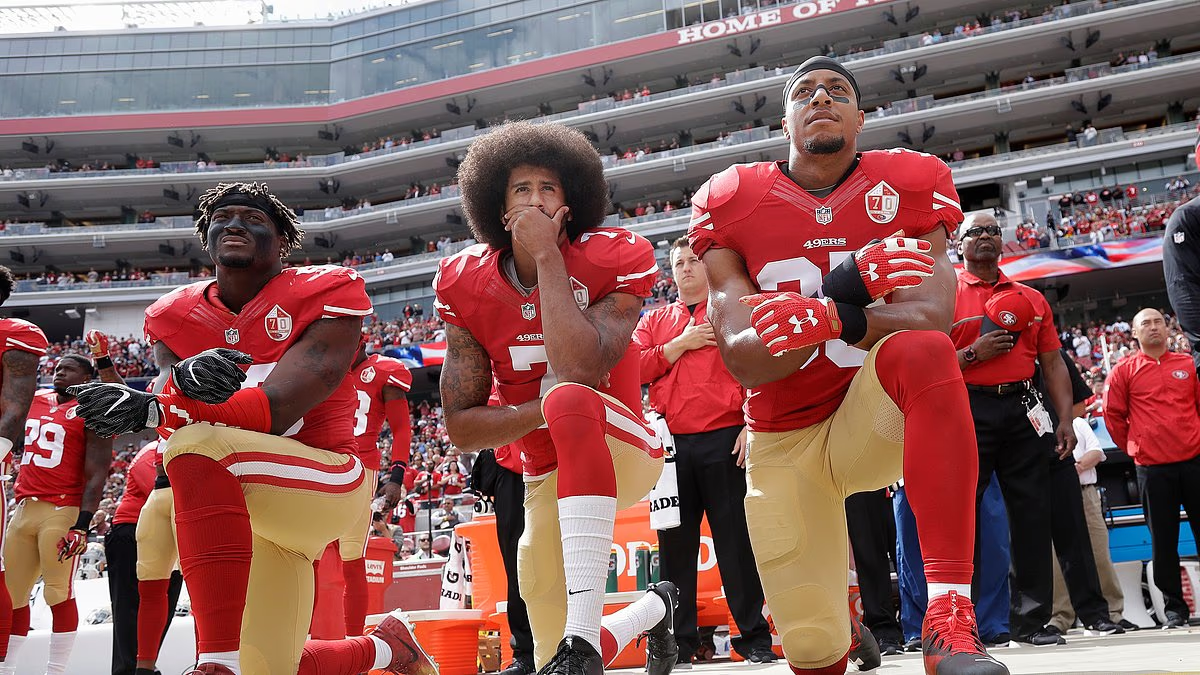
San Francisco 49ers outside linebacker Eli Harold, quarterback Colin Kaepernick and safety Eric Reid kneel during the national anthem before a game to protest racist police brutality
He has not played in the NFL since the 2016 season, when he ignited a nationwide free-speech debate with the protests. And although Kaepernick has been in contact with a few interested teams, the quarterback who once guided the 49ers to the Super Bowl has remained a free agent.
‘I had had a visit with the Seattle Seahawks,’ Kaepernick told Remnick. ‘They brought me in. They did not do a workout with me because, they said, “We already know you’re a starter.” What they asked me was everything about my political beliefs, the protests, and then ultimately said, “We’re not going to offer you to play on the Seahawks.”‘
These days, Kaepernick refuses to watch the NFL, saying the league is still ‘actively blackballing’ him a decade after his controversial protests.
‘I’m not gonna support an organization that one, is actively blackballing me, but two, has targeted my brothers who have been protesting as part of this as well,’ Kaepernick recently told NBC News in an interview. ‘I watch college football.’
The NFL has denied blackballing Kaepernick and Reid, who both reached confidential settlements with the league in 2019 over allegations of collusion. Kaepernick has since gone through a few NFL tryouts without being welcomed back into the league.