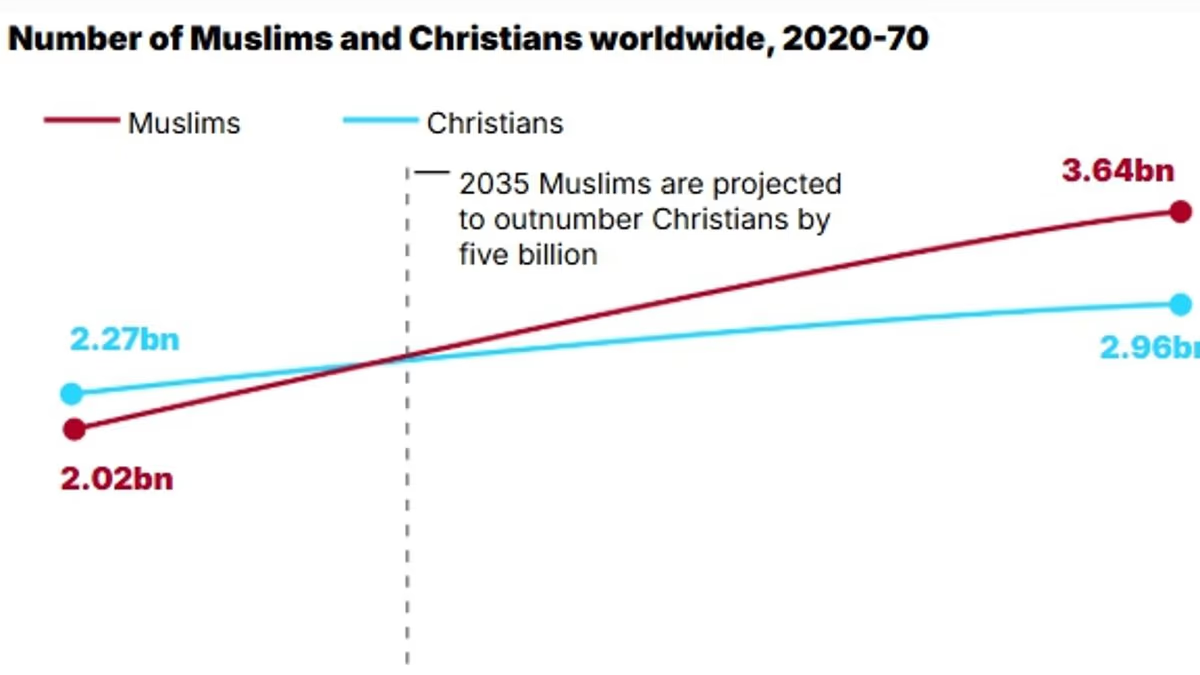

New projections show Muslims could outnumber Christians worldwide by 2035.
A report from the US-based Pew Research Center found that both faiths are growing, but Islam is expanding at a considerably faster pace.
The report identifies higher fertility rates among Muslim women as a key factor behind the trend.
“It’s the babies,” said Conrad Hackett, Pew’s senior demographer. He explained that religious conversion and other changes in identity have a far smaller impact on population growth than birth rates.
Between 2020 and 2025, Muslim women had an average of 3.1 children, compared with 2.5 among Christian women, according to Pew.
The average fertility rate among women in all other religious groups was 1.6 children—below the replacement level of 2.1 needed for each generation to replace itself.
Pew estimates that the global population included 2.27 billion Christians and 2.02 billion Muslims in 2020.
Its latest projections suggest the number of Muslims will reach 2.57 billion by 2035, compared with 2.52 billion Christians, as shown in the graphic below.
If current trends continue, the number of Muslims worldwide will exceed 3.6 billion by 2070, while the Christian population will stand just below three billion.
In Britain, Christians are also on course to be overtaken by people with no religious affiliation, according to the projections.
The share of Christians in the UK is expected to fall from 49.4 per cent in 2020 to 25.4 per cent by 2070.
During the same period, the Muslim share of Britain’s population is projected to rise from 6.4 per cent to 16 per cent.
The largest increase, however, is expected among the “religiously unaffiliated”. Their share is forecast to climb from 40.2 per cent to 52.3 per cent, giving them a majority of the UK population by 2070.
The estimates form part of a wider Pew study examining how the world’s major religious groups could change between 2020 and 2070.
The projections consider differences in age structure, fertility, religious switching and migration between faith groups.
Pew also forecasts that the United States will lose its Christian majority within the next 40 years.
Christians currently make up 62 per cent of the US population, but that figure is expected to fall below 50 per cent by 2065.
In neighbouring Canada, Christians are projected to account for less than half the population by 2030.
In both countries, the growing number of people with no religious affiliation is a major factor behind the decline in the Christian share.
By 2070, religiously unaffiliated people are expected to represent 41 per cent of the US population and outnumber Christians in Canada.
Muslims and Christians are projected to grow broadly in line with the increase in the global population.
The world’s population is expected to rise by 29 per cent between 2020 and 2070, Pew said.
Among the religious groups analysed, Muslims and Christians are the only ones expected to match or exceed that pace, with the Christian population growing by 30 per cent and the Muslim population by 80 per cent.
Hindus and Jews are both expected to increase in absolute numbers, but their shares of the global population are projected to decline, the think tank said.
Buddhism is forecast to decline both in overall numbers and as a share of the world’s population, partly because of expected population decreases in China, South Korea and Japan.
Pew said most global population growth over the coming decades is likely to take place in Africa, particularly south of the Sahara, where Christianity and Islam are the dominant faiths.
READ MORE: Father Dies of Blunt Force Trauma After Roller Coaster Fall
High fertility rates and longer life expectancy in the region are expected to increase the worldwide populations of both religions.
By 2070, more than half of the world’s Christians are expected to live in sub-Saharan Africa. The Democratic Republic of Congo is projected to overtake the United States as the country with the largest Christian population, with its Christian population tripling to 270 million.

Muslims are projected to outnumber Christians worldwide by 2035, according to a report from the US-based Pew Research Center
Other major regions are expected to experience slower population growth or an overall decline.
Europe’s population, for example, is projected to shrink by 17 per cent by 2070. Over the same period, the number of Christians there is expected to fall by a third, from 505 million to 324 million.
The Muslim share of Europe’s population is forecast to rise from 6 per cent to 13 per cent during those five decades.
In the US, the Christian population is projected to fall from approximately 217 million in 2020 to about 174 million by 2070.
Several mainline Protestant denominations in the United States have experienced years of declining membership.
However, Jeffrey Brodd, a religious studies professor at California State-Sacramento, said a recovery remained possible after several Democrats involved in moderate-to-liberal denominations won congressional elections this month.
Pew estimates that Muslim women had more babies than women in any other major religious group between 2020 and 2025.
Approximately 252 million babies were born to Muslim mothers, compared with 208 million born to Christian mothers.
Muslims are the only major religious group expected to see the number of births increase in the decades ahead.
Births among other groups are projected to remain broadly stable or decline gradually.
If current trends persist, Pakistan will have the world’s largest Muslim population by 2070, followed by India, Nigeria and Indonesia—the country with the largest Muslim population today.
Gina Zurlo, a senior researcher at Harvard Divinity School who specialises in religious demographics, said Christian-Muslim relations were “extremely important” as these demographic changes unfold.
She said: “The ‘clash of civilisations’ theory still looms large in some religious communities, and there is a great deal of misunderstanding about both religions on both sides.
“Many Christians are not happy to see that Islam will become the world’s largest religion, and that is causing even more angst.
“I hope people seek out more opportunities for interreligious education.
“Personal contact matters—when people form relationships across religious differences, it humanises the ‘other’ in productive ways.”
Alan Cooperman, Pew’s director of religion research, said most of the projected growth in Muslim and Christian populations would occur in countries where those faiths are already the majority. Conversion, he noted, plays only a limited role.
“I don’t think this is a situation in which the growth of Muslims is coming at the expense of Christians,” he said.
“I do worry about mischief being made with headlines or narratives that take this finding and portray it as some kind of clash in which Christians are losing to Muslims.”
Across many countries, the number of “nones”—people who are atheist, agnostic or have no religious affiliation—has been steadily increasing.
Outside China, which has a large unaffiliated population but is facing a sharp overall population decline, the number of “nones” is expected to rise by more than 180 million by 2070, Pew said.
The unaffiliated already make up a majority of the population in 10 countries, including the Czech Republic, Japan, the Netherlands, New Zealand, Uruguay and Vietnam, according to Pew.


