A cybersecurity incident has thrown key US government systems into disarray, disrupting federal programs that help support the nation’s farmers and food supply.
The US Department of Agriculture (USDA) has faced widespread system outages since at least Monday, affecting financial services used by farmers. The incident was not publicly disclosed until Thursday.
Employees have been unable to access important platforms for tracking farm loans and assistance payments, and officials warned that some disruptions could persist through the remainder of the week.
Authorities have not identified the source of the breach or said whether sensitive government information was accessed or taken.
In an internal email sent Monday and obtained by Nextgov, Chris Rottler, acting assistant chief information officer for the USDA’s Farm Production and Conservation Business Center, said the department’s Cybersecurity and Privacy Operations Center had “uncovered a security incident.”
The incident prompted officials to “reset all database passwords in all environments,” the email said. That process required applications to be reset as well, resulting in service outages.
The USDA disruption is the latest in a series of problems affecting major US government and technology systems over the past week. It comes as White House National Cyber Director Sean Cairncross announced Thursday that he would leave his position.
His exit follows growing concerns about the protection of America’s critical infrastructure after disruptions involving aviation networks, banking services, Microsoft platforms and even the National Security Agency (NSA).

The US Department of Agriculture (USDA) has taken multiple applications offline for several days, disrupting financial systems used to issue payments and emergency aid to farmers
USDA Farm Service Agency Administrator Bill Beam confirmed the outages Thursday, telling DTN that teams were working to bring the affected systems back online.
“I have heard that there are some outages. I talked to our leader in the IT department, and you know they’re working on it. Seems like we’ve been able to work through a lot of this stuff,” Beam said.
Some employees, however, said they were instructed internally to “proceed with caution and don’t do any critical work.” Users also reported difficulties accessing the USDA’s eAuthentication platform on online discussion forums.
Richard Fordyce, the USDA’s undersecretary for farm production and conservation, did not directly comment on the reported cyber incident. Instead, he suggested that temporary outages can occur during routine system updates, according to DNT .
“We will occasionally have outages sometimes because there’s updates,” he said.
The email obtained by Nextgov indicated that the USDA’s technical problems had continued for several days.
A bulletin issued Thursday warned that applications “may continue to experience intermittent outages throughout the week.”
The department’s virtual private network (VPN) has also been affected, making it difficult for some employees to connect to internal systems.
MORE STORY: NYC Driver Omatoyo Neverson ID’d in Fatal Belt Parkway Police Shooting

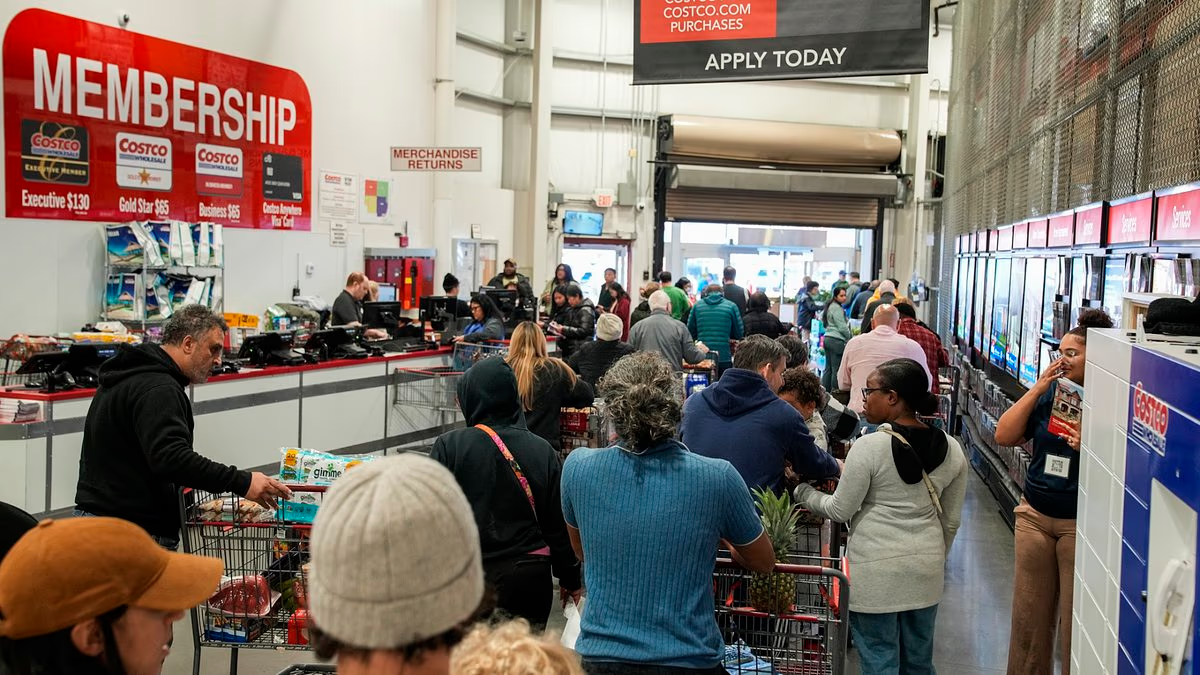
The USDA cyber incident has raised concerns about America’s food supply as panic buying has recently been reported nationwide. Above, shoppers visit a Costco in New Jersey on Wednesday
Frustration has grown among USDA employees, who say they have received limited information about the breach and have not been told when essential services will be fully restored.
People familiar with the situation told NextGov that staff had received few updates from senior departments.
One source said employees were initially given only general warnings about a possible security breach and were provided with no additional explanation.
Two other sources said workers who did not know about the cyber incident feared the USDA had become the latest victim of the broader wave of technology failures.
The outage has renewed scrutiny of the vulnerability of the extensive digital networks that support essential services throughout the United States.
Unlike several recent technical breakdowns, however, the USDA disruption followed a confirmed security incident. That has prompted fresh questions about whether unauthorized access occurred and how widely the intrusion may have spread.
The potential consequences are significant because the USDA manages billions of dollars in assistance for American farmers, including programs intended to protect agricultural businesses from natural disasters and severe crop losses.
A lengthy interruption to those payments could add to the financial strain already facing farmers. There is currently no evidence that the incident has affected food production or disrupted supplies.
The latest US technology turmoil began roughly a week ago, when a global Microsoft outage on November 12 affected government agencies, businesses and individual users.
A day later, the Federal Aviation Administration announced a nationwide ground stop for the second time since 9/11 after a system error.
Since then, outages have affected banks, airlines and other major services, with some incidents raising concerns that customer information may have been stolen.

The USDA cyber incident comes after a turbulent week for US technology systems, while President Donald Trump was in Asia for a visit to the Philippines and China that included an unprecedented trilateral summit with Russian President Vladimir Putin and Chinese President Xi Jinping in Shenzhen (pictured)
Officials at Chase, the country’s largest bank, said Thursday that “customer names and email addresses” may have been exposed during a cyberattack.
Visa and Mastercard were also affected by the same breach, which was attributed to a ransomware group. The group claimed on the dark web to possess private records, phone numbers and even dining and hotel reservations belonging to “tens of thousands” of customers.
Cybersecurity company SOCRadar said the attack was conducted by a group known as n0n, which claimed responsibility online.
Chase, the consumer banking division, and JPMorgan, the company’s investment and corporate banking arm, said the attackers targeted third-party vendors that had access to the financial company’s marketing data.


