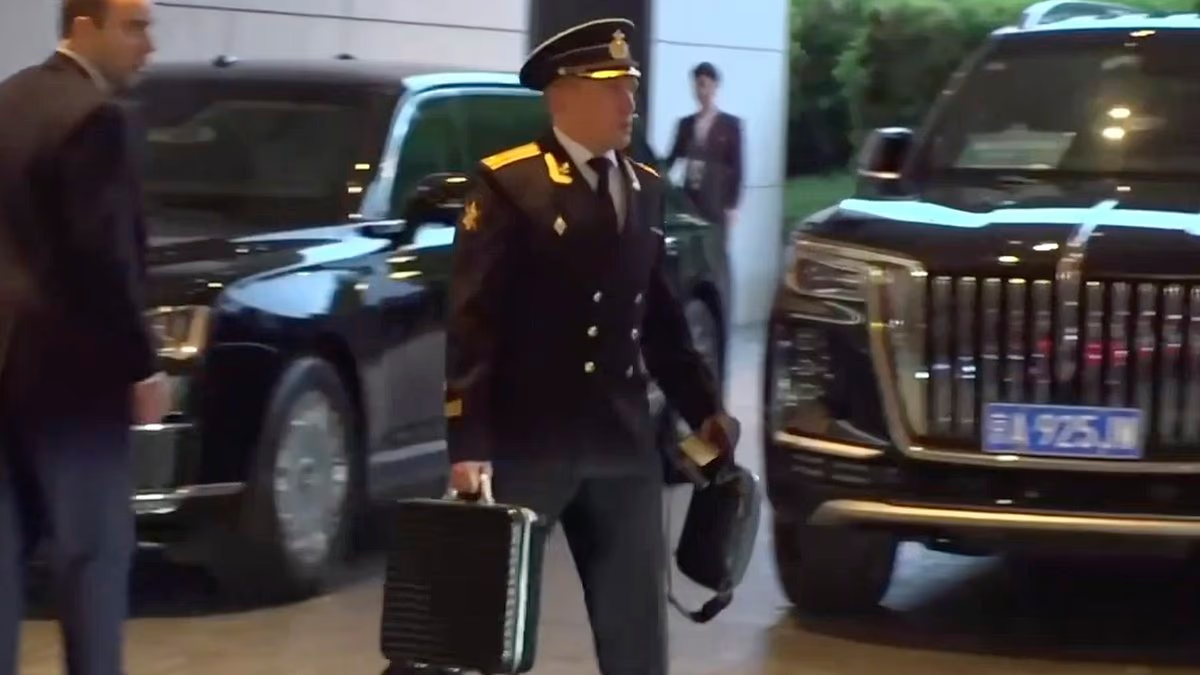
Vladimir Putin brought Russia’s nuclear briefcase with him when he travelled to China for talks with Donald Trump and Xi Jinping.
The three leaders held a historic trilateral meeting focused on limiting nuclear weapons and exploring the possibility of ending the war in Ukraine.
The Russian president was reportedly accompanied by the ominous device, which is capable of transmitting the orders needed to launch a nuclear strike against the West.
A naval captain, appearing alongside loyalist State TV presenter and MP Yevgeny Popov, appeared to confirm that the suitcase contained Russia’s nuclear codes.
Known as the “nuclear football”, the briefcase reportedly contains a personalised key code and a flash card. It is kept under constant supervision and is said to provide remote control over Russia’s nuclear arsenal.
The sighting prompted speculation that the Kremlin had deliberately allowed the nuclear briefcase to be shown on Popov’s programme, presenting Putin as a major global power alongside Trump and Xi.

A beaming Vladimir Putin greeted Donald Trump and Xi Jinping in China today

The sinister “nuclear football” briefcase contains a device capable of launching an atomic strike against the West
Earlier, Putin had unexpectedly sent two Tu-95MS nuclear-capable strategic bombers to Vietnam in what appeared to be a show of strength aimed at the West.
The aircraft, known by the NATO codename “Bear”, reportedly breached the airspace of Japan and Taiwan while flying towards Da Nang.
Two Ilyushin transport aircraft accompanied the bombers during the surprise visit to Vietnam.
At the same time, Russian state television warned that Putin could order “demonstrative nuclear explosions” after Ukrainian drones struck and damaged his £3 billion bridge link to Crimea.
Colonel Mikhail Khodarenok, a Moscow-based military expert, told state television: “All bridges in Kyiv should be razed to the ground in the shortest possible time.
“It is also necessary to intensify strikes against high-level command-and-control centres.
“Operations involving conventional weapons should be accompanied by demonstrative nuclear explosions, intended to signal to our adversaries in the West that, if they fail to understand the full extent of their responsibility, these demonstrations could escalate into actual nuclear strikes against their facilities.”
The talks marked the first meeting between Trump and Putin since their Russia-US summit in Alaska the previous year.
Putin described the global situation as “turbulent”, but said disagreements could be resolved by leaders “sitting at the table”.
“I therefore expect big potential benefit from the upcoming trilateral meeting,” he said.

Putin described the world as “turbulent”, but said disagreements could be addressed by “sitting at the table”

World leaders pose for a group photograph at the APEC summit in Shenzhen
The meeting followed a rare gesture from Xi, who personally welcomed Trump on the runway at Shenzhen Airport earlier in the day.
It was the first time the Chinese president had greeted a visiting leader at an airport since taking office. The gesture mirrored Trump’s own welcome for Xi at Joint Base Andrews when the Chinese leader visited the United States in September.
After stepping off Air Force One, Trump saluted beside Xi on a red carpet lined with people waving colourful pom-poms and holding Chinese and American flags. The two leaders then shook hands.
Chinese state news agency Xinhua quoted Xi as saying that Trump and First Lady Melania Trump had made a “special trip to the airport” to greet him during his September visit and had held a “grand welcoming ceremony”.
“I welcome your renewed visit to China and look forward to in-depth exchanges of views with you on major issues concerning China-US relations, Asia-Pacific co-operation, and the global order, and to promote the development of a constructive strategic and stable relationship based on respect, fairness, and equality,” Xinhua quoted Xi as saying.
Trump thanked Xi for travelling to the airport to welcome him personally, according to state media.
When Putin arrived earlier on Wednesday, however, Xi did not meet him at the airport despite their longstanding relationship.
The meeting drew comparisons, particularly in Russia, with the 1945 Yalta Conference involving the United States, Britain and the Soviet Union. That gathering helped establish spheres of influence, shaped the post-Second World War order and became shorthand for agreements between major powers imposed on smaller nations.
Trump signalled that he intended to take an improvised approach during his time in Shenzhen.
The US president said he planned to discuss nuclear arms limits with Xi and Putin, as well as efforts to end the war in Ukraine, which began with Russia’s invasion in 2022.
Despite the unprecedented nature of the meeting, analysts did not expect it to produce major breakthroughs.

Chinese President Xi Jinping personally greeted Trump at the airport as the US leader arrived on Wednesday
Before the trip, Trump’s aides had told reporters that the war in Ukraine would not be included on the agenda.
But Trump said on Tuesday that the deaths of tens of thousands of Russian troops each month had created an opportunity to bring the conflict to an end.
“I think it’s very close to getting it done,” Trump said. “We’re going to have a good meeting on that.”
Trump arrived in China hoping to reinforce the United States’ position as the world’s leading technology power. However, a troubling series of technical failures at home had left his administration scrambling to reassure the American public.
The problems put the administration on the defensive just as the president sought to project strength and confidence ahead of his meeting with Xi and Putin.
Outages involving Microsoft, the Federal Aviation Administration, JPMorgan Chase and the National Security Agency’s communications network had overshadowed Trump’s visit.
The disruptions also fuelled concerns about the potential for artificial intelligence and other emerging technologies to interfere with everyday life. Newly identified cyber vulnerabilities require software to be regularly updated through “patching”, a process intended to correct flaws and close security gaps.
Trump also raised the possibility of holding a private meeting with Putin, as well as separate talks with North Korean leader Kim Jong Un.
US Secretary of State Marco Rubio said on Wednesday that Trump was “serious” about meeting Kim as part of efforts to ease tensions with North Korea.
However, Rubio indicated that no meeting between Trump and Kim had been scheduled for Thursday.