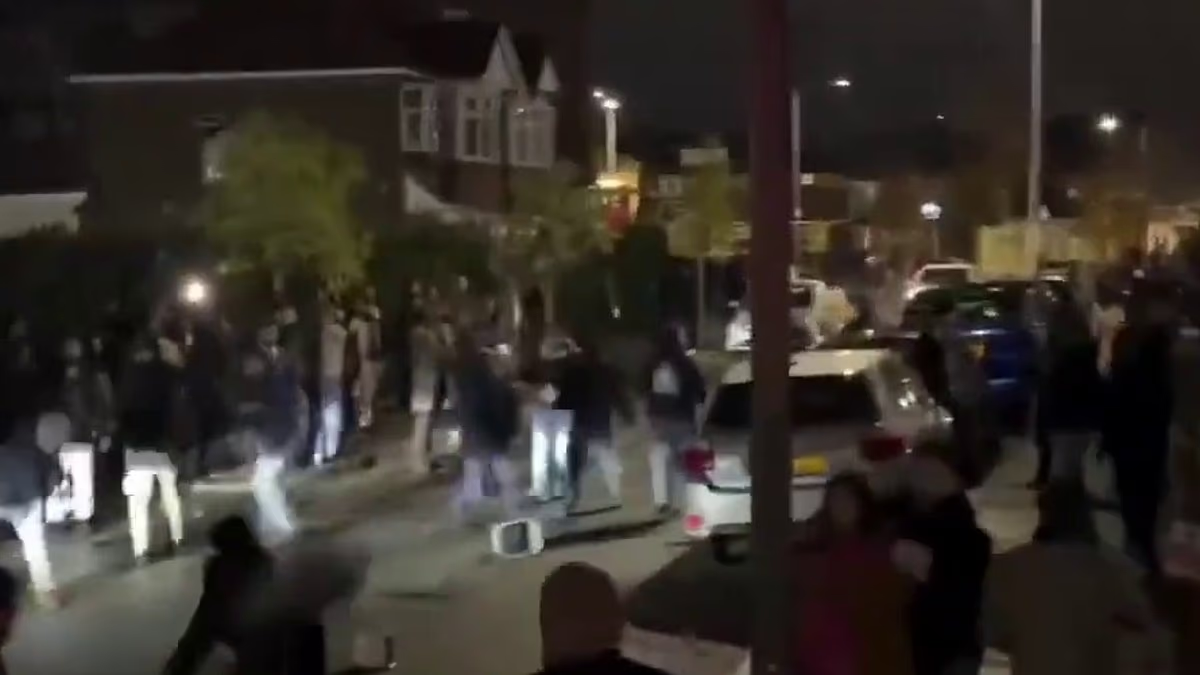

Violent clashes broke out on the streets of East London this week, yet the incident received comparatively little national coverage.
A search of Google News produced only three reports, all published by local newspaper websites.
GB News also covered the incident, while searches of the BBC, ITV and Sky News produced no immediate results. There were no high-profile police briefings, parliamentary questions or prominent statements from ministers and MPs.
The disorder in Chadwell Heath took place on Monday night, when two Bangladeshi groups became involved in a confrontation linked to a political dispute in Bangladesh.
The argument escalated when supporters of one party attempted to prevent the visiting leader of another, Nahid Islam, from speaking at a venue more commonly used for wedding receptions and private celebrations.
Residents of the surrounding suburban homes reportedly sheltered indoors as the violence spread into nearby streets. Bricks, bottles and other objects were thrown, while branches were pulled from trees and used as weapons. Six people were taken to hospital.

A riot between two rival Bangladeshi groups over a political dispute thousands of miles away took place on Monday night in Chadwell Heath

Local residents were forced to shelter in their homes as bricks, bottles and other objects were thrown; no arrests were made and police were not present at the scene
Video of the incident is available online. It appears to show no police officers, dogs or riot shields, and no arrests were reported.
Questions remain over whether police in Romford were aware of the potential for conflict between the two groups. Just days earlier, activists had held a noisy demonstration at St John’s College, Cambridge, where Islam was delivering a talk.
The limited response can be contrasted with the extensive investigation that followed disorder after the stabbing of three young girls in Southport in July 2024.
That unrest was far broader and continued for longer, with speculation intensified by the police decision not to identify the suspect immediately.
Police spent a year pursuing those involved, using CCTV, facial-recognition technology, social media investigations and information from local sources. More than 1,800 people were arrested, and those convicted received sentences averaging two years, with some receiving as much as nine years.

The trouble erupted when supporters of one party tried to stop the leader of another, Nahid Islam, speaking at a venue more suited to hosting wedding receptions and birthday parties

The High Court granted Birmingham City Council an injunction banning the flying of Union and St George’s flags from lampposts and other structures this week
Lucy Connolly, from Northampton, was sentenced to two years and seven months in prison for an inflammatory post on Twitter that she deleted after about ten minutes.
While the most serious offenders were widely regarded as deserving punishment, many people argued that those not convicted of violence were treated disproportionately harshly.
That raises an obvious question about the response to the Chadwell Heath confrontation: will police pursue those involved with the same determination? Officers are reportedly reviewing video footage, although it remains unclear whether that will lead to arrests.
So far, the public response has been limited, leaving residents with the impression that the incident has been treated as something to be moved past rather than fully investigated.
Following the Southport unrest, then-Prime Minister Keir Starmer was labelled ‘Two Tier Keir’ by critics who claimed that police and courts treated alleged far-Right offenders differently from suspects from ethnic-minority or non-Christian backgrounds.
Critics are now asking whether the Chadwell Heath suspects will receive a less forceful response because those involved were Bangladeshi or of Bangladeshi heritage.
Home Secretary Shabana Mahmood added to the debate this week by acknowledging concerns that two-tier policing has existed in Britain.
There must be no tolerance for neo-Nazi groups or violent far-Right protesters who demonstrate against immigration.
IN CASE YOU MISSED IT: New York Woman Deirdre Keane Runs 7 Marathons While Pregnant, Finishes NYC Race at 34 Weeks
Nor should politically motivated groups on the far Left be permitted to use anti-Semitic abuse or intimidation at pro-Palestinian demonstrations. The same standard should apply to every protest movement, regardless of its political or religious identity.
The debate over unequal enforcement has also been raised in relation to historic grooming-gang cases, in which vulnerable girls were abused for years while authorities were accused of being reluctant to act for fear of being labelled racist.
Mahmood may be signalling a change in approach, but reforming police culture and ensuring consistent enforcement will require more than political statements.
The wider issue concerns the limits of Britain’s multicultural model. Trevor Phillips, when he led the Commission for Racial Equality, warned that poorly managed integration could leave communities increasingly separated from one another.
Britain is home to citizens and residents with varied national, cultural and political connections. The Chadwell Heath violence illustrates how disputes originating overseas can sometimes be transported into local communities.
Similar tensions have appeared elsewhere, including Leicester, where clashes between Muslim and Hindu groups have been linked both to local disputes and to events in India. Some parts of Leicester and other cities remain heavily divided along cultural and religious lines.
Critics argue that political leaders, public institutions and the legal system have failed to promote integration effectively, while national identity and pride have often been treated with suspicion.
The controversy over public flags has reinforced that argument. While Palestinian and Iranian flags have been displayed during demonstrations, the High Court this week granted Birmingham City Council an injunction restricting the flying of Union and St George’s flags from lamp-posts and other structures. The council has also removed the word ‘British’ from a celebration of Birmingham’s ‘diverse’ heritage.
The decision has prompted criticism from those who believe national symbols should be welcomed rather than treated as divisive.
For the residents of Chadwell Heath, however, the immediate concern was more practical: being confined to their homes while violence unfolded outside, apparently over a dispute rooted thousands of miles away, without seeing the police presence they expected.
There is also concern that residents who responded angrily online could face investigation if their comments were considered threatening or hateful, even though the original disorder had not resulted in arrests.
Keir Starmer may eventually move beyond the ‘Two Tier Keir’ label, but the broader debate over equal treatment and social cohesion is unlikely to disappear.
The question is whether authorities will act consistently before the next confrontation.

Members of an endangered Amazonian tribe emerged from the forest in Brazil for the first time this week to ask for food.
Carrying slings and spears, and wearing feathered headdresses and necklaces, they communicated through hand gestures before receiving yams to take back to their camp.
The group has been described as ‘Earth’s most threatened tribe’, with its traditional territory under pressure from illegal loggers, hunters and cattle ranchers.
Their appearance highlights the severe risks facing isolated Indigenous communities as development and criminal activity encroach on their land.
The story also comes amid debate over plans to accommodate 1,250 asylum seekers in Oxfordshire, a proposal that has drawn criticism from some local residents who fear pressure on public services.
The Archbishop of Canterbury, Sarah Mullally, has warned that Church of England congregations may struggle to afford Labour’s proposed 20 per cent VAT on church roofs, buildings and organ repairs.
At the same time, she has backed a proposal for the Church of England to contribute £100 million towards slavery reparations.
Critics have questioned whether the Church should prioritise its immediate financial pressures before taking on such a substantial commitment.
The principle that charity begins at home is commonly associated with the Bible, including 1 Timothy 5:8. For some observers, that passage reinforces the argument that the Church should first protect its own congregations and buildings.


