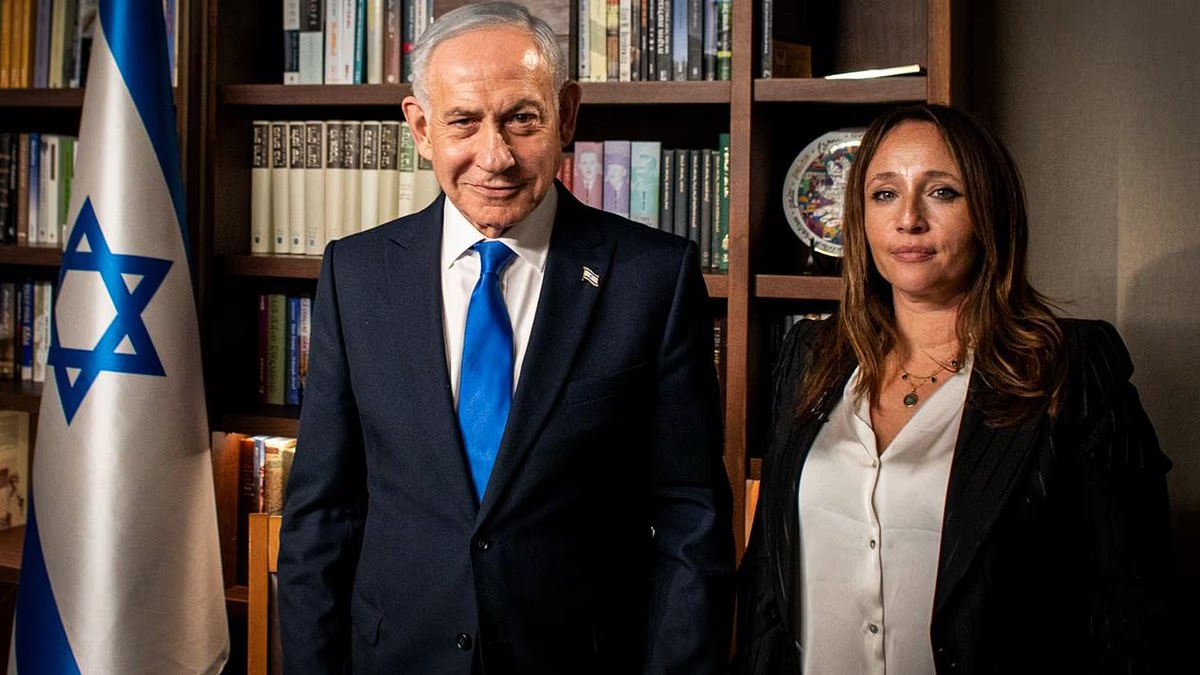

Securing an interview with the man who, apart from Donald Trump, may be the most heavily protected person in the world was never likely to be simple. Still, nothing prepared me for what lay ahead.
After a taxi dropped my photographer and me a short distance from Israeli Prime Minister Benjamin Netanyahu’s office, we made our way towards the seven-storey building, located about a minute’s drive from the Knesset in central Jerusalem.
We passed the anti-ramming bollards outside, presented our identification at a wrought-iron gate and entered a maze of scanners and X-ray machines that made even the strictest airport security look modest by comparison.
Armed guards carrying MI6 assault rifles surrounded us as the checks began. Two hours later, the Daily Mail photographer was still there, with every piece of his equipment dismantled to make sure it contained no explosives.
Few people understand the deadly potential of electronic devices better than the Israelis. Two years ago, explosives hidden inside pagers and walkie-talkies were detonated, killing and wounding hundreds of Hezbollah members.
My interview with Netanyahu had been scheduled for 8.30pm on Thursday. By the time I reached the purpose-built studio, however, it was after 9pm. More armed men were waiting inside, this time masked special forces troops dressed entirely in black.
The prime minister arrived soon afterwards. Following a warm handshake, he gestured towards a chair opposite him at the long oak table that dominated the room.
Despite spending the three years since the October 7 attacks confronting one crisis after another, including the attempted Flydubai hijacking just 18 hours earlier, he appeared remarkably composed. Wearing a dark suit, an enamel Israeli flag pin and a white shirt with a royal blue tie, he quickly made clear that he intended to speak bluntly. Britain’s Labour Government, he said, was acting ‘like a rogue state’ while appeasing an ‘Islamist Leftist alliance’.

Benjamin Netanyahu speaks to Natalie Lisbona in an exclusive interview with the Daily Mail
He was referring to the Government’s decision the previous month to prohibit trade with Israeli settlements in the West Bank. That move followed Keir Starmer’s decision to suspend some arms licences and recognise a Palestinian state before all the hostages taken on October 7 had been released.
The timing particularly angered Netanyahu because it came as Israeli intelligence warned British security services of an imminent Iran-sponsored ‘murderous attack’ targeting RAF Fairford.
‘It was stopped. It was prevented,’ he said. Without the intelligence supplied by Israel, he added, ‘it would probably have gone through and we don’t know how many British lives would have been lost’.
Netanyahu insisted that Israel still considered Britain an ally, before launching an extraordinary attack on the Government. ‘It’s mind-blowing hypocrisy, I don’t know how many lives we have saved giving Britain information about impending attacks.
‘They’re appeasing, they’re attacking Israel, [the country] that is fighting the terrorists in the terrorist regime that is attacking them. They appease their enemies, and they attack their protectors, really. That’s what’s happening. But this is a twist of both logic and justice. It doesn’t serve Britain well, it doesn’t serve the world well.’
Netanyahu also confirmed that he had yet to speak to Andy Burnham, despite the former Manchester mayor having taken office in July. He accused Labour of allowing domestic political pressure to shape its policy towards Israel.
‘There is a pressure from inside Britain to appease these various Islamist forces in Britain. And once you start appeasing, you don’t stop. That’s what we learn. Churchill called it the slumber of democracies. And by that he meant the democracy sort of slumbers while their enemies begin to attack them… until they hear the jarring gong of danger.
‘Well, it’s gonging all the way, and they still haven’t woken up.’
Asked to describe the current state of relations between Britain and Israel, Netanyahu was equally direct. ‘Well, it’s not very good, is it? I mean, when they appease our common enemies and attack us, it doesn’t say much.
‘Look, we’re fighting the battle, I call it the Battle of Britain, the Battle of Western civilisation against these barbarians. And there’s so much deception. There’s so much propaganda. I mean, trying to glorify Hamas, trying to glorify the Islamists that have killed Britons. It killed Americans, it killed Israelis. It killed nationals of dozens and dozens of countries.
‘And Israel is painted as this great devil. We’re not the devil. We’re a tiny country fighting here in the heart of the Middle East, not only to protect ourselves, but also to protect the modern Arab states against the Iranian domination and these murderous proxies.
‘We always consider Britain as an ally, even though we have, on occasion, differences with them.’

Dressed in a dark suit – with an enamel badge of the Israeli flag on his lapel – and a white shirt with a royal blue tie, it was soon clear he meant business
He said the relationship risked deteriorating to the point where the British Government, ‘in order to ingratiate itself with its political base, has gone rogue. Like a rogue state’.
In his view, Labour should regard the ‘Islamist Leftist alliance’ as its ‘natural adversaries’.
‘What do these people do? They hang gays, you know, they deprive women of any rights. They murder their own people in Gaza, or Lebanon, or Iran. Executing all their enemies. They are the opposite of democracies. And what does the government in Britain do? It turns on the one democracy that is fighting these monstrous regimes in this terrible state, the worst terrorist state on the planet. That’s what Britain is doing.’
Britain and Israel retain extensive intelligence links, particularly on terrorism, Iran and regional security. Asked whether Israel would continue sharing intelligence with the UK, however, Netanyahu declined to give a direct answer.
‘I won’t get into that, but we just did,’ he said, pointing to the Fairford incident. ‘That’s a fact.’
He said the episode was not unique, claiming that Israeli intelligence had repeatedly helped protect Britain from attacks.
‘I don’t know how many Britons know how many lives we saved by giving Britain advance information of impending attacks.’ Netanyahu argued that the UK Government was singling out Israel while failing, in his assessment, to confront their shared enemies. His series of public criticisms from a long-standing ally underscored the deterioration in Israel-Britain relations.
He also said Labour’s policies towards Israel were contributing to anti-Semitism. ‘Look, we’ve been there before. The Jewish people have suffered these kinds of vilifications that always, always preceded the most violent attacks on our people during our, you know, centuries of our exile and the various diasporas.
‘And then, of course, it reached a peak in the Nazi Holocaust, which was also preceded with the same lies and the same vilifications… Apparently, this is something we’re going to have to live with in this century, too. The one thing that has changed is that we now have a state. We now have an army. We have security and intelligence agencies that can help us protect ourselves. But in so doing, when we defend ourselves, we also defend our vilifiers. That’s the incredible thing that is happening.’
Turning to Iran, Netanyahu delivered a message to those opposing the country’s leadership. ‘This regime will fall. They take time, but they’ll fall. Right now, they’re very weak. President Trump’s blockade is really weakening the IRGC [the Iranian Revolutionary Guard Corps] a lot. So I’d say, don’t lose faith. Your day of freedom will come.’
He then redirected his criticism towards Britain, asking why protesters and the Government were not expressing greater anger towards Tehran.
‘But what I say to the people in Britain, where are you? Those who are protesting against us? Why aren’t you protesting outside the Iranian embassy? Why don’t you get the full venom of the British Government? Where is it? Why is it not directed against Iran? Why is it not directed against his proxies?
‘Why are you taking this brave, small democracy, fighting as Britain fought against the tyranny that threatened not only Britain, but the entire world. Why are you turning against the one country that is standing in defence of freedom and democracy? Why are you buying all these lies that are perpetrated against us?’
Netanyahu accused Western governments of directing their criticism at Israel while underestimating the threat from Iran. ‘This is a regime in Iran that murdered or maimed tens of thousands of its own citizens. They’re now choking the economies of the West. They’re choking your energy supplies. They’re choking your economies. They’re choking the international waterways.
‘I don’t see the railing of, you know, of rage that is directed against Israel directed there. So it’s completely misplaced. In Israel, which is the defender of civilisation right now.
‘With the help of our American allies, we went against Iran’s nuclear programme. What would have happened if Iran had nuclear weapons now? Think of what they’re doing without nuclear weapons. Just hitting everybody in sight. And choking the world.’

Netanyahu, who confirmed that he is yet to speak to Andy Burnham despite the fact the former Manchester mayor took office in July, went on to accuse Labour of bowing to domestic pressure over its approach to Israel
Because the interview took place the day after the dramatic hijacking attempt involving an airliner travelling from Dubai to Tel Aviv, I asked whether he suspected Iranian involvement.
‘As time passes, the picture becomes clearer: the attacker had undergone Islamist radicalisation,’ he replied. ‘He came to crash the plane, along with its passengers. We are investigating whether he was sent, and whoever sent him will pay a very heavy price.’
The incident carried particular significance for Netanyahu because it happened around the 50th anniversary of the Entebbe raid. His brother Yoni was killed while leading the Israeli operation to rescue hostages from a hijacked Air France aircraft in Uganda.
He praised the Israeli passengers who intervened bravely to rescue the Flydubai pilot and retake control of the aircraft, saying he was ‘amazed’ that they had prevented what could have become a 9/11-style disaster.
‘If it wasn’t for the extraordinary courage and resourcefulness of this Israeli passenger, you know, the sewage plumber. He heard screams from the cockpit. He ran to the cockpit. The plane was already veering out of control. He was thrust to the side.
‘He apparently managed to open the door because of the Indian pilot’s action, but he still had to move the Indian pilot, this brave pilot, and grab the attacker, the co-pilot, who nearly stabbed this guy to death, and pull him away. He was leaning, actually, he said, on the instrument panel, kicking it. Tried to jam it to make sure that [the plane] goes down.
‘He grabbed him, pulled him back, then grabbed the stick, pulled the stick back, and prevented, you know, that continuous slide down. And he was joined by other Israelis and a crew member. They tied the hijacker with the cord of the headphones in the cockpit. Can you imagine?’
Netanyahu praised the ‘extraordinary teamwork’ between the plumber and the off-duty pilots who happened to be aboard. He called their actions ‘so improbable that it almost sounds miraculous, and in fact, it is miraculous’. He added: ‘I served in our special forces. We said, ‘if we have these contingencies, we’ll know what to do’. These are civilians. First of all, I’m not sure that had I been there with my team, my soldiers, we would have done better. But these extraordinarily brave Israelis, you know, they organised the matter.’
Netanyahu will soon face another challenge as Israel heads to the polls on October 27. The sitting prime minister is seeking another term after three years of war.
Asked why voters should return him to office, he pointed to his government’s record against Hamas and Hezbollah, as well as its efforts to prevent Iran from acquiring nuclear weapons. ‘We could have all been incinerated by now,’ he said, ‘and they are developing long-range missiles.
‘They’re attacking us from the outside, and they’ll attack you from the outside, but from the inside, you have this appeasing the government, that is a very deadly combination.’
In a rare admission about the personal cost of his political career, Netanyahu said attacks on his wife Sara and their children were particularly painful. ‘I’m used to paying the price, being in public office, but the virulent attacks against my wife, the character assassination, and against my kids, is hard to take. That is hard. I won’t tell you that it’s easy. It’s not.’
By then, I had already been told that my 20 minutes were almost over. After managing to secure an additional ten, I decided to bring the interview to an end.
Netanyahu still had time for one final criticism of Burnham’s Britain, this time focused on the small-boat crisis in the English Channel.
‘I think that if Britain doesn’t regain control over its borders, you will lose Britain,’ he said.
He said Churchill had always believed Britain’s status as an island gave the country a powerful defensive advantage. ‘I don’t think that’s holding now because of the boats, and obviously, it’s up to the British Government to control that, or to prevent it. It’s possible. But they haven’t asked for our advice, and we haven’t given it.
‘There’s still time for Britain to recover, to regain its senses. I hope that it does, because we’ve had an extraordinary relationship with Britain over the decades, and I’m the first one to regret that it’s… that it’s gone where it’s going.’


