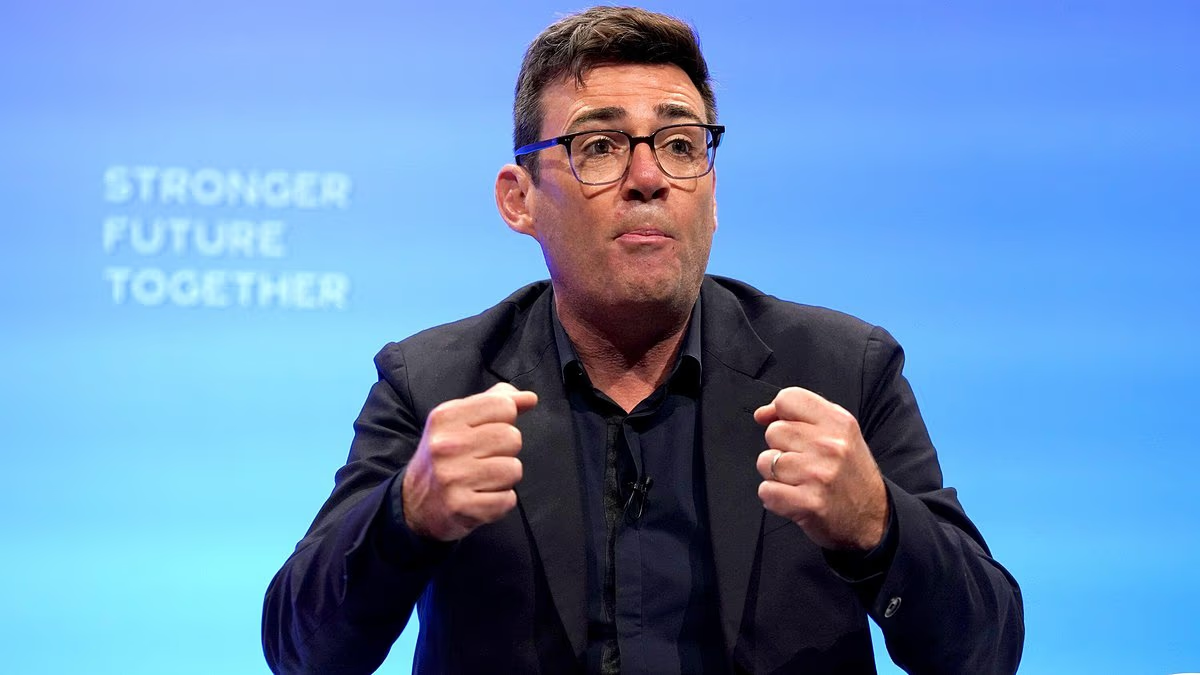

In recent years, a powerful—and often blamed—force has emerged in political debate: the so-called “bond vigilantes”. These investors are portrayed as financial enforcers who can topple governments or pressure them into changing course by selling, or threatening to sell, their debt.
In Britain, they are widely regarded as having played a decisive role in the downfall of Liz Truss’s premiership.
Now Andy Burnham is said to be in their sights, as fears over a high-spending Labour administration help drive UK borrowing costs to their steepest levels since the global financial crisis of 2008.
Unlike the masked crime fighters who inspired the name, bond vigilantes target governments they believe are pursuing reckless or financially unsustainable policies.
The phrase was coined in the 1980s by American economist Ed Yardeni, during Ronald Reagan’s presidency. He used it to describe investors who sold US Treasury bonds in protest against Federal Reserve policies they feared would fuel inflation.
When investors sell bonds, prices fall and yields—the effective interest rates paid to bondholders—rise. That increases the cost of government borrowing and can place intense pressure on ministers to reconsider their plans.
The term returned to prominence during Bill Clinton’s presidency, when yields on 10-year US Treasury bonds rose above 8 per cent. The turmoil became known as the Great Bond Massacre of 1994.
Clinton adviser James Carville captured the bond market’s power with a memorable quip: “If there was reincarnation, I’d like to come back as the bond market. You can intimidate everybody.”
Liz Truss experienced that intimidation first-hand after her September 2022 mini-Budget triggered a sell-off in UK government debt, or gilts. Yields approached 5 per cent, setting off a crisis in pension funds’ liability-driven investment strategies and forcing the Bank of England to intervene urgently.
The episode helps explain the criticism Burnham faced last September after declaring that Britain should not be “in hock to the bond markets”. His comments came as 30-year gilt yields climbed to a 27-year high.
The tough task facing Andy Burnham
Since becoming Prime Minister, Burnham has moderated his tone, pledging to use “any flexibility” available under the Government’s fiscal rules.
Financial markets, however, remain sceptical. A surge in oil prices has revived concerns about worldwide inflation, pushing the yield on 10-year UK government bonds to roughly 5 per cent—the highest level since 2008.
Yields on 30-year gilts have climbed to 5.8 per cent, their highest point since 1998.
If Burnham thinks carefully chosen language will calm the bond market, many observers believe he may be misjudging the scale of the challenge.
Anthony Peters, who describes himself as an “old bond dog”, argues that the idea of a distinct group of bond vigilantes is misleading. “It’s far more dangerous than that,” he said. “The whole gilts market is the vigilante. That’s its job.”
The vigilantes, he says, exist only in the minds of those who believe traders conspire against governments.
But, he says: ‘It’s got nothing to do with being in hock to the markets. It’s maths. If investors think something bad will happen, they sell.’
Britain now borrows at higher rates than Portugal, Italy, Greece and even Morocco.
US bond yields have also soared over worries about America’s budget deficit, triggering the controversial move by US Treasury Secretary Scott Bessent to intervene with a bond buy-back programme aimed at lowering borrowing costs.
However, fighting against the market almost never works – long-dated yields have shot up again.
Yields matter. Servicing the UK’s £3trillion national debt costs £120billion a year.
So each upward twitch in yields adds to the burden on taxpayers. Keeping yields low is vital, not only to refinance existing debt but for new borrowing.
Why this isn’t a Liz Truss moment… yet
Yet if yields are higher than in the Truss chaos, why is there no similar panic? Chris Fellingham, dubbed the City’s gilts king after 40 years of trading, says the market has priced in catastrophe.
‘We are at an impasse until John Healey’s first Budget. The market is treading water,’ he says. ‘Despite all the damaging Budget leaks, we don’t know what they are planning. It’s a game of wait and see.’
Chris Fleming, formerly of Japanese bank Nomura, agrees saying: ‘The markets decide. Right now, no one wants to buy ten-year gilts, let alone 30-year paper. Maybe if yields move closer to 6 per cent they’ll have a nibble. Investors lost confidence after Reeves’ first Budget, and it’s not returned.’
He says we’re seeing a slow-motion crash: ‘Investors don’t see signs of growth. They see only the politics of envy. Bond markets are the best intelligence source you’ll get for where a country’s heading.’
Britain is in a fiscal trap, argues George Cooper at Equitile Investments, saying: ‘Burnham’s trapped by deteriorating public finances, with every extra pound of spending widening the deficit.
‘War bonds are sticking plaster. Underlying the problems is that we’re below population replacement levels. Who will pay for future debt?’
Markets are also increasingly worried about ‘fiscal dominance’ –the point at which investors no longer believe central banks can control inflation through higher interest rates without rendering governments insolvent.
Faced with that dilemma, Cooper argues, policymakers will ultimately tolerate higher inflation.
What next for the gilt market?
The gilt market underpins our financial stability. Once dominated by UK pension funds, it has altered dramatically.
Domestic pension funds and insurers now hold only a third of gilts, while the Bank of England still owns 18 per cent through quantitative easing. Foreign investors control a third, with the rest owned by hedge funds and non-financial corporations, which are becoming more influential.
So where next for gilts? Fellingham says: ‘Healey must convince the markets that Labour will work with the private sector to achieve growth.
He must set out serious spending cuts in the Budget and maybe a small income tax rise on the middle classes – the rich have been squeezed enough. This could raise £30billion to pay down debt.’
There are even signs among Burnham’s allies that the Government is realising difficult choices must be made to stop the cost of Britain’s borrowing spiralling further out of control.
Mortifyingly for the Prime Minister, Jim O’Neill, his former economic adviser, said the Government must rein in the ‘excesses’ of spending on areas such as the pension triple lock and the welfare system if it is to regain the confidence of bond markets.
Even more embarrassing for the Government, Andy Haldane, former Bank of England economist and now head of the British Chambers of Commerce, and another potential PM adviser, has argued against raising taxes again, saying the UK has reached ‘saturation point’ and that any higher taxes will harm future growth.
And if Healey fails to convince the markets? Fellingham says: ‘If Labour does something stupid like wealth taxes, which will reduce tax revenue and drive more talent overseas, we’re f*****.’
For Burnham, the message is simple: disrespect the bond market at your peril.
DIY INVESTING PLATFORMS

AJ Bell
AJ Bell
Easy investing and ready-made portfolios

Hargreaves Lansdown
Hargreaves Lansdown
Free fund dealing and investment ideas

interactive investor
interactive investor
Flat-fee investing from £4.99 per month

Freetrade
Freetrade
Investing Isa now free on basic plan

Trading 212
Trading 212
Free share dealing and no account fee
Affiliate links: If you take out a product This is Money may earn a commission. These deals are chosen by our editorial team, as we think they are worth highlighting. This does not affect our editorial independence.
Compare the best investing account for you