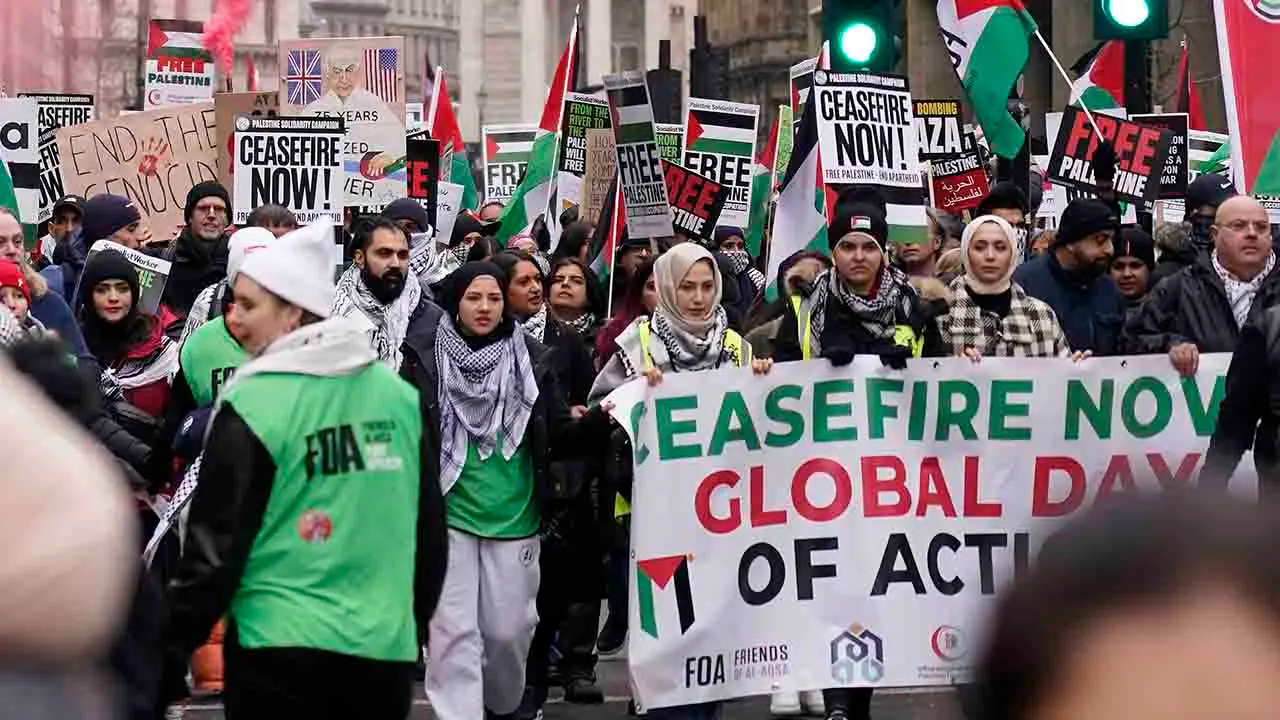

Known as the “Red-Green Alliance,” the growing relationship between Europe’s far-left parties and Islamist groups is increasingly influencing political debates and policy, particularly on Israel. Critics say the partnership is also contributing to a troubling rise in antisemitism across the continent.
As Europe’s Muslim electorate grows, left-wing and far-left parties are paying closer attention to the voting bloc, which has become increasingly influential in shaping their political positions.
In the U.K. last week, critics accused the left-wing Labour government of targeting Israel in an effort to win back Muslim voters who had shifted toward the anti-Israel Green and Independent parties. Conservative lawmaker Tom Tugendhat described the announcement of sanctions as “performative politics.”
In Sweden’s parliamentary elections Sunday, exit polling by the state broadcaster indicated that support from non-European Swedish voters had helped give an alliance of left-wing parties a narrow three-seat advantage over a right-leaning coalition headed by current Prime Minister Ulf Kristersson.
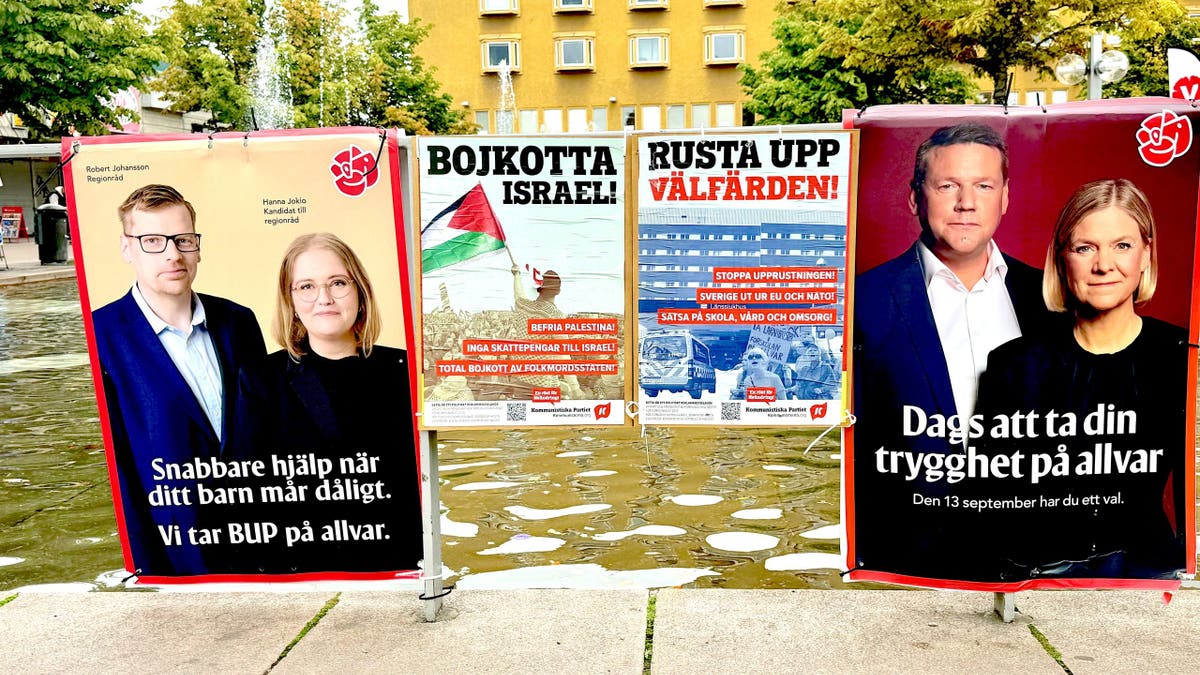
Campaign posters for the Social Democrats and Communist parties appear in a public area during Sweden’s general election in Stockholm on Sept. 13, 2026. (Atila Altuntas/Anadolu via Getty Images)
Swedish political researcher Tobias Hübinette compared the results with Mayor Zohran Mamdani’s victory in New York City. The Swedish election, he wrote on X, showed that the country had experienced a “Mamdanification” of urban Sweden, with the divide between cities and rural areas now wider than ever.
“They should be in disagreement,” Simone Rodan-Benzaquen, the Foundation for Defense of Democracies’ senior envoy to Europe, told News Outlet. “But the Islamists are very capable of covering that up for political purposes… The antisemitism that we have today, in particular in Western Europe, is definitely fed far more (by) the far left’s discourse.”
Alan Mendoza, executive director of the Henry Jackson Society in the U.K., said Europe had spent the past decade focusing almost exclusively on the far-right. Although that vigilance remains justified, he argued, it has created “a blind spot on the other flank.” “Antisemitism is not less dangerous because it arrives waving a progressive banner,” Mendoza said.
Janek Treiber, a research fellow at Dresden University of Technology in Germany, said there is “indeed an intriguing alliance between the supposedly progressive left and regressive forces within Islamism.” In comments to News Outlet, he said the groups are united by “a kind of victimization narrative.” For parts of the left that support the Palestinian cause, he explained, Muslims are portrayed as the oppressed while the West, including Israel, is cast as the oppressor. “Whether Muslims hold conservative-religious views in this context is irrelevant,” he said.
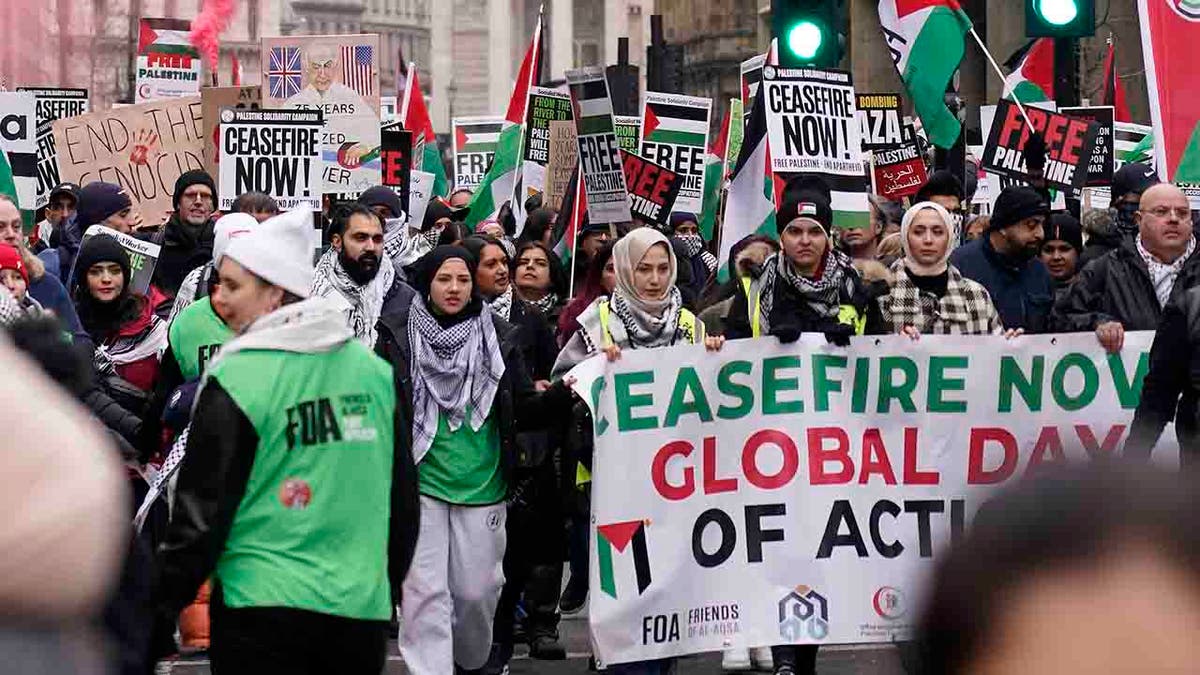
Protesters display flags and placards during a pro-Palestinian demonstration in London on Saturday, Jan. 13, 2024. (AP Photo/Alberto Pezzali)
Voters in Berlin are scheduled to go to the polls this coming Sunday, with surveys showing the far-left Die Linke Party—literally translated as “The Left”—leading the center-right Christian Democratic Union by two points.
“In Berlin, a party polling at the top of the field has factions that share platforms, demonstrations and slogans with networks that German security services themselves link to Hamas and the PFLP,” Mendoza claimed. “When ‘Death to the IDF’ and ‘Intifada’ are chanted at an election event, and parts of the party respond by defending the person who led them, the red line has been erased, not crossed.”
Rodan-Benzaquen said Germany’s political “firewall” against far-right parties such as the AfD “seems to work more or less on the right,” but not on the left. She attributed that difference to a perception that views coming from the left—even the far-left—are not considered as morally repugnant as those associated with the right.
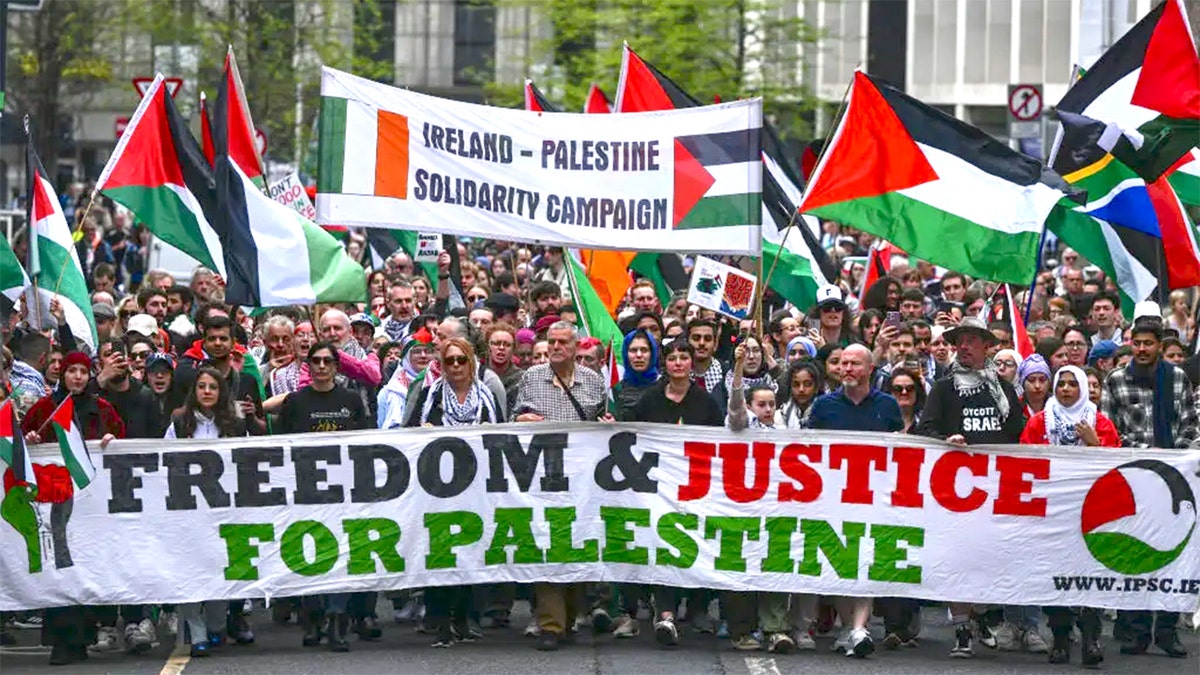
Pro-Palestinian activists from the Ireland Palestine Solidarity Campaign, joined by members of left-wing parties including People Before Profit and the Socialist Party, as well as students, take part in a National March for Palestine from the Garden of Remembrance to Connell Street and Leinster House on May 18, 2024, in Dublin, Ireland. (Artur Widak/NurPhoto via Getty Images)
Germany and the U.K. are not the only countries where this dynamic is playing out. In Spain, the far-left Sumar Party is part of Prime Minister Pedro Sánchez’s governing coalition. Its strongest support in the last election came from areas with large Muslim populations, while party members have appeared at demonstrations alongside Muslim Brotherhood-adjacent groups and at Gaza protests organized by Islamist-leaning networks. Sumar members have also advocated for Spain to recognize a Palestinian state and described Israel as an “apartheid state.” Spain recognized a Palestinian state in 2024.
The far-left La France Insoumise (LFI) Party in France has been accused by academics and ministers of “Islamo‑leftism” after their de facto leader, Jean-Luc Mélenchon, refused to call Hamas a terrorist organization and party members marched with Islamist-linked NGOs during Gaza protests. The LFI’s popularity has been on the rise in polling ahead of next year’s presidential election and, according to French newspaper Le Monde, the LFI’s electoral strength lies in Muslim-majority suburban districts.
Israeli Ambassador to France Joshua Zarka recently told News Outlet that, “The way [LFI leader] Jean-Luc Mélenchon speaks in front of a crowd reminds me of Hitler. The way he uses the idea of uniting against one enemy by speaking of Israel is similar to the way Hitler used to speak about the Jews.”

Leader of French left-wing La France Insoumise (LFI) Party Jean-Luc Mélenchon delivers a speech during an electoral campaign meeting of the local LFI candidate for French municipal elections in Marseille, southern France, on March 7, 2026. (Miguel Medina / AFP via Getty Images)
Commenting on the sanctions imposed by the U.K. government on Israel, Britain’s Chief Rabbi Sir Ephraim Mirvis called the announcement on X “a truly dark day for British Jews.” His statement continued in part, “Gesture politics of this kind feeds into an increasingly hostile discourse about Israel,” he wrote, warning that the cumulative effect of such policies could “further embolden those, at home and abroad, who use hatred as a weapon against Jews.”
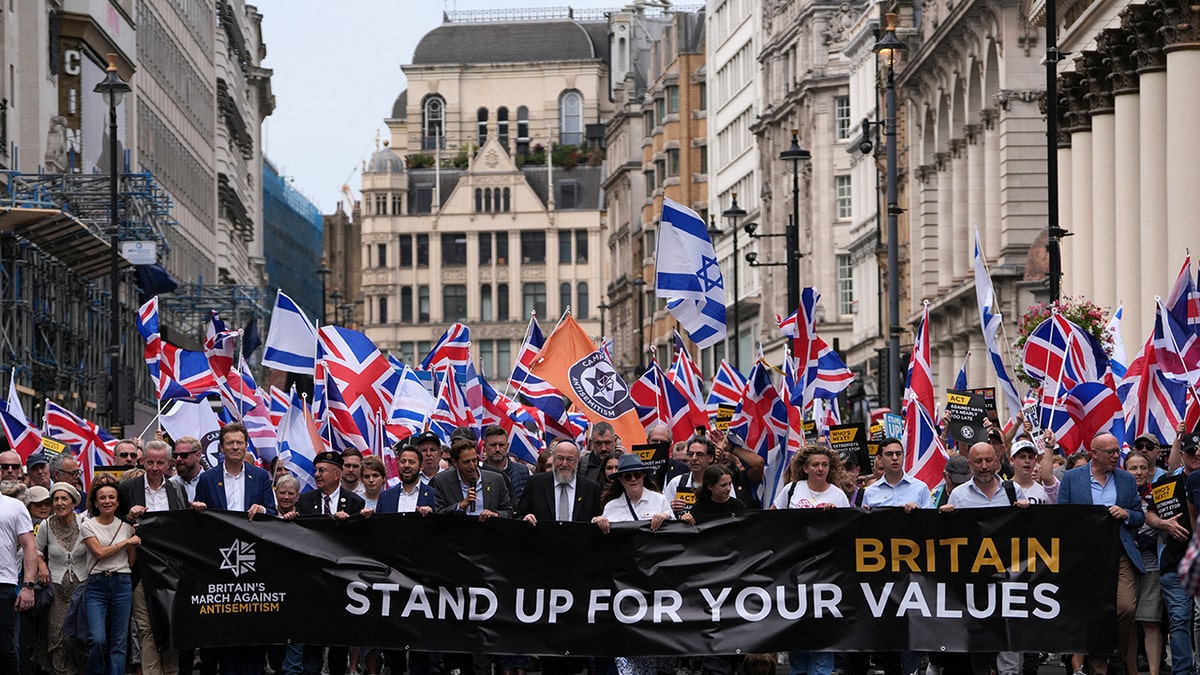
Former Conservative Cabinet Minister Michael Gove, Reform UK Deputy Leader Richard Tice and Chief Rabbi Ephraim Mirvis lead a “march against antisemitism” demonstration in central London on September 7, 2025. (Carlos Jasso/AFP via Getty Images)
Pointing to the U.K., Rodan-Benzaquen said the alliance grew while Jeremy Corbyn was the Labour Party leader. “You have this far left anti-imperialist, anti-colonialist, opposition to American power and, of course, to Israel itself. An alliance with Islamist organizations and movements that sort of adopt a common language, despite the fact that on many topics they are in certain disagreement… They have basically turned themselves from a party that cared about class, that cared about improving (lives), social rights, etcetera, into a party that is basically looking at identity politics and is trying to appeal to certain voters.”
She said the red-green alliance is nothing new. “We’ve seen it for a long time. We’ve actually seen it in the Islamic Republic of Iran when the Islamic Revolution happened.”
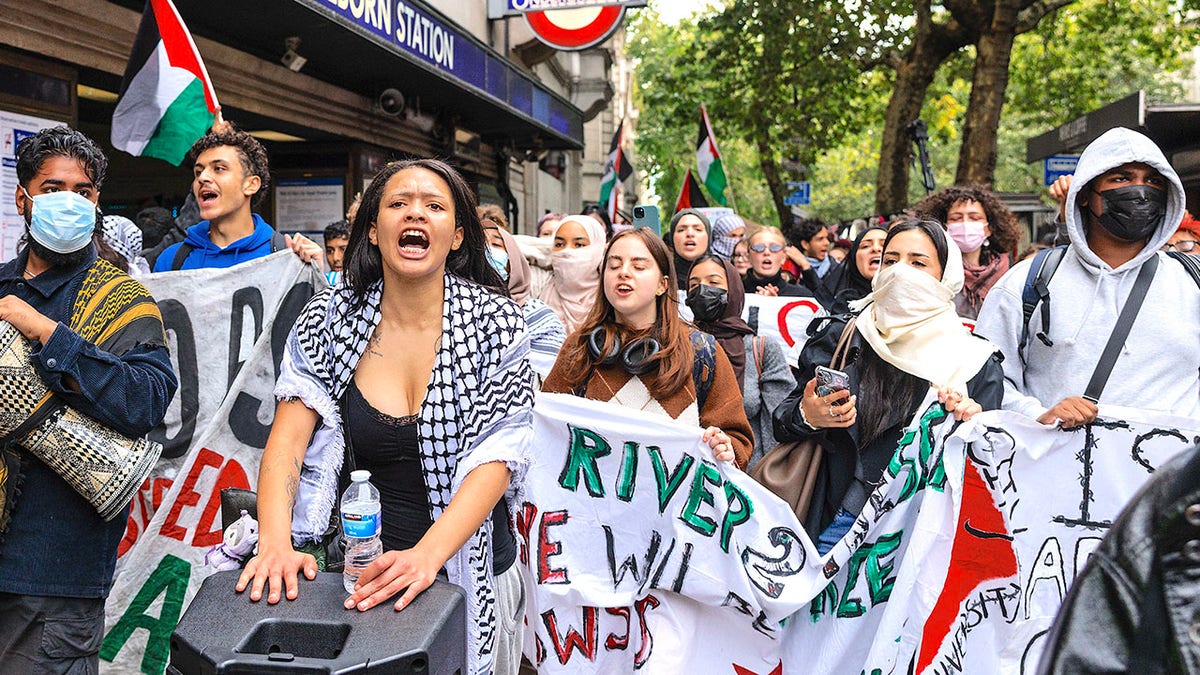
Protesters from a number of London universities attend an anti-Israel demonstration on Oct 7, 2025 in London, England. On the same day as people mark the second anniversary of the Hamas attacks on Israel which led to more than 1200 deaths and 251 hostages taken. (Dan Kitwood/Getty Images)
Europe’s Muslim population is estimated to be 45–46 million, up by 15.9% from 2010, based on Pew Research Center projections. That same study revealed the population of European Jewry had fallen to under 1.3 million — down 8% from 2010.
Rodan-Benzaquen says of European Jews, “electorally, we don’t weigh,” so they have again become a political football. She says when left and far-left parties say, “Oh, we want to fight against antisemitism. The only reason why they’re saying it is because it’s a tool to attack the far-right.”