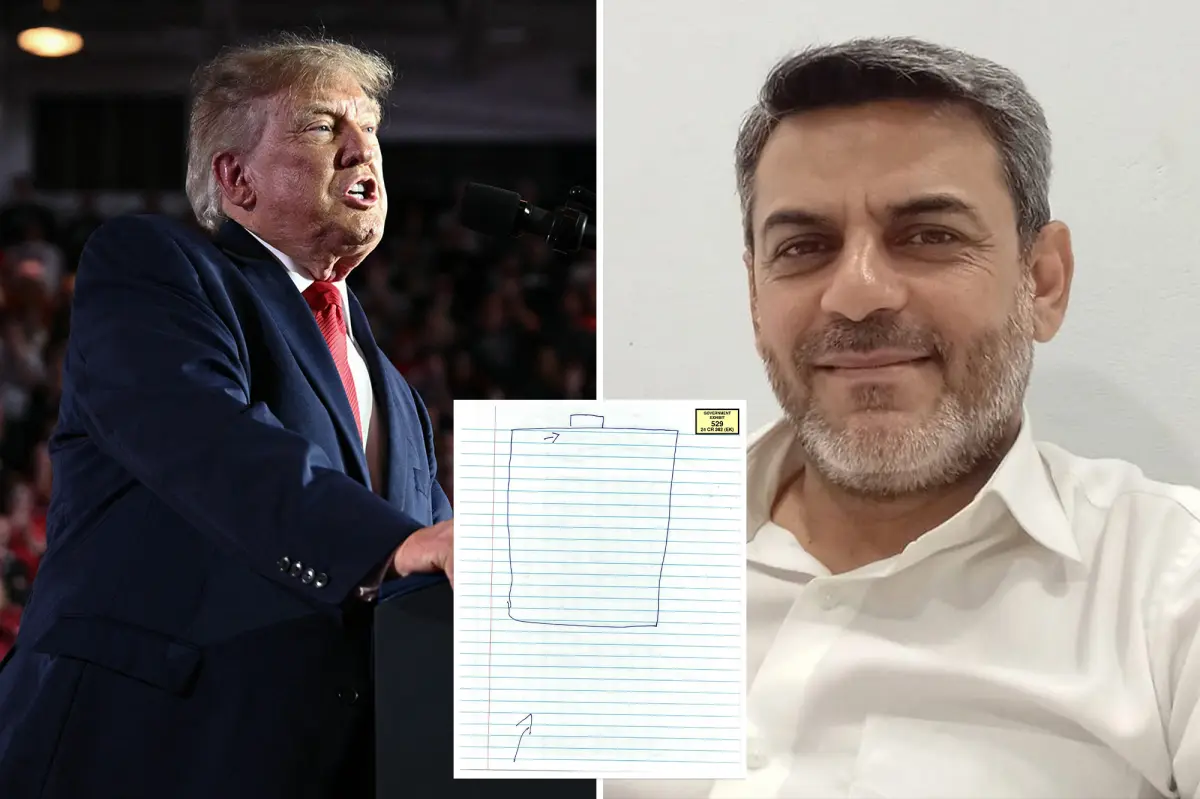

A bumbling would-be terrorist and failed banana exporter who devised a poorly executed plot to assassinate President Trump was sentenced Tuesday to 27½ years in prison, avoiding the life term sought by Brooklyn federal prosecutors.
The judge showed leniency after even Merchant’s own attorneys described the scheme as being more suited “to an Inspector Clouseau movie than James Bond.”
Asif Merchant, 48, learned his sentence after a jury convicted him of attempting to hire hitmen to kill Trump, then the Republican presidential front-runner, at a campaign event. Merchant, who prosecutors said was backed by Iran, described the plan to an FBI informant and illustrated it in a crude drawing in June 2024.
“This was an exceptionally serious crime,” US District Judge Eric Komitee said Tuesday as Merchant, shackled at the ankles, appeared for sentencing in Brooklyn federal court.
Trial evidence showed that Merchant, a native of Pakistan recruited by Iranian operatives for the failed plot, had previously worked as a banker and started unsuccessful banana and clothing export businesses.
Testifying in his own defense, Merchant said he came to the United States in April 2024 with several assignments, including “maybe to have somebody murdered.”
He told jurors that the potential targets were the three leading presidential candidates at the time: Trump, then-President Joe Biden and former South Carolina Gov. Nikki Haley.
Merchant testified that he expected to be paid as much as $1 million, depending on the outcome of the assignment.
His assassination scheme unraveled after the FBI launched a sting based on information from a recruit who testified at trial under the name “Nadeem Ali.”
“This is the target. How will it die?” Merchant asked the supposed accomplice, who had already begun cooperating with federal investigators.
Inside a Floral Park Motor Lodge room equipped with hidden cameras, Merchant used a creamsicle-colored vape to point out his intended target on an awkward sketch.
Agents arrested Merchant in August 2024 after he handed FBI operatives posing as hitmen $5,000 apiece as an advance payment. According to trial evidence, the agents later cemented the fake arrangement by taking Merchant to a Manhattan strip club and paying for his lap dances.
SEE ALSO: Florida Man Accused of Sending Peanut Butter-Smeared Envelope to Allergy Sufferer
Merchant, who has two wives and separate families in Pakistan and Iran, testified that he understood the plot was unlikely to work and that “nobody does anybody’s murder” for such a small amount of money.
He nevertheless claimed that Iranian operatives had threatened relatives living in Iran if he refused to pursue the plan.
“I didn’t think I would be able to be successful,” he told jurors. “I was not wanting to do this so willingly.”
His court-appointed attorneys asked for a lighter sentence, arguing that the scheme was so “poorly conceived and executed” that Merchant could not have genuinely “intended to succeed.”
“The government’s own evidence sounds more like the plot of an Inspector Clouseau movie than James Bond,” the lawyers wrote, invoking the bumbling detective from the “Pink Panther” film series.
The Brooklyn US Attorney’s Office had unsuccessfully urged the judge to sentence Merchant to life in prison.
An FBI agent testified at trial that Merchant had discussed killing Trump as retaliation for the 2020 US drone strike that killed prominent Iranian military commander Qassem Soleimani during Trump’s first term.
“This was not a casual plan,” Assistant US Attorney Sara Winik told the court Tuesday, arguing that Merchant was motivated by “vengeance” when he attempted to carry out the quickly disrupted plot.
Jurors also saw evidence that Merchant had posted several anti-Trump images on Facebook, including one depicting the president with a severed head.
Judge Komitee said Tuesday that he was rejecting the government’s request for a life sentence partly because investigators intervened at an early stage of the scheme. He also cited Merchant’s “compliance” and “respect,” reflected in his calm behavior during court proceedings.
The judge said Merchant’s courtroom demeanor “was an outlier of sorts” compared with defendants in other terrorism cases.
Merchant’s trial took place this spring as US and Israeli forces carried out an unprecedented military offensive that killed Iran’s Supreme Leader Ali Khamenei and dozens of other senior Iranian officials, fueling a still-simmering conflict in the Middle East.


