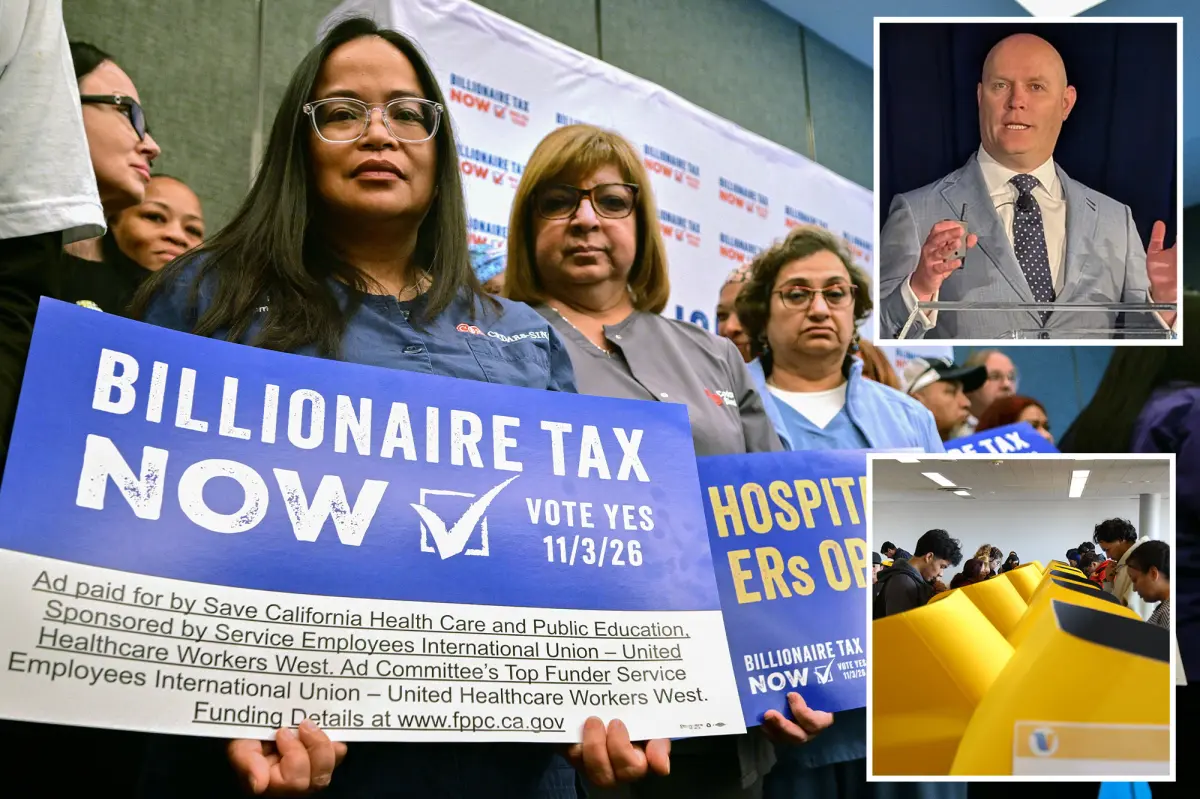

California voters have rejected a billionaire tax, but the debate over how much the wealthy should contribute is already heading toward another potential showdown.
Dustin Corcoran, CEO of the California Medical Association, is considering a 2028 ballot initiative to revamp the state’s income-tax system, Politico reported. The proposal could give affluent Californians another major tax fight just two years after voters defeated Proposition 40.
This time, Corcoran is seeking a broader coalition and wants any new revenue directed across health care, education and workforce development.
The proposal is still in its earliest stages. No tax rates or revenue projections have been released, but Corcoran says the defeat of the billionaire levy does not necessarily signal that Californians oppose asking the state’s richest residents to pay more.
“Californians’ rejection of Proposition 40 reflects the shortcomings of the measure itself, not a lack of support for addressing wealth inequality and ensuring the wealthiest Californians pay their fair share,” Corcoran told Politico.
Proposition 40 proposed a one-time tax equal to 5% of billionaire wealth. The measure failed by a vote of 52.8% to 47.2% after the Associated Press called the race on Nov. 9.
Backers estimated the tax could generate about $100 billion, with most of the money earmarked for health care. Critics countered that the plan could undermine the very public services its supporters hoped to strengthen.
“Proposition 40 risked California’s economic competitiveness and fiscal stability, as well as the revenue we rely on to fund our top priorities — from education and health care to public safety and infrastructure,” an opposition group told the Los Angeles Times.
The dispute over how to replenish California’s coffers could set up multiple tax measures for the 2028 ballot, triggering a contentious fight among organizations that agree the state needs more funding but differ sharply over the best approach.
Corcoran criticized the coalition assembled for Proposition 40 and said he is speaking with potential partners in health care, education and organized labor, according to Politico.
His concept would overhaul California’s current income-tax structure, potentially by changing the state’s tax brackets. He is also evaluating other options while building support and refining the plan.
Unlike Proposition 40, which sought to tax accumulated wealth, an income-tax overhaul would focus on earnings. Still, the union that backed the failed initiative has no intention of abandoning its campaign.
KEEP READING: Danielle Lopez’s Remains Found 2½ Years After She Vanished in NJ
Dave Regan, president of Service Employees International Union-United Healthcare Workers West, said the union will return with another tax proposal if lawmakers do not identify new revenue to cover rising costs.
“That’s not a hypothetical,” Regan told reporters. “That is our plan.”
Regan also rejected Corcoran’s criticism that Proposition 40 failed to attract a sufficiently broad base of support.
Suzanne Jimenez, Regan’s chief of staff, cited backing from dozens of labor and community groups, including the California Nurses Association and the California Federation of Labor Unions.
She argued that opponents had not presented a credible alternative to replacing an estimated $100 billion in federal health care funding cuts.
Gov. Gavin Newsom opposed Proposition 40, warning that the measure could drive wealthy residents and technology founders out of California.
The opposition campaign also benefited from substantial financial support from Google co-founder Sergey Brin, former Google CEO Eric Schmidt and Palantir co-founder Peter Thiel.
Voters added another obstacle for future wealth-tax efforts by approving Proposition 42, which prohibits new taxes on assets.
Corcoran told Politico that if his proposal ultimately goes beyond changes to income taxes, it may need to include language repealing that restriction.
For now, organizations that support raising additional revenue are withholding firm commitments while the details remain unsettled.
Jodi Hicks, CEO of Planned Parenthood Affiliates of California, which opposed Proposition 40, told Politico that it is too soon to endorse a particular 2028 initiative. She said a wealth tax remains part of the broader discussion.
No finalized alternative has emerged, but the next California tax campaign is already beginning to take form. Proposition 40 may be over, yet its defeat could prove to be only the opening round in a longer fight over how the state’s wealthiest residents should be taxed.


