
Former State Department official warns of escalating Spain-Morocco border crisis
Former State Department Foreign Service Officer Simon Hankinson joins ‘Fox & Friends Weekend’ to examine dramatic footage showing thousands of Moroccan migrants storming Spain’s border in Ceuta. Hankinson says Morocco has used sudden migrant surges as a hybrid pressure tactic in disputes with Spain. He also discusses the broader geopolitical implications as Spanish forces move to secure the frontier.
Six years after President Donald Trump recognized Moroccan sovereignty over Western Sahara, a senior regional official says the long-running territorial dispute has entered a new phase. Negotiations are now centered on how Morocco’s autonomy proposal could be carried out following the end of the United Nations peacekeeping mission.
Sidi Hamdi Ould Errachid, president of the Laâyoune–Sakia El Hamra Regional Council, told News Outlet in an exclusive Zoom interview that Morocco remains willing to negotiate with other parties. He also suggested that opposition to the proposal would not necessarily stop Morocco from implementing it.
“The Moroccan side remains open to international engagement, and we are prepared to negotiate how the autonomy proposal will be implemented,” he said through an interpreter.

Sidi Hamdi Ould Errachid, right, president of the Laâyoune–Sakia El Hamra Regional Council, stands with members of a U.S. medical delegation visiting Western Sahara. The visit was part of efforts to deepen American-Moroccan cooperation in healthcare, medical education and research. (Fox News)
Asked what would still need to be negotiated with the Polisario Front, which advocates independence for Western Sahara, Ould Errachid said Morocco plans to continue pursuing its autonomy initiative even if the parties fail to reach a comprehensive agreement.
“If the other parties do not agree, we will continue implementing the autonomy proposal on the ground,” he said through the interpreter.
His comments followed Russia’s veto of a U.S.-drafted Security Council resolution on Oct. 30, blocking the renewal of the U.N. Mission for the Referendum in Western Sahara, known as MINURSO. A separate Russian proposal also failed, and the mission began winding down on Nov. 1.
MINURSO was created in 1991 to help organize a referendum on the territory’s future after Morocco and the Algeria-backed Polisario Front agreed to a ceasefire. The vote never occurred, leaving the dispute unresolved.

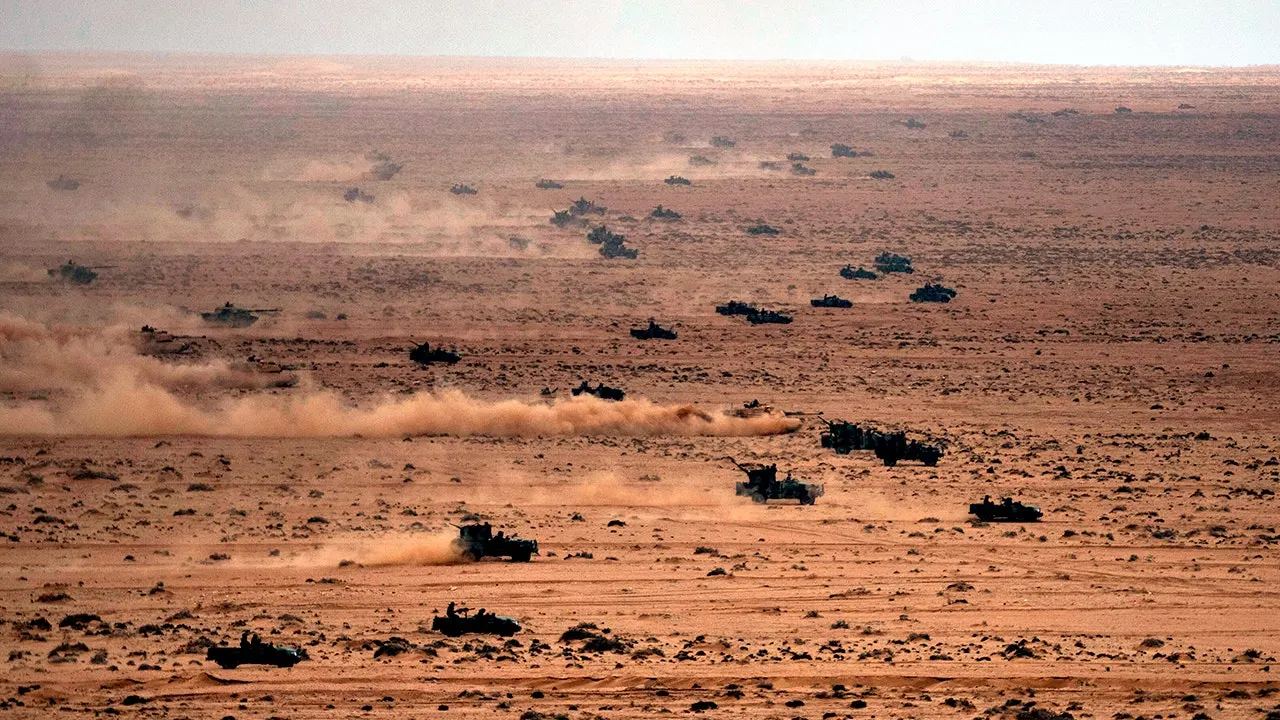
U.S. and Moroccan forces take part in the 20th edition of the African Lion military exercise in Tantan, south of Agadir, Morocco, on May 31, 2024. (Mosa’ab Elshamy/AP)
The United States recognized Morocco’s sovereignty over Western Sahara in December 2020 under Trump. His administration reaffirmed that position in July 2026.
In October 2025, the U.N. Security Council approved Resolution 2797, naming Morocco’s autonomy proposal as the basis for negotiations while preserving the objective of a mutually acceptable political settlement that provides for Sahrawi self-determination.
Ould Errachid, a Sahrawi politician raised in Laâyoune who took part in U.N.-sponsored negotiations in Geneva in 2018 and 2019, presented the autonomy plan as a way for Sahrawis to manage their own affairs.
“Except for the king, the Moroccan flag, the currency, the armed forces and foreign affairs, we would have full autonomy to manage our own affairs,” he said.
MORE STORY: Undercover at Stores Selling Opioid-Like Legal Highs
When asked whether the U.N. mission’s departure could threaten stability, he dismissed the concern.

Pro-Sahrawi activists hold Western Sahara flags during a demonstration on Dec. 4, 2010, at a Moroccan fair in Malaga, Spain. (Jorge Guerrero/AFP via Getty Images)
“We are not worried. We have a credible project that guarantees a decent future for our people and for our cousins in the Polisario Front,” he said.
The Polisario Front, which calls for independence, rejects Moroccan sovereignty over Western Sahara. Human Rights Watch warned in March 2026 that negotiations focused solely on Moroccan autonomy could undermine the Sahrawi people’s right to self-determination.
Alongside the political dispute, Ould Errachid is working to turn Washington’s support into stronger economic ties by encouraging U.S. companies to invest in renewable energy, manufacturing, agriculture, water desalination and healthcare.

A security guard stands watch during a meeting between U.N. envoy to Western Sahara Staffan de Mistura and Polisario Front officials in Tindouf, Algeria, on Jan. 15, 2022. (Ramzi Boudina/ Reuters)
He credited Trump with the 2020 recognition of Moroccan sovereignty and pointed to a major highway linking Morocco and Western Sahara that has become associated with the former president’s name.
“Nobody here will ever forget the moment President Donald Trump decided to support Morocco. His decision will remain engraved in the history of this region,” he said.
Medical cooperation is one visible example of growing U.S. engagement. Laâyoune hosted American medical delegations in February 2025 and October 2026, bringing U.S. specialists together with Moroccan physicians and students.
The first visit led to a partnership agreement between New York’s St. Francis Hospital & Heart Center and hospitals in Laâyoune. The second produced agreements between Laâyoune’s Faculty of Medicine and Pharmacy and two U.S. organizations, Celenova Fertility and the Fetal Research Fund.
Organizers said the partnerships are designed to expand medical education, research, student exchanges and access to specialized care.

The Morocco-Algeria border, closed since 1994 because of political disputes largely tied to Western Sahara, is seen from Algeria on Jan. 29, 2026. Tensions between Morocco and the Algeria-supported Polisario Front have persisted since Morocco annexed Western Sahara, formerly a Spanish colony, in 1975. Morocco maintains that the territory should remain under its sovereignty, while the Polisario Front claims Western Sahara as an independent state. (Hamza Zait/Anadolu via Getty Images)
Ould Errachid said he plans to conduct additional outreach to U.S. investors in February or March, with the goal of extending cooperation beyond healthcare into other areas of the economy.
“We need your help,” he said, describing Western Sahara as a possible gateway for American companies pursuing opportunities in African markets.


