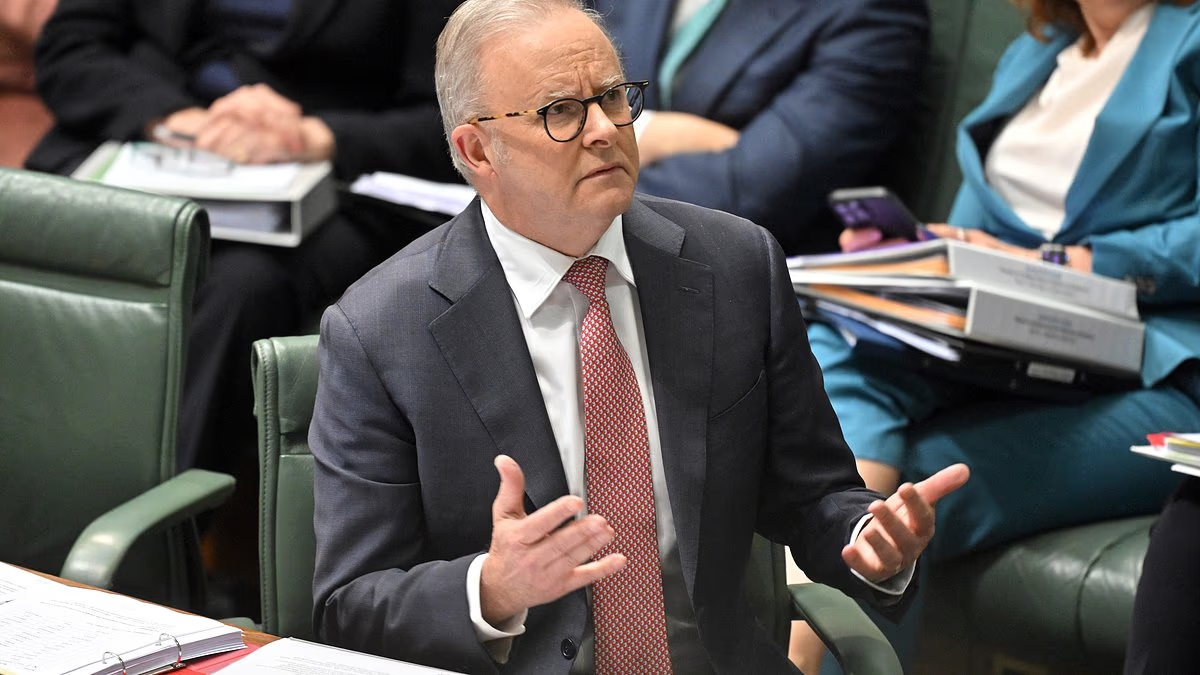
All visitor visas will carry a “no further stay” condition under a government crackdown on people using tourist visas to extend their time in Australia.

Labor has announced a major overhaul of Australia’s migration system that would prevent international students from automatically bringing family members, reduce access to extended working holiday visas and make it more difficult for temporary migrants to stay by repeatedly changing visa types.

The reforms will also target students who switch courses to extend their stay, impose tighter conditions on visitor visas, crack down on questionable protection claims and strengthen enforcement against people who remain after their visas expire.

The revamped system will give priority to migrants with skills the government considers essential to Australia’s needs.

Visa applications from workers in critical fields—including healthcare, construction, education, law enforcement, defence, resources, agriculture, aquaculture and fishing—will be fast-tracked.

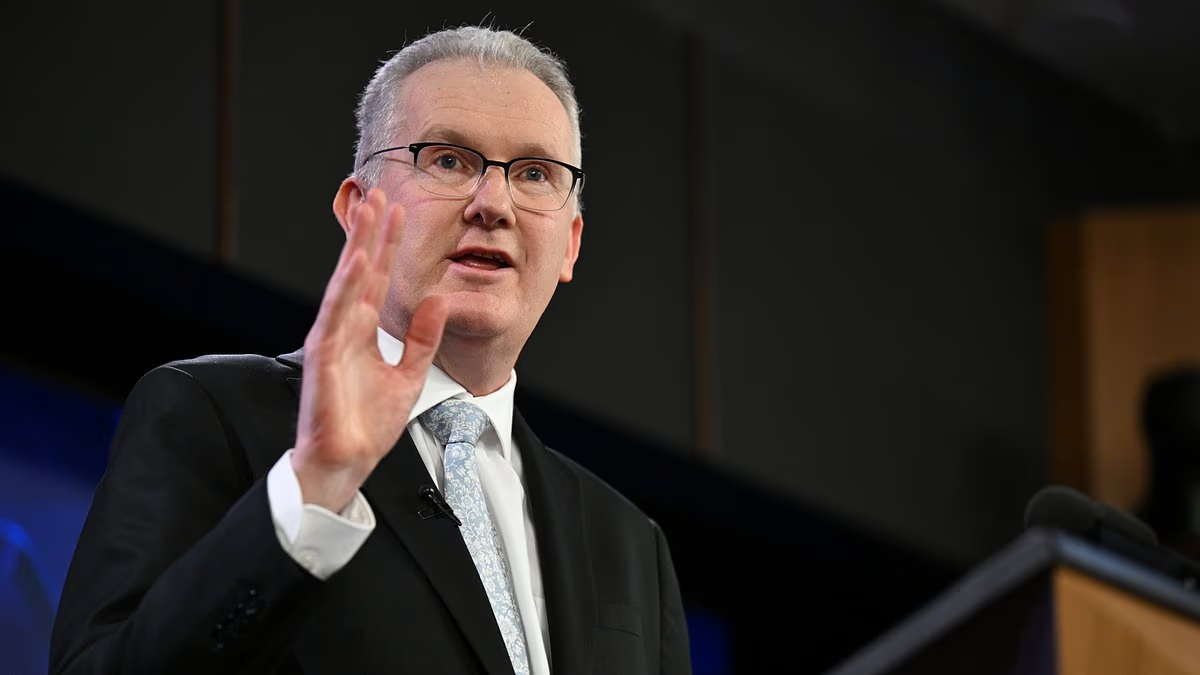
Home Affairs Minister Tony Burke outlined the measures at the National Press Club on Thursday, cautioning that an overly sharp reduction in migration could harm the economy.

‘The times that we’ve had massive reductions too far in immigration have coincided with the worst economic times in Australia’s history. We need to be careful with it, and I’m being careful with it.’

Mr Burke said the government wanted to establish a clearer divide between temporary and permanent migration pathways.

‘If you want to come on a temporary basis to Australia, apply for a temporary visa. If you want to come to Australia permanently, apply for a permanent visa. And if you no longer have a valid visa, you should leave Australia,’ he said.

All visitor visas will carry a “no further stay” condition under a government crackdown on people using tourist visas to extend their time in Australia.

As part of the crackdown on tourists using visitor visas to extend their stay, all visitor visas will include a ‘no further stay’ condition.

Anthony Albanese's government has announced major migration changes as Pauline Hanson's popularity surges

Anthony Albanese’s government has unveiled major migration reforms as Pauline Hanson’s popularity continues to rise.

In one of the most significant changes, international students and graduate visa holders will no longer automatically be permitted to bring family members to Australia.

‘For international students, we will no longer be allowing the attaching of family members for international students or for graduate visas,’ he said.

The new rules will not apply to partners or relatives who are already in Australia under an existing visa.

Working holiday-makers will also face stricter requirements if they want to remain in Australia for a second or third year.

Backpackers who complete the required regional work will no longer automatically qualify for another working holiday visa. Instead, eligible applicants will be selected through a ballot.

The number of second-year visas will be capped at 45,000, compared with about 57,000 people who qualified last year.

The cut will be much sharper for third-year visas, with just 5,000 places available, compared with about 31,000 people who qualified last year.

‘Not everybody will get through because we need to have some control and certainty of what those numbers are.’

Visitor visas will also be tightened to prevent people entering Australia as tourists and then switching to another visa while onshore.

At present, a visitor can apply for another visa after arriving in Australia and potentially remain on a bridging visa while that application is processed.

Burke said the practice had contributed to visa-hopping and made authorities more reluctant to approve some genuine visitor visa applications.

Under the new system, many visitor visas will carry a ‘No further stay’ condition, generally preventing holders from applying for another visa while they remain in Australia.

International students will also be prevented from repeatedly moving between courses at the same or lower qualification level in an attempt to extend their stay.

‘You can go up the qualification scale, but only up the qualification scale,’ he said.

‘So, at the end of a bachelor degree, if you want to then do a master’s, that’s up the scale, that’s ok.’

Burke suggested Australia was often retaining migrants without the skills the country needed, with the government set to give greater weight to skilled tradespeople

Burke suggested Australia was often retaining migrants without the skills the country needed, with the government set to give greater weight to skilled tradespeople 

Burke said the government was targeting cases where students finish one course before enrolling in another, often cheaper or lower-level qualification primarily to remain in Australia and work.

‘One of the classic areas of Visa hopping is people finish a course, hop to the next course, hop to the next,’ he said.

He said some students were moving to questionable education providers that offered cheaper courses with minimal attendance requirements.

‘Study with me. It will cost you less. We’re not very demanding on whether you attend anything. And you’ll be able to go for your life and get out there and work.’

The government is also planning a crackdown on what Burke described as disingenuous protection claims lodged by temporary migrants who have exhausted other options for remaining in Australia.

He said some applicants were being encouraged to lodge asylum claims despite having little prospect of success because the appeal process could allow them to continue living and working in Australia for years.

‘Put one in anyway and you’ll be able to wait out the appeal system, wait out the court system, you might get up to nine years working in Australia.’

Migration agents who encourage clients to lodge bogus claims could also face sanctions or deregistration.

Albanese Government Unveils Sweeping Migration Policy Changes

Burke suggested the wrong type of migrants were often staying, and the government will give greater weight to migrants with a trade 

The government will also ramp up enforcement against visa overstayers, with Burke seeking to revive the approach used before 2015 of directing people whose visas have expired to leave Australia and potentially detaining those who refuse.

An additional 100 compliance officers and 250 detention beds will be added to support the crackdown.

The government is examining existing facilities near airports as well as the former Melbourne quarantine facility for additional detention capacity.

Despite the crackdown, Burke rejected claims Australia was experiencing mass migration.

‘There are parts of the world where mass migration is something that they are dealing with. It is not something we’re dealing with in Australia,’ he said.

‘There was a peak post-pandemic, which was too high. There are reasons why it was too high and reasons why, logically, there was always going to be a peak.’

Burke also defended immigration as critical to the Australian economy, arguing that both regional communities and major cities relied heavily on overseas workers and international students.

‘It is true that immigration is critical to the economy of our regions. It is also true that immigration is critical to the economy of our cities as well,’ he said.

Anthony Albanese's government has announced major migration changes as Pauline Hanson's popularity surges

Anthony Albanese’s government has announced major migration changes as Pauline Hanson’s popularity surges

He said international education supported jobs far beyond universities, including cleaners, maintenance workers and businesses.

‘There’s a whole section of the economy in the cities that is only there because we have an important export industry in international students,’ Burke said.

‘Drastic cuts, wherever you make them, hurt the economy in every part, in every area.

‘We talk about the need for extra housing. It’s pretty hard to get a house built without having a plasterer involved.

‘In both Sydney and Melbourne, close to two-thirds of the plasterers we have were born overseas.

‘We need immigration. We just need to make sure that it is targeted to Australia’s needs, both in terms of numbers and across the different categories that work for our economy.’

Burke suggested the wrong type of migrants were often staying. 

‘There are individuals who would never, in fact, meet the qualifications to be able to become a permanent resident, and effectively jump from visa to visa, use the appeals process to be able to stay here as long as possible,’ he said.

‘It eventually becomes absurd not to just let them stay because, at that point, they have Australian-citizen children and, at that point, they are so integrated into a local community.’

Burke also rejected claims Australia’s housing shortage was primarily caused by immigration, arguing that falling household sizes had played a major role.

‘Housing, and the housing shortage we have, is not caused by immigration.

‘Anyone who looks at the migration program and wants to somehow say it was their fault, no. Australians have made a decision about how many people they want per household.’

WHO GOES: Labor ramps up enforcement on visa overstayers

The Albanese government is targeting people who remain in Australia after their visas have expired, arguing the migration system needs clearer consequences for those who no longer have a legal right to stay.

The policy is also aimed at people who have used successive visa applications, appeals or non-genuine protection claims to delay departure for years.

Burke said the government wants to return to a system where overstayers understand they will ultimately be required to leave, creating a stronger incentive for people to depart voluntarily when they lose their legal status.

Burke addresses One Nation’s sweeping plans

Earlier this week, Pauline Hanson unveiled a plan to cut Australia’s temporary migrant population by about 750,000 over three years, with international students among the groups most affected.

Under the proposal, net overseas migration would be driven below zero during a three-year ‘reset’ before being permanently capped at 130,000 people a year.

That compares with Labor’s forecast of 245,000 net overseas arrivals this financial year and 225,000 the following financial year.

One Nation Leader Pauline Hanson at a press conference at Parliament House in Canberra, Thursday, September 17, 2026. (AAP Image/Mick Tsikas) NO ARCHIVING

Asked how the Albanese government could defend higher levels of migration during his speech to the National Press Club, Home Affairs Minister Tony Burke said One Nation’s lower migration figures would ‘trash’ the economy.

‘Imagine half of the construction workers who we have to build the houses that we need, not coming,’ he said.

‘Imagine two-thirds of the people who we rely on in aged care or nursing not coming. That’s the impact of those policies.’

But Burke acknowledged that Australians are worried by lengthy queues at rental property inspections.

‘We have a shortage of homes and people want to make sure that we guide the immigration system so that we soften our numbers to be able to allow housing to catch up,’ he said.

Embeded Article Preview Image

WHO STAYS: Labor tightens pathways to remain in Australia

Under Labor’s migration changes, people who are most likely to be allowed to stay in Australia are:

  • Skilled workers in areas of labour shortage, including construction, agriculture, teaching, resources and fisheries.
  • Genuine international students, although most new students will no longer be able to bring family members with them.
  • PhD students and some specialised student cohorts, who will continue to have access to family provisions.
  • Pacific and ASEAN visa holders covered by special arrangements.
  • People with genuine asylum claims, with Burke stressing Australia remains committed to its refugee protection system.
  • Migrants who qualify for permanent residency through established pathways, rather than through repeated temporary visa applications or appeals.

Burke’s blunt warning to visa overstayers

Tony Burke has issued a blunt warning to overstayers as he announced the Albanese government will hire an additional 100 compliance officers and expand detention capacity.

He told the National Press Club that, before 2015, visa overstayers who failed to leave voluntarily could be placed in detention for short periods before arranging their departure from Australia.

‘We need, with the integrity of the program, to make sure that we can go back simply to what we did before 2015. No more, and no less,’ Burke said.

‘If you want to come on a temporary basis to Australia, apply for a temporary visa.

‘If you want to come to Australia permanently, apply for a permanent visa. And if you no longer have a valid visa, you should leave Australia.’

The Home Affairs minister announced plans for an additional 100 compliance officers as well as an additional 250 beds in detention centres.

Melbourne’s former quarantine facility could also be repurposed to support the initiative.

Burke said the changes were not intended to mirror mass deportation programs seen overseas, such as those under the Trump administration in the US.

Instead, they aim to restore consequences for people who remain in Australia unlawfully.

Burke targets ‘disingenuous’ asylum claims and migration agents

Tony Burke said the Albanese government wanted to crack down on people using Australia’s asylum system to prolong their stay despite, he argued, having little prospect of being granted protection.

Burke stressed Australia remains committed to protecting genuine refugees and asylum seekers, describing a functioning protection system as ‘critically important’.

‘Australia does support a legitimate asylum system,’ Burke said.

‘What there is no community support for, and I certainly have no time for, is when someone gets to the end of their visa hopping and they know they don’t have a legitimate protection claim.’

Burke argued some applicants are being advised to submit asylum claims regardless, allowing them to remain in Australia while appeals and court processes play out.

‘They get advised, “Put money in anyway and you’ll be able to wait out the appeal system, wait out the court system, you might get up to nine years working in Australia”,’ Burke said.

The Home Affairs minister said applicants from countries where more than 85 per cent of protection claims are ultimately rejected now make up around 80 per cent of the department’s caseload.

Australian Minister for Immigration and Citizenship Tony Burke addresses the National Press Club in Canberra, Thursday, September 17, 2026. (AAP Image/Lukas Coch) NO ARCHIVING 16137813

Burke also declared the the Albanese government will tackle migration agents who encourage people to lodge weak or non-genuine visa claims in order to stay in Australia longer.

‘We’ll be changing the code for migration agents,’ Burke said.

‘Migration agents who encourage the exact sort of behaviour of non-meritorious claims that I just described will be able to be sanctioned and will be able to be deregistered.

‘It’s something that should have happened some time ago.

‘We cannot have people with some sort of official, formal status using that official formal status to encourage people to make something which, by any definition, is an unacceptable use of the system.’

PETER VAN ONSELEN: ‘Forecasts aren’t worth the paper they’re written on’

‘Tony Burke claims it is “absurd” that “Australia is a nation of mass migration”,’ Peter van Onselen, Politics and Economics Editor for Daily Mail Australia, writes.

‘He cites “one simple fact”. The intergenerational report handed down before the pandemic forecast that our population by 2030-31 would be 700,000 larger than it’s now predicted to be.

‘First up, that’s if you believe those projections. How often does the government get its forecasts right?

‘Secondly, here is a simple fact for the minister that’s already happened.

‘In 1998 the ABS forecast the Australian population come 2051 would land somewhere between 23.5 and 26.4 million.

‘What is the current Australian population? It moved above 28 million in the middle of this year, 25 years before it was forecast to hit somewhere between 23.5 and 26.4 million. Why? Because of mass migration.

‘So, believe Burke if you want to. I don’t think his forecasts are worth the paper they are written on. And his claim that was aren’t a nation of mass migration is utterly absurd.’

Labor’s new backpacker ballot system: ‘Not everyone will get through’

The Albanese government will introduce a new ballot system for non-British backpackers seeking to stay in Australia beyond their first working holiday visa.

Burke said backpackers would still need to complete the required regional work to qualify for additional years, but eligibility would no longer guarantee approval.

‘To qualify for your second year, you have to do 88 days in the regions. To qualify for your third year, you have to do six months. That won’t change,’ Burke said.

‘What you will be qualifying for is a ballot. Not everybody will get through because we need to have some control and certainty of what those numbers are.’

Under the changes, second-year working holiday visas will be capped at 45,000 places. Burke noted that 57,000 backpackers qualified for a second-year visa under the existing system last year.

The cap will be lower for third-year visas.

‘We will be seriously limiting year three down to a ballot system of 5,000,’ Burke said.

‘Last year, there were 31,000 in this group. That will only become 5,000 places.’

Burke said applicants would still be required to complete regional work before entering the ballot, ensuring the incentive for backpackers to work in regional Australia remains in place.

Crackdown on international student family visas

The Albanese government will introduce restrictions on international students bringing family members to Australia.

‘If you’re an Australian citizen, and your partner is not an Australian citizen and they live overseas, and you put in an application for them to come here, you have to wait quite some years,’ Tony Burke said.

‘At the moment, if you’re an international student and you want to come here with your partner, you get them right from the start.’

Under the changes, new international students and graduate visa holders will generally no longer be able to attach family members to their visas.

‘For international students, we will no longer be allowing the attaching of family members for international students or for graduate visas,’ Burke said.

The government has stressed the policy will not apply retrospectively.

‘Anyone who already has their family that are attached to a visa and is already here, we’re not going to be breaking up families onshore,’ Burke said.

Exceptions will remain for some groups, including students from Pacific and ASEAN countries, as well as certain higher-level courses such as PhDs.

Burke: British backpacker visas will take longer to process

Tony Burke said the Albanese government was monitoring an increase in British working holiday-makers, with the number of backpackers in Australia more than doubling in recent years.

Visa processing priorities will be changed, he said, with slower processing times for UK working holiday-maker applications introduced.

Burke said the increase followed the Australia-UK Free Trade Agreement, signed in 2023, which removed regional work requirements for British backpackers seeking to extend their stay.

‘At the time that the free trade agreement was signed, the number of UK backpackers we had here in Australia was in the order of 17,000,’ Burke said.

He noted that, even before the pandemic, numbers typically peaked at around 35,000.

‘It’s now just shy of 80,000 in terms of the number of people here in Australia,’ Burke said.

The minister said the government would continue prioritising working holiday-maker applications from visa holders completing regional work, while UK applicants would remain subject to standard processing arrangements during discussions with Britain.

Immigration not to blame for the housing crisis, Burke says

The Home Affairs minister rejected claims migration is responsible for Australia’s housing crisis, arguing the housing shortage is driven by changing household sizes rather than population growth alone.

‘Housing, and the housing shortage we have, is not caused by immigration, but immigration needs to be part of the solution for the housing crisis,’ Tony Burke said.

‘If you go back to the Hawke Government … the number of people in Australia has increased by 75 per cent. The number of homes has increased by 100 per cent.

‘So, how on Earth did we end up with a housing problem?’

Burke claimed the answer lies in Australians choosing to live in smaller households.

He said the average number of people per household has fallen from 2.9 during the Hawke era to 2.5 today, creating demand for hundreds of thousands of additional homes.

‘Every time we get a 0.1 change in the number of people per household, we have to find an additional 450,000 homes,’ he said.

Panoramic Aerial Drone view of Inner Western Suburbs of Sydney housing, roof tops, the streets and the parks, the roads and trees of Ashbury Ashfield Burwood Summer Hill Canterbury and Campsie in Sydney NSW Australia; Shutterstock ID 2742249345; purchase_order: -; job: -; client: -; other:

Burke said Australians have every right to decide how many people they live with, but argued this trend means migration cannot be blamed for the housing shortage.

‘Anyone who looks at the migration program and wants to somehow say it was their fault, no,’ Burke said.

Instead, he argued immigration should form part of the solution by helping boost the workforce needed to increase housing supply and allow construction to catch up with demand.

He said post-pandemic shifts in living arrangements had intensified pressure on the housing market, further increasing the need for new homes.

Albanese government admits it must deal with ‘visa hopping’

Tony Burke claimed the government needed to crack down on ‘visa hopping’, which he argued allows people to stay in Australia for years despite having no realistic pathway to permanent residency.

He said a small number of migrants are able to ‘jump from visa to visa’ and use the appeals system to prolong their stay.

‘There is a problem with visa hopping,’ Burke said.

Burke said some individuals who would ‘never, in fact, meet the qualifications’ for permanent residency are able to remain in Australia for extended periods before becoming deeply connected to their communities.

He argued this can create situations where governments are reluctant to remove people because they have Australian-citizen children and have spent years building their lives in Australia.

‘We need immigration’: Tony Burke

Tony Burke told the National Press Club that migration remains essential to Australia’s economy, warning that deep cuts would have consequences far beyond major cities.

‘We need immigration,’ he said.

‘We just need to make sure that it is targeted for the needs of Australia in numbers and across the different categories that work for our economy.’

The Home Affairs minister said immigration supports businesses, jobs and industries across both regional and metropolitan Australia.

He added that the benefits extend beyond universities, supporting workers in areas such as maintenance, cleaning, hospitality and retail.

‘Drastic cuts, wherever you make them, hurt the economy in every part, in every area,’ Burke said.

But he also linked migration to challenges in Australia’s housing market, noting many of the workers needed to build new homes were born overseas.

He said close to two-thirds of plasterers in Sydney and Melbourne were migrants.

Leave a Reply

Your email address will not be published. Required fields are marked *

You May Also Like

Don Jr. and Bettina Trump’s Pre-Wedding Cosmetic Enhancements Revealed

Donald Trump Jr. appeared to undergo a pre-wedding makeover ahead of his…

Albanese Government Rejects Australia Mass Migration Claims

Tony Burke finally appeared at the National Press Club this afternoon to…

Houthis Claim Mecca Drone Strike, Down Saudi Fighter Jet

The Houthis have been accused of sending a drone towards the holy…

Father Pleads for Help Finding Missing 3-Year-Old Noah

The father of missing three-year-old Noah Woods has urged the public to…

Hayden Panettiere’s Ex Brian Hickerson Addresses False Death Rumors

Brian Hickerson, Hayden Panettiere’s on-and-off boyfriend, has spoken publicly about the actress’s…

EU Faces Backlash Over Canada Associate Member Proposal

Brussels faced an angry backlash today after unveiling unprecedented plans for Canada…

VIDEO: Shocking Articles of Impeachment Introduced by Thomas Massie!

Thomas Massie is making headlines with the introduction of Articles of Impeachment…

VIDEO: Shocking FBI Findings: No Co-Conspirator in Butler Assassination At…

FBI Director Kash Patel reveals that investigators analyzed 27 devices connected to…

Seattle Mayor Reverses Course on Pledge to Move Homeless People Off Streets

Seattle Mayor Katie Wilson has scaled back a campaign pledge to ensure…

Third Victim Identified in Fatal Los Angeles Helicopter Crash

A Guatemalan man who had arrived in Los Angeles only two days…

Woman Arrested for Murder After Deadly Los Angeles Bus Crash

The driver accused of causing the fatal bus crash that killed two…

VIDEO: Shocking Helicopter Crash During Live News Coverage!

In a dramatic turn of events, an NBC Los Angeles news helicopter…