
It is evening at our farmhouse, and I am eating dinner with my husband and our teenage daughter. As usual, he has cooked: shepherd’s pie followed by apple crumble and custard. I will load the dishwasher, while our daughter wipes down the table.
From the outside, it could be any ordinary Sunday evening. In reality, my husband and I divorced three months ago, our daughter is receiving treatment for anxiety, and I have been more than a year into a new relationship that makes me feel accepted, joyful and loved. It also leaves me overwhelmed by guilt.
The situation feels so painful that, during dinner, I want to escape the kitchen. As I pass the family photographs on the wall, including the picture from our wedding day with its cracked glass — damaged when I threw it at him — I feel an urge to punch myself in the face.
For now, we are forced to remain under the same roof while we try to sell the house in a stagnant property market.
Neither of us can afford to rent somewhere else, so we continue to follow the familiar routines of our former life, even as we both desperately want our freedom.
I retreat to the marital bedroom, which overlooks the garden. My wedding dress hangs in the cupboard in tatters. I tore it apart, but I still cannot bring myself to throw it away.
My husband sleeps in a tiny pink room at the back of the house, furnished with a single bed and our daughter’s old, childish bedding. She has since moved into a larger room with more grown-up sheets, but he has not.
I offered him the bigger spare room, but he refused. I take that rejection personally, treating it as proof that he does not want to be happy — and perhaps never did. I convince myself that he wants nothing pleasant for himself or for anyone else.

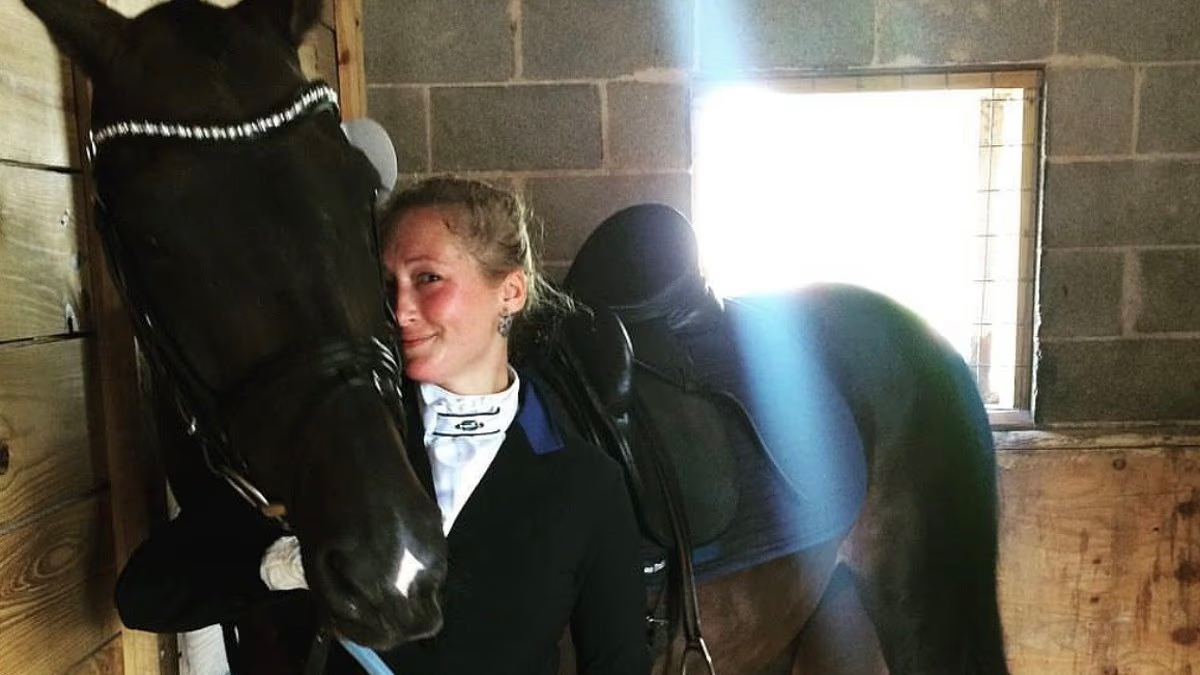
We cannot afford to rent separately, so we remain living together, writes Pippa Richmond (picture posed by models)
I switch off my light and read on my phone in the darkness, hoping he will not come in to talk when he goes upstairs. He used to do that in the early days of our separation. I try not to remember how excited we were when we bought this house ten years ago — the hopes we shared and the plans we made. Nor do I want to think about how our marriage unravelled, first gradually and then all at once.
We had known each other at university, when I was reckless and he was quiet. But we did not marry until we were both in our mid-30s.
Before then, I had been trapped in a disastrous affair with a married man. To be fair, I did not know he was married when we first began seeing each other, but once I discovered the truth, I still could not let him go. Eventually, I accepted that my longing for a baby would not disappear and that I had no future with him. Looking back, I think I wanted to prove that I could build a proper relationship with someone who would truly be there for me.
More than a decade after we had last seen each other, I ran into my future husband while shopping in central London. The first year together was wonderful. He was dependable, affectionate and funny. I overlooked the fact that he smoked despite having a heart condition and earned almost nothing as a freelance writer. I had a good job, and he intended to find one.
In what felt like extraordinary luck, I became pregnant very quickly. That was when our relationship began to deteriorate in earnest.
The birth was traumatic, and instead of supporting each other, we argued loudly on the hospital ward. The nurses were appalled, and I returned home feeling utterly shell-shocked.
In the first few years of our daughter’s life, I would scream at him, looking for a reaction, for anything – but he retreated into himself. He left the house looking like a bomb site every day, earned almost no money and spent compulsively. When I lost my good job in marketing, we were broke.
There were happy times with our daughter, of course, but that happy, functional life you dream of when you think of marriage – the thing you build together – never happened. We had lived on hope, and that had gone.
I retreated from him physically after the birth. I would lie beside him willing myself to reach out to him. But I couldn’t, and our marriage began to die.
We almost never had sex, because I felt he was a stranger. It was as if something was removed from me when I had our daughter.
Perhaps trying to paper over the cracks, we moved to the ‘dream house’ in the country. I took all the work I could find, and he didn’t work at all, though he looked for admin jobs.
I felt helpless and trapped but I swallowed those feelings. After all, where could I go, what could I do? I was in deep denial.
‘We have a great love,’ I told him, hugging him. I told myself that we had a beautiful house and a perfect child. Isn’t this love? So what if we don’t sleep together – ever? So what if I work all the time and you never? (He did have a job as an administrative assistant for a bit. But then he got into £15,000 of debt that year, as if to punish us for having something.) So, what if on quiet Sundays I want to scream that this cannot be my life?
I think we did a reasonable job of pretending in front of our daughter. She never noticed, or she pretended she never noticed, our unhappiness. We tried to keep our fights away from her, waiting until she went to school. So, when we broke up, it was much more of a shock for her.
He broke before I did. Three years ago, he came home, burst into tears and said he was in love with someone else. Why, I asked stupidly. ‘Because she wants me,’ he replied. He then told me they had been sleeping together.
My response was sequential: utter shock that he would do this to us all; terrible grief that it was over; then furious rage at his behaviour; then nothing much at all.
That kicked off two years of hell. He wanted us to stay together and said that we should ‘try’.
I was broken and agreed from shock. I couldn’t imagine having the gumption to do anything as powerful as leave. But he was always on the phone to her – even on my 50th birthday. He would tell me about it and call it honesty.

Pippa says there were happy times with their daughter, of course, but that happy, functional life you dream of when you think of marriage never happened
I cried every day as soon as our daughter left for school – for her, for myself and my broken dream of a perfect marriage, and for him. I wonder now if I had ever really loved him as he wanted or deserved to be loved.
We never talked about our feelings; it was too painful.
After a few months, his affair petered out. He said he wanted us to stay together and it didn’t matter that we had no romantic life. I tried to reignite us by kissing him one night when he came home from the pub.
‘You’re taking advantage of me,’ he said, and pushed me away.
I was mortified, and felt gaslit: he was always saying my lack of lust killed our marriage.
We had separate rooms by then: I had moved into the box room days after he admitted the affair, and we swapped a few weeks later. When my daughter asked why, I put it down to my snoring.
The following year, my old boyfriend – the one who was married – got in touch. He begged me to meet him in London.
In a coffee shop, he told me he was separated. I felt a vague longing, but I walked away. I was no longer the sort of woman who was loved or made love to. So, I went back to my usual dead life. One day in spring 2025, besieged by emptiness, I followed my husband’s ex on Instagram. He went quiet for a few days. Then, on a Sunday – it’s always a Sunday, my day off – I could sense he was seething.
‘Go on. Out with it,’ I said.
‘She wants to know,’ he snapped. Then he shouted at me, sneering, ‘“Why is your f****** wife following me on Instagram?”’
All my remaining loyalty to our marriage drained away in that one moment. I was done: I knew he didn’t love me any more, if he ever did. Walking to the park, I telephoned my ex-boyfriend and told him that my husband had slept in the spare room for two years.
‘Your marriage is over,’ he said, before adding: ‘I don’t want to die without holding you in my arms again. And I promised myself that if you ever rang me again I would tell you that.’
‘That’s ridiculous,’ I stuttered, to which he simply replied: ‘It’s always been you.’
‘I wanted you so much it frightened me,’ I said.
He shot back: ‘What makes you think I don’t feel the same?’
Two weeks later, we met in London. I don’t really have words to describe my feelings, but I can say that, if true love lives anywhere, it lives in cheap hotels near Paddington Station. I laughed a lot and I cried a lot, and love songs made sense to me at last.
Last year was, as Dickens wrote, the best of times, the worst of times. I have never felt such an incredible combination of erotic charge and deep trust.

Pippa says she tells herself that all living under one roof is best for their daughter – meals and games and Saturday night television is bearable
I looked so happy the facial recognition software on my phone didn’t work and, on my monthly trips to London, we had so much sex I put my back out. With my husband, I had always felt like a woman doing penance: like I was being punished for some non-specific sin. Here I was known and forgiven.
But, of course, I would always have to go back, catching the train home like Persephone returning to the Underworld.
My boyfriend tried to cheer me up and keep me safe, as much as he could: he bought me pillows and a duvet to keep me warm at home. The guilt was terrible though. My husband has always made me feel like I am the cause of all his pain, and I have always struggled to disagree; and I have hurt our daughter.
Before I was reunited with my ex-boyfriend, I had told my husband that I didn’t want ‘to try’ any more. ‘I believe you when you say our romantic life is over,’ I said. ‘You can see other women. I don’t mind.’
A few months later, I told him I had someone else. ‘Is it him?’ he asked me. (He knew I left a married man to marry him.) Yes, I confirmed simply, to which he sighed.
My husband had two ways of being with me. The first is patient martyrdom. The second is silent rage. The first makes me feel like the worst person in the world; the second frightens me.
He was furious I had a boyfriend, which I didn’t really understand. I would scream at him: ‘What do you care what I do?’
I thought we could tell our daughter the usual story: it’s a mutual decision to separate, but we love you, and that will never change. But he wouldn’t give us that, instead making me take responsibility. When I was away, he told her I wanted to end the marriage, but he didn’t, yet he accepted my decision.
She rang me in tears, begging me to change my mind. ‘We’ve always been so happy,’ she sobbed, ‘Daddy wants you to stay.’ I told her, ‘I can’t’ – also in tears.
She is studying for her GCSEs, her grades have got worse and she has put on weight. I held her and told her I was sorry. But I cannot give her childhood back.
Mostly, she doesn’t talk about it, though she asked to see a therapist a few months ago, and I found her one. She goes once a week, but she doesn’t talk about that either. She has gone into herself, and I fear for her.
The day our divorce came through, I cried in my husband’s arms. I will always be grateful to him for letting me. Part of me cannot stop loving the part of him that is vulnerable and sweet and very young. But I also need someone who can take care of me, and that is not him. He cannot take care of himself.
I eventually told my daughter I have a ‘friend’ – I couldn’t say ‘boyfriend’ – because I don’t believe in secret lives. Now I wish I hadn’t. She doesn’t want details, and she doesn’t want to meet him. So my secret life goes on. It feels like part of my punishment.
To sell the house, we have lowered the price repeatedly, eventually cutting it by £150,000. Still we have few viewings.
Meanwhile, I slowly demolish the material structure of our marriage, as if by stealth.
I take pictures off the wall – the oils he bought on our honeymoon; the still life his godmother painted – and hide them. I throw out travel guidebooks for journeys we will never take now. I put the boardgames in a cupboard: we spent lockdown playing them, when I thought we would be together for ever.
I feel him watching me, noting it all down in some invisible ledger of my crimes against him.
We almost never fight now. There is nothing left to fight over… or for.
Sometimes I feel OK. I tell myself that all living under one roof is best for our daughter – meals and games and Saturday night television is bearable.
He says that if we sell, he will move away to find work, and leave me with sole custody as it is ‘less confusing’ for her. This made me weep with anger, because she needs him.
Sometimes I want to clutch my head and scream. I tell myself I am trapped here, that I will die here, he will never let me go.
I fear I will never have my new life, that the path before me – a pretty cottage in the West Country, visits from my boyfriend and his children – has disappeared.
My boyfriend tells me to be calm, that I can bear this. He is not going anywhere, he soothes, and I must be patient. There is no other option.
It is the start of autumn now: three years since my ex-husband’s affair, and a year since mine. I told myself I couldn’t do another winter in a rural farmhouse with him, but it seems I must. I will stack up the woodpile and wait for another spring.
Pippa Richmond is a pseudonym. Names and identifying details have been changed.