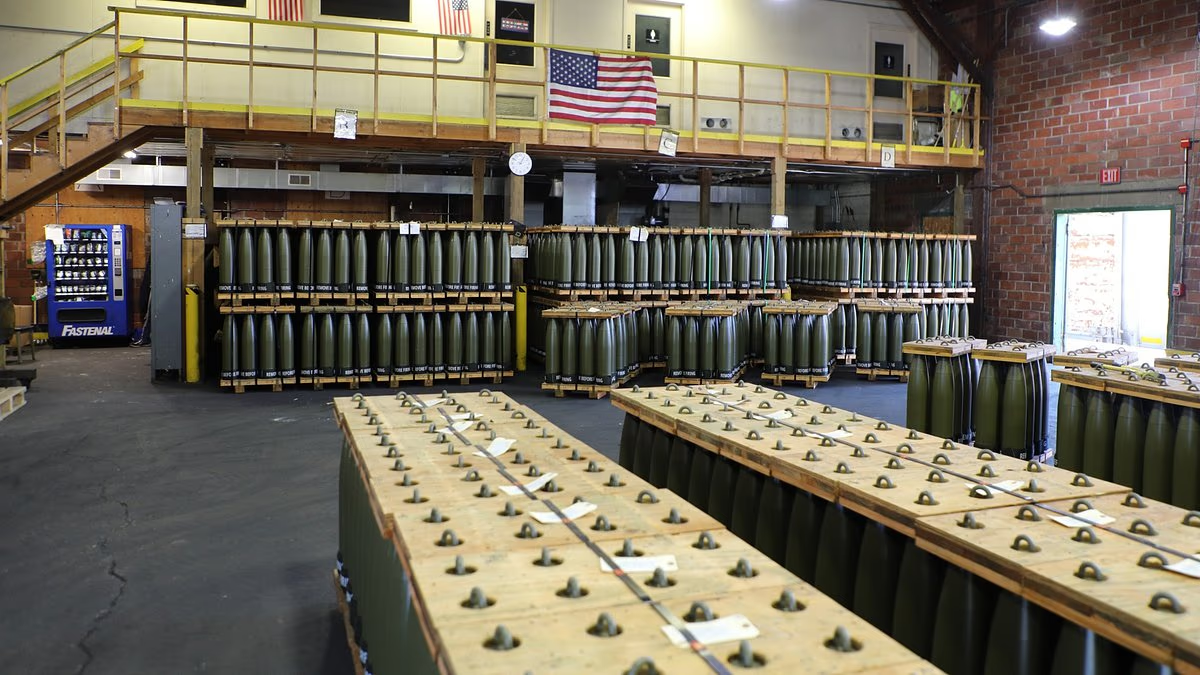
The Army is urging residents to remain indoors as it prepares a large-scale detonation in Iowa that could send toxic lead particles drifting across the region.
In a statement issued late Monday, the Army said the controlled blast would take place Wednesday at 9 a.m. at the Iowa Army Ammunition Plant near Middletown. The operation will destroy 68 barrels containing lead azide, with federal agencies offering what officials described as unanimous support.
A federal appeals court lifted a temporary injunction Monday, clearing the way for the Army to dispose of nearly 10,000 pounds of deteriorating explosives that officials say are now too unstable to transport.
Adam Telle, the Army’s acting secretary, said during a Tuesday news conference that “inaction is no longer an option.” He added that military personnel with extensive experience would carry out the blast after completing a series of rehearsals.
People living within 20 miles of the affected area are being advised to stay inside for as long as 48 hours after the detonation. Officials also recommend keeping windows and doors shut and minimizing the amount of outdoor air entering homes.
The most immediate risk is expected during the first hour, when anyone beneath the Army’s projected plume could be exposed to airborne contaminants. Precautions could continue through Thanksgiving, as residents remain uncertain about where lead dust may ultimately settle after Wednesday’s operation.
A plume forecast indicates that lead dust could travel about 46 miles southwest of the plant, reaching parts of southeastern Iowa and northeastern Missouri. Lead azide, a highly toxic compound used to initiate munitions, has been stored at the military facility for more than 20 years and poses dangers to both people and animals.
Court documents say changes in the liquid used to stabilize the compound allowed it to recrystallize inside its containers. That process increased the material’s sensitivity to shock and friction, raising concerns that it could detonate without warning.

The Army says it will conduct a controlled detonation Wednesday morning to destroy 68 barrels of lead azide at the Iowa Army Ammunition Plant near Middletown, after receiving support from federal agencies
The authorization came only hours after the federal appeals court rejected a petition from environmental groups seeking to stop the blast.
The ruling followed President Donald Trump’s decision to pause the operation and direct the Army to wait for approval from the court and Iowa’s incoming governor.
Telle wrote on X Monday night: “Every expert agency agrees, and both Iowa’s current and incoming Governors say the call belongs to the experts.
“We are proceeding with the controlled removal in full coordination with all state, local and federal authorities, because the safety of Iowa’s citizens comes first.”
The Army concluded in March that the stored lead azide had deteriorated and become unstable.
However, The New York Times reported that the military had previously canceled a contract for chemical neutralization and opted instead for a controlled detonation.
The Army initially hired MuniRem Environmental, a Georgia company that specializes in chemically neutralizing munitions, but terminated the contract two months later.
Officials have not publicly explained why the alternative plan was abandoned.

The controlled blast is intended to destroy unstable lead azide stockpiles stored at the Iowa Army Ammunition Plant
The operation, which has been postponed repeatedly, has sparked anger among residents, public officials and environmental advocates concerned about possible lead exposure, particularly in southeastern Iowa communities near Middletown.
Meteorologist Ryan Hall posted a plume forecast on X showing light winds Wednesday morning. He said the conditions would likely push the air southwest, “past Donnellson and into northeast Missouri.”
Forecasters expect the plume to remain active for at least six hours after the detonation.
The Federal Aviation Administration has imposed flight restrictions around Middletown from Monday through Wednesday, while Iowa Governor Kim Reynolds activated the state emergency operations center on November 20.
Officials in neighboring Illinois have also warned that airborne lead particles could affect communities across the state line.
Illinois Governor JB Pritzker said Sunday that he had discussed the operation with the Army, the EPA and other agencies. He said he was “continuing to press for the release of more public information to help keep Illinoisans safe.”
Wally Taylor, an attorney for the Iowa chapter of the Sierra Club, which joined the challenge to the EPA’s decision, said: “The Army has clearly mishandled this situation, and Iowans and residents in our neighboring states deserve a full review of all of the missteps that led us to this point.
“However, if detonation is now the only option, it is imperative that everyone impacted has access to the full range of testing, mitigation and remediation resources.”
Federal officials have cautioned that falling temperatures could make the material even less stable, increasing the threat of an accidental explosion if the operation is postponed again.
Military officials say the lead azide stored at the plant has recrystallized, leaving it more vulnerable to shock, friction and movement.
Transporting the stockpile to another facility could disturb the containers and trigger an accidental blast either on the road or near a more densely populated area.
The military routinely destroys aging explosives, but officials have classified this operation as an emergency because of the unusually dangerous condition of the lead azide.


