
Hello, I’m Priyanka Salve, reporting from Mumbai.
Welcome to the latest edition of “Inside India”—your guide to the key stories shaping the world’s fastest-growing major economy.
India’s Unified Payments Interface, the world’s largest payment system by transaction volume, helped make cashless payments mainstream by offering them free of charge. That model is now set to change. From next month, merchants will pay a 0.4% fee when they accept UPI payments above $20.
The government insists the change will not slow India’s shift toward a cashless economy. Critics, however, remain unconvinced.
Have feedback on today’s newsletter? Share it with our team.
The big story
India’s decision to introduce a merchant fee for its widely praised real-time payments platform, UPI, has triggered a heated national debate. The system has rapidly gained ground against international card networks such as Visa and Mastercard.
Critics question why merchants should now pay for a service the government once promoted as a “digital public good.” Political opponents of Prime Minister Narendra Modi have also alleged that New Delhi is responding to pressure from the United States.
The National Payments Corporation of India, which oversees the country’s retail payment infrastructure, said Tuesday that merchants will be charged 0.4% on UPI payments exceeding 2,000 rupees, or $20.84. For transactions above 75,000 rupees, the fee will be capped at 300 rupees per payment.
Person-to-person UPI transfers will remain free, NPCI said. The merchant charge is also significantly below the fees typically applied to card payments: about 0.9% for debit cards and between 1.5% and 2.5% for credit cards.
Bouquets and brickbats
Fintech companies have broadly welcomed the decision to impose a fee on merchant transactions.
“UPI’s success was built on zero-cost adoption by consumers, small shopkeepers and micro-enterprises, and the notified MDR framework preserves that foundation,” Girish Krishnan, Amazon Pay’s director of payment experience, told CNBC.
Kunal Shah, head of Meta’s WhatsApp Pay business, described the policy as a “great move forward.” Paytm, another leading digital payments provider, said the change would create an additional source of revenue from its merchant operations.
In 2020, the Indian government reduced the merchant discount rate—the fee businesses pay to accept UPI—to zero in an effort to accelerate digital payments. Since then, UPI’s transaction value has increased tenfold, reaching 213 trillion rupees over the roughly six years through January 2025.
“UPI made digital payments feel like cash for the user: instant, universally accepted, and free at the point of use,” the World Bank said earlier this year. That sense of effortless, cost-free payments is now poised to change, putting the government’s decision under renewed scrutiny.
Ashneer Grover, the former chief executive of Indian fintech company BharatPe, has condemned the new merchant charge. “Any levy on UPI is just tax collection,” he said.
India’s opposition Congress party has accused the government of privileging U.S. companies. It argues that the policy will result in money being “collected from the pockets of Indians to fill the coffers of American companies,” including PhonePe, Google Pay and Amazon. Some analysts also warn that the move could prompt consumers and businesses to return to cash.
Level playing field
UPI processed an average of more than 1.1 million transactions every two minutes in September, according to NPCI data. The Indian government said in January that UPI had overtaken Visa in daily transaction volumes, accounting for 85% of digital payments in India and 50% of transactions globally.
That scale has drawn attention in Washington. In a report issued earlier this year, the U.S. Trade Representative’s office said India’s electronic payments policies “appear to favor Indian domestic suppliers over foreign suppliers, creating a non-level playing field.”
The USTR also said U.S. electronic payments providers were unable to participate fully in India’s payments ecosystem, including credit transactions conducted through UPI and the domestic RuPay card network.
Experts told CNBC that although UPI will no longer be entirely free, the new merchant fee is unlikely to significantly benefit card networks such as Visa, Mastercard or American Express.
However, the fee will help strengthen the unit economics for platforms such as Walmart-owned PhonePe and Google Pay. The two payment apps together account for nearly 85% of UPI transactions by value and 81% by volume, as per a report by Indian brokerage Ambit Capital.
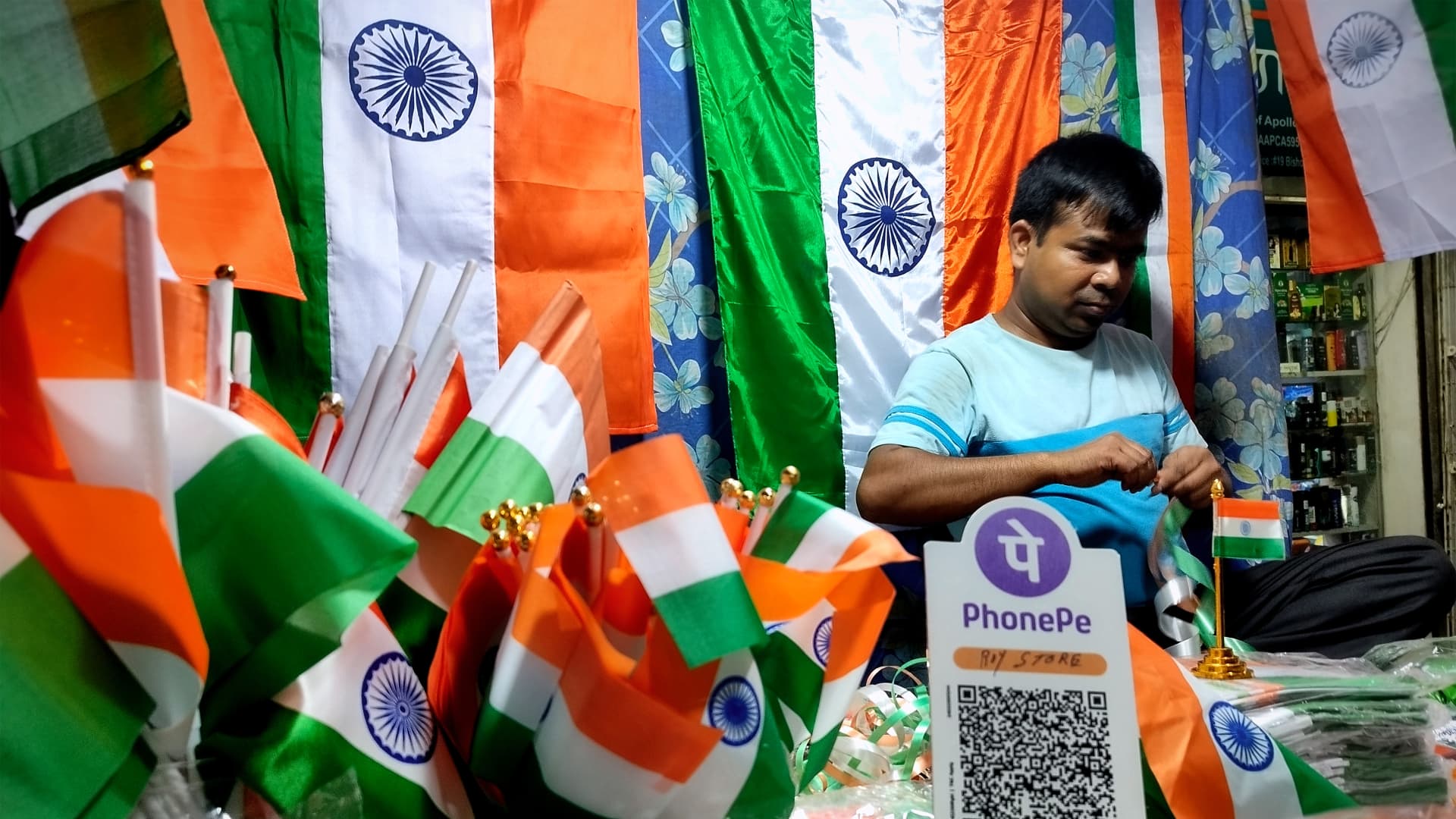
A person is using the Phonepe Digital Payment app QR code while selling the National flag of India on a roadside stall ahead of India’s Independence Day in Kolkata, India, on August 12, 2024. (Photo by Sudipta Das/NurPhoto via Getty Images)
Nurphoto | Nurphoto | Getty Images
“A 0.4% rate severely undercuts credit cards at 1.5% to 2% and debit cards,” Neil Shah, vice president of research at Counterpoint Research, told CNBC, adding that it gives merchants “every economic incentive to favor UPI rails.”
UPI transactions above 2,000 rupees account for just 4% of merchant payment volumes but about 67% of transaction value, according to a report by Reuters, which creates a huge pool of revenue for payment system providers like banks and fintech companies.
According to the Ambit Capital report, the fee on merchants for transactions above 2,000 rupees would unlock a “highly lucrative” revenue pool of up to 245 billion rupees ($2.5 billion) for the sector.
“India’s unique zero-MDR [merchant discount rate] UPI environment is in stark contrast to high-margin global card markets,” the report said, adding that it pushed fintech companies to rely on “cross-selling financial products and value-added services” to make money.
Need to know
India’s retail inflation hits 4.8% in August, rises for 10th straight month
India’s headline rose to 4.82% in August from 4.45% in July, adding to pressure on the country’s central bank to raise key benchmark rates. Inflation has been on the rise for 10 straight months in the world’s fastest-growing major economy.
Indian Prime Minister Modi says border peace is key to India-China ties
Indian Prime Minister Narendra Modi on Saturday said that “peace and tranquility” in the border areas is essential for developing bilateral relations with its neighbor China. Ties between the two countries, which had deteriorated sharply following a deadly border skirmish in 2020, have been thawing for more than a year.
Coming up
Sept. 17: National Stock Exchange IPO opens.
Sept. 23: HSBC Flash PMI for September.