Five Cue and Veronika Maine stores have closed as the fashion retailer’s receivers work to reduce costs and secure a buyer, while a retail expert has outlined where the iconic Australian brand lost its way.
Cue Clothing Co entered voluntary administration on Tuesday, with FTI Consulting partners Kate Warwick and Vaughan Strawbridge appointed to oversee three companies within the group.
The administrators moved quickly to close five stores across Australia.
The affected Cue outlets include Woden, Parramatta, Melbourne Central and Armadale.
The Veronika Maine store in Mosman, on Sydney’s lower north shore, has also shut its doors.
“No concessions are included in the closures. The receivers will explore opportunities to re-deploy staff across the network where possible,” FTI Consulting said in a statement on Friday.
Together, Cue and Veronika Maine operate 46 stores across Australia and New Zealand.
Despite the closures, the receivers said potential buyers had shown strong interest in acquiring Cue.
“The receivers are continuing to trade the businesses as going concerns while running a sale process,” they said.

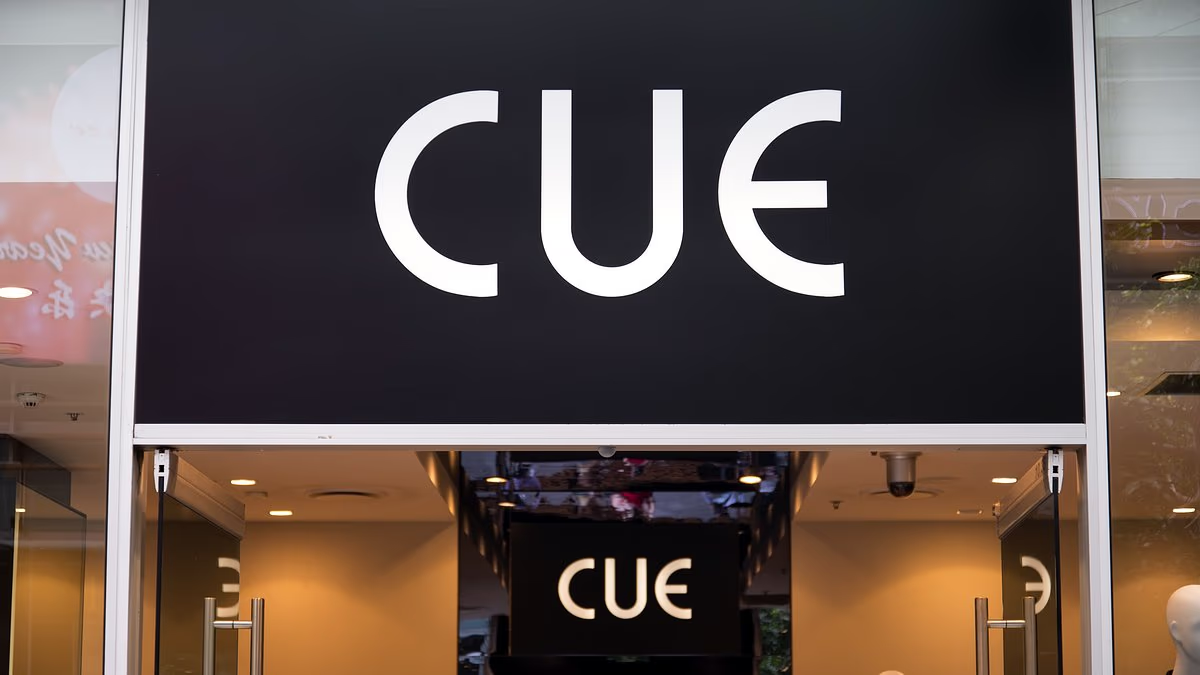
Five Cue and Veronika Maine stores have closed in recent days. The Sydney QVB store, pictured, is among the dozens that remain open for now.

Cue and its sister brand, Veronika Maine, entered voluntary administration this week.
“There has been good initial interest from potential buyers in the sale process, highlighting the strong brand recognition and positive sentiment for Cue and Veronika Maine,” the firm said.
Expressions of interest are expected to be submitted in early October.
Rod Levis founded Cue in Sydney in 1968 after being inspired by London’s thriving youth fashion scene. The brand’s first store opened in the Strand Arcade in Sydney’s CBD.
Cue expanded rapidly, securing a section in every Myer store across Australia by 1975.
The company withdrew from Myer in 1982 and spent the following 18 years developing its own retail network, eventually reaching around 100 standalone stores.
Cue returned to Myer in 2000 and was stocked in about 70 per cent of the department store chain’s locations within four years.
The Levis family launched the sister label Veronika Maine in 1999, later establishing a dedicated store network for the brand from 2005.
After more than 50 years of family ownership, the Levis family sold the business to turnaround specialist Hilco Capital in April 2025.

Cue is an iconic fashion retailer founded by Rod Levis in 1968.

Cue and Veronika Maine sold more upmarket pieces than fast fashion retailers, like Zara and H&M, but below luxury designers (pictured is the 2023 Cue fashion show)
Join the discussion
What’s to blame for the demise of Cue?
Hilco attempted to return the company to profitability, but the business continued to struggle under the weight of its operating costs.
Despite sales rising to more than $103million in its latest financial year, the company still recorded a $5.1 million loss, with the cost of maintaining its extensive retail network continuing to weigh on its finances.
Cue and Veronika Maine ultimately entered receivership this week.
Cue’s demise is about the changing economics of retail, according to RMIT School of Fashion and Textiles associate professor Carol Tan.
She explained that customers have become much more selective about where they spend their money.
‘Cue built a strong reputation over almost six decades for quality womenswear. The challenge wasn’t necessarily the product but whether the economics of the business remained sustainable in a rapidly changing retail environment,’ Professor Tan wrote on Thursday.
‘Reports from the receivers suggest sales had improved, but overhead costs remained too high. That indicates the challenge wasn’t simply attracting customers, but generating sufficient margin to support costs associated with operating a large retail network.
‘Brand heritage remains valuable, but it’s no longer enough on its own. Consumers can compare products, prices and brands instantly, so retailers need a compelling reason for customers to choose them.
‘The brands that are succeeding today aren’t just selling products. They’re offering a clear value proposition. Whether that’s innovation, functionality, quality, sustainability or solving a specific customer problem, consumers increasingly want to know why a brand matters.
‘Cue and Veronika Maine still have strong brand recognition and customer loyalty. A future owner may well see value in those brands. The key question will be what business model and store footprint make sense in today’s retail environment.’