
Britain’s next-generation fighter jet could be the last crewed combat aircraft the country ever develops, the RAF’s Air Chief Marshal has said, as artificial intelligence accelerates the shift towards autonomous warfare.
Air Chief Marshal Sir Harv Smyth said AI-powered, uncrewed aircraft could transform military aviation as dramatically as the move from propeller-driven planes to jet engines.
Sir Harv said the Global Combat Air Programme (GCAP)—a joint effort by Britain, Italy and Japan to create a sixth-generation stealth fighter—would still require a crew. However, he suggested that drones were likely to dominate many future aircraft programmes.
The new GCAP aircraft, informally known as “Tempest”, is expected to use artificial intelligence and advanced sensors. Western nations are pursuing the technology as they seek to preserve air superiority amid growing threats from powers including Russia and China.
The UK agreed a £4.6 billion design contract for the aircraft with Italy and Japan in July. The programme is targeting the delivery of an advanced fighter jet by 2035.
Development is being led by Edgewing, a joint venture involving Britain’s BAE Systems, Italy’s Leonardo and the Japan Aircraft Industrial Enhancement Company.
The RAF has also equipped Typhoon fighter jets with a laser-guided rocket system designed to help counter Iranian drones.
In October, the service deployed a Protector drone for the first time to track Russian warships and other foreign vessels in the English Channel. The RAF has ordered 16 of the remotely piloted aircraft.

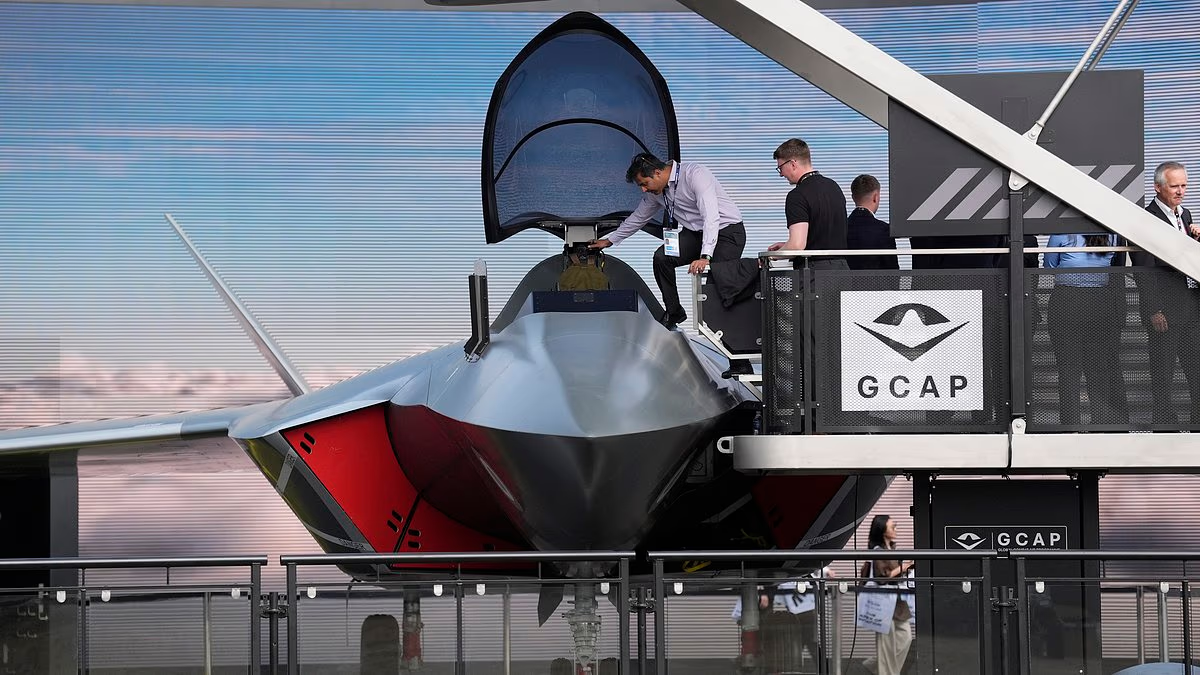
A mock-up of the Global Combat Air Programme’s sixth-generation stealth fighter, being developed by Britain, Italy and Japan, with the aim of producing an advanced combat aircraft by 2035

Despite increasing automation, he stressed that RAF personnel remain essential and that the service needs modern aircraft, weapons, resilient bases and strong cooperation with NATO allies
Sir Harv said the RAF of the future would operate a mixed fleet combining Typhoon and F-35 jets with autonomous systems.
MUST READ: British Swimmer Lewis Pugh Swims Hormuz to Spotlight Wildlife
“Used properly, AI and machines will take on the most dangerous tasks instead of humans, but technology must strengthen human judgment rather than remove accountability,” he said.
“The GCAP jet is perhaps the last crewed fighter we will ever build—not because people will become less important, but quite the opposite.”
He described the current international climate as increasingly unstable and difficult to predict, pointing to Russia’s invasion of Ukraine and what he called an almost five-year war of attrition in which neither side has secured control of the skies.
Sir Harv also warned that space was emerging as another contested domain, with navigation, banking and national security all increasingly dependent on satellite networks.
Writing in The Telegraph, he said: “Uncrewed fighter jets will start flying in UK airspace next year. This is exciting and necessary in equal measure.”
He revealed that approximately 300 RAF trainees are now graduating each month as the service expands its workforce.
While automation is advancing, Sir Harv said personnel would remain central to RAF operations. He added that the service needed modern aircraft and weapons, resilient bases and close cooperation with its NATO allies.
Speaking at the Royal United Services Institute in October, Sir Harv said an AI system had accumulated the equivalent of 50 years of human air-combat training and experience in only 14 days during a simulation.
GCAP began as an agreement between the UK, Italy and Japan to develop a sixth-generation fighter. Canada joined the programme as an “observer nation” in July.
As an observer, Canada will not take part in decision-making but will receive privileged access to the initiative.
In October, Andy Burnham said Britain was “open” to Germany joining the international partnership to develop the next generation of fighter aircraft.


