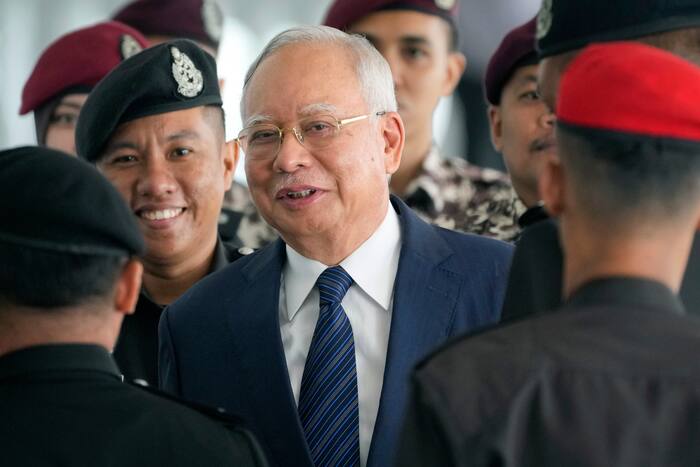
KUALA LUMPUR – Malaysia’s King Sultan Ibrahim Iskandar has granted imprisoned former Prime Minister Najib Razak a rare conditional pardon, allowing him to complete the remainder of his sentence under house arrest.
The decision followed a Pardons Board meeting convened unexpectedly on Friday, just one week after the panel postponed consideration of Najib’s latest clemency request. It represents Malaysia’s first known use of house arrest as a form of royal clemency and is likely to reignite questions about the monarchy’s authority, the rule of law and the treatment of the country’s most high-profile corruption convict.
According to a statement from the Legal Affairs Department in the Prime Minister’s Office, Sultan Ibrahim issued the “conditional pardon” during the board meeting. Najib may serve the rest of his sentence at home until Aug. 23, 2028, provided he pays the 50 million ringgit ($12 million) fine imposed by the court.
The department said Najib must comply with additional conditions, although it did not disclose what they are. Any breach would cause the pardon to be revoked, the statement added.
Najib, 73, has been behind bars since August 2022, when Malaysia’s highest court upheld his conviction over the multibillion-dollar scandal involving state investment fund 1Malaysia Development Berhad, better known as 1MDB.
He was initially sentenced in 2020 to 12 years in prison and fined 210 million ringgit ($51.5 million). The charges involved abuse of power, criminal breach of trust and money laundering connected to 42 million ringgit ($10.3 million) transferred into his personal accounts from SRC International, a former 1MDB unit.
In January 2024, a Pardons Board chaired by the then-king cut Najib’s prison term in half, reducing it to six years, and lowered his fine to 50 million ringgit.
Najib has said the previous king, Sultan Abdullah Ahmad Shah, issued an additional order permitting him to serve his sentence under house arrest. However, the High Court ruled that the purported order could not be enforced because the house-arrest arrangement had not been presented to or discussed by the Pardons Board during its January 2024 meeting.
The latest house-arrest decision also creates uncertainty over how it could affect a separate prison term imposed in another graft case.
In December 2025, Najib was convicted of abuse of power and money laundering after more than $700 million linked to 1MDB was transferred into his bank accounts. The conviction came in his main trial related to the fund. He received an additional 15-year prison sentence and an 11.4 billion ringgit ($2.8 billion) fine, both due to take effect after his current sentence. Najib is appealing the verdict.
Home detention has also featured in wider criminal justice reform discussions in Malaysia. The government said in 2024 that proposed legislation allowing house arrest in certain cases was intended to ease prison overcrowding and reduce repeat offending, rather than to benefit Najib specifically.
Najib established the 1MDB fund soon after becoming prime minister in 2009. Investigators allege that at least $4.5 billion was siphoned from the fund and moved through a network of bank accounts in the United States and elsewhere by his associates. The money was allegedly used to bankroll Hollywood productions and lavish acquisitions, including hotels, a luxury yacht, artwork and jewelry.
Public anger over the 1MDB scandal helped fuel the historic 2018 election defeat of the political party that had ruled Malaysia since independence from Britain in 1957.
Even after his conviction, Najib remains influential within the United Malays National Organization. The party is now part of Prime Minister Anwar Ibrahim’s unity government, which came to power following the 2022 election.