
Welcome to “hell week” in New York City, when Manhattan’s already punishing traffic is pushed to the brink by the annual arrival of world leaders for the United Nations General Assembly.
With streets closing for security operations and Secret Service motorcades transporting roughly 200 visiting dignitaries, congestion is expected to be even more severe than usual.
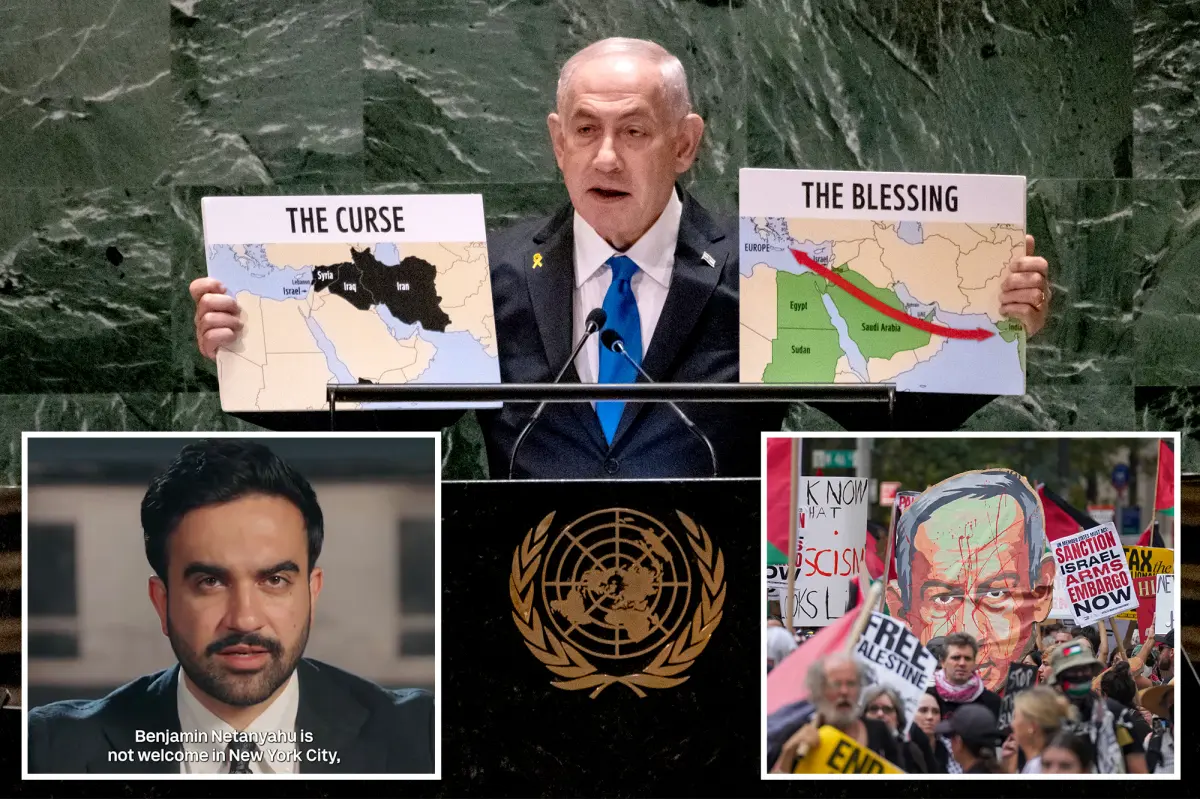
The conflict involving Iran will dominate the diplomatic agenda. President Trump is set to address the General Assembly on Tuesday, Iranian President Masoud Pezeshkian is scheduled to speak Wednesday, and Israeli Prime Minister Benjamin Netanyahu will take the podium Thursday.
Reports indicate that the State Department approved visas for a limited number of Iranian officials, including Pezeshkian and Foreign Minister Abbas Araqchi. Their movements in the United States have been restricted, and they have reportedly been barred from purchasing luxury items.
No formal meeting between the opposing governments has been announced, but it would be surprising if diplomacy did not produce at least an informal encounter. Trump has not previously met Iran’s leaders, and his stated desire to end the conflict before the midterm elections—combined with his preference for direct, face-to-face negotiations—could create an opening for talks.
Without directly referring to his trip to the United Nations, Trump said last week, “Hopefully we are toward the end of the war.”
More From Michael Goodwin
For that hope to become reality, Iran would have to be willing to meet Trump’s demand that it surrender its enriched uranium and dismantle its nuclear facilities.
Axios reports that Trump is expected to meet Gulf Arab leaders Wednesday after invitations were extended to officials from Saudi Arabia, the United Arab Emirates, Qatar, Bahrain, Kuwait and Oman. He is also scheduled to return to Washington that day to host Chinese President Xi Jinping for a two-day summit.
Whatever unfolds inside the United Nations complex is likely to be considerably more orderly than the disruption expected on the streets surrounding the East Side landmark.
Trump’s presence alone is typically enough to draw large protests, but this year’s demonstrations could be especially sizable—and potentially volatile—amid tensions involving New York’s first-term Mayor Zohran Mamdani.
Mamdani’s outspoken criticism of Israel and Netanyahu has added another combustible dimension to the demonstrations expected during the General Assembly.
Netanyahu, who is campaigning for re-election, is expected to reach New York Wednesday, deliver his address Thursday and depart soon afterward.
As has happened in previous years, Netanyahu may face a largely empty chamber if some delegates leave the hall in protest during his speech.
Those walkouts are likely to be framed around the wars in Gaza and Iran, although critics of Israel argue that deeper hostility is driven by opposition to the country’s military strength and political success.
The NYPD is preparing for heightened security concerns during Netanyahu’s visit. Police operations are expected on city streets and in the East River, while counter-drone units may also be deployed in the air.
Security concerns have been intensified by Mamdani’s description of Netanyahu as a “war criminal” and the “architect of a horrific genocide” in Gaza.
In July, Mamdani said Netanyahu was “responsible for the killing of more than 73,000 people, for the maiming of tens of thousands of children, as those who survive undergo amputation without anesthesia.”
Mamdani has also accused Netanyahu of targeting children’s hospitals and maternity centers and of obstructing food and humanitarian assistance—claims disputed by Israel and its supporters.
Mam’s call to arms
Critics characterize those allegations, along with other claims promoted by Hamas, as narratives that have gained traction in far-left media and on social media accounts accused of spreading antisemitic content.
Mamdani has also declined to condemn the slogan “globalize the intifada,” which critics interpret as a call for Israel’s elimination. In May, he became the first New York mayor in roughly 60 years to skip the annual “Salute to Israel” parade on Fifth Avenue.
Mamdani made it clear he wanted Netanyahu arrested on the basis of an indictment by the anti-Israel International Criminal Court because of Israeli military actions in Gaza.
When the mayor belatedly learned the US doesn’t recognize the court or its jurisdiction, he openly flirted with having the NYPD execute the warrant and arrest Netanyahu.
The harebrained idea collapsed, but the well-publicized effort served as the Pied Piper’s signal to his fellow travelers that they should raise hell during Netanyahu’s visit.
The mayor was most explicit in July when he stressed that New Yorkers had the right to protest the Israeli leader’s appearance and called protests “one of the bedrocks of our city.”
“It is something that has been a part of what makes our city so special, that New Yorkers can express themselves whether they are in support or in opposition no matter on whatever topic,” he continued, and added: “I’ve always said that when we respect our Constitution, we also respect our First Amendment. And here in New York City it will always be a place where you can exercise that.”
The call to arms was clear, but last week he tried to wash his hands of any responsibility if violence erupts.
“I do not have any plans to attend any protest, “ Mamdani said. He also claimed that “I have never encouraged New Yorkers to protest. What I have always told them is that they have the right to do so in this city.”
Oh, please.
He certainly has not fooled Danny Danon, Israel’s UN ambassador. He told the Post Friday that Mamdani had fanned the flames for Netanyahu’s visit and is now trying to avoid any responsibility.
“He’s very clever, “Danon said, “but you cannot set the fire, then say this,” meaning Mamdani’s bid to avoid blame.