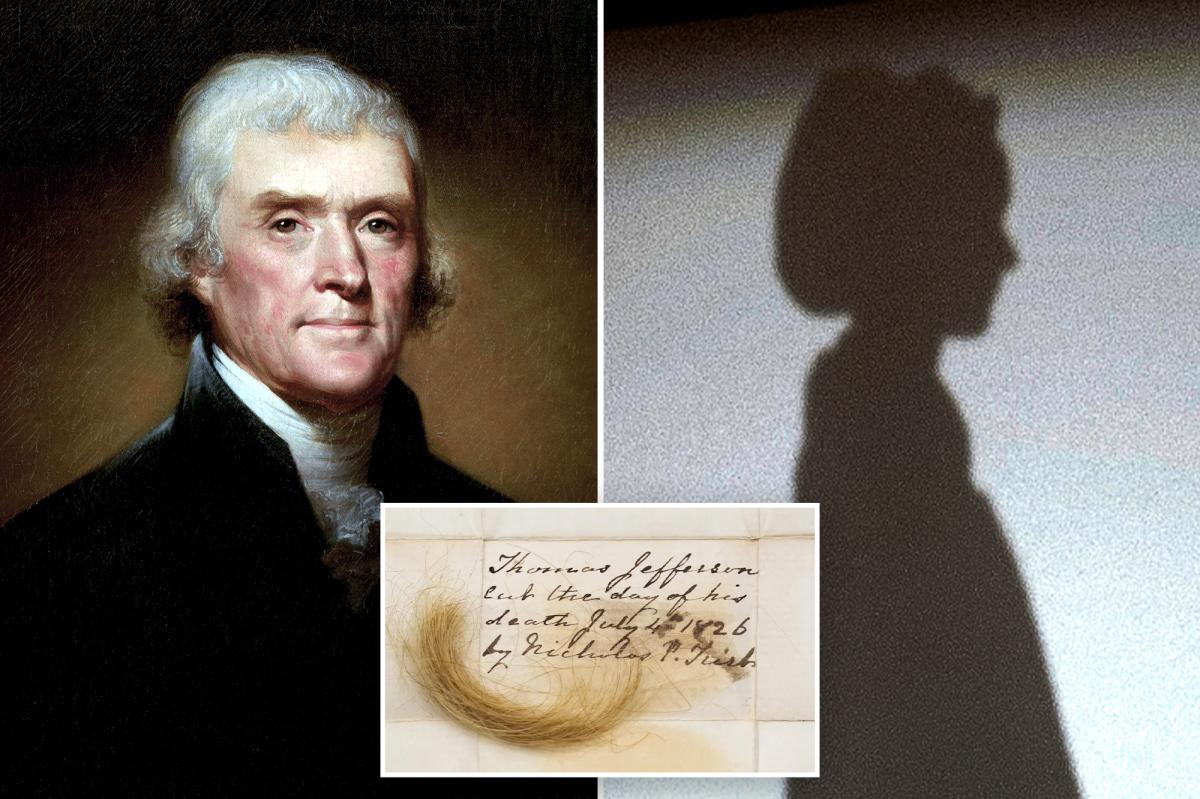

Advanced DNA analysis of hair attributed to Thomas Jefferson has produced what researchers describe as “extraordinary proof” that the third U.S. president fathered children with Sally Hemings, an enslaved woman at Monticello. The same genetic methods also played a role in investigations involving suspected serial killers, including Rex Heuermann.
According to The New York Times, Smithsonian researchers sequenced Jefferson’s genome from a small number of hairs and compared it with DNA provided by 13 people believed to descend from Jefferson and Hemings.
Rumors that Jefferson and Hemings had children have circulated since the early 1800s. After 15 years of research involving archaeologists, genealogists, molecular geneticists and historians, the team says the genetic evidence establishes the connection.
Richard Kurin, the Smithsonian scholar who directed the project, called the evidence compelling and clear while discussing his new book. He acknowledged that others may interpret the findings differently and said the Smithsonian has not necessarily adopted a formal institutional position.
“This is a topic of interest to the American people,” Kurin said, noting that the debate predates the Smithsonian and reaches back to discussions involving Founding Fathers such as Alexander Hamilton, Jefferson and John Adams.
“If we have evidence, scholarship and science that helps elucidate American history, I think we have a duty to pursue it,” he added.
The pioneering methods developed to decode Jefferson’s full genome have since helped investigators make progress in other major criminal cases, including the Gilgo Beach murders and the search for the Golden State Killer.
Beth Shapiro, an ancient-DNA specialist at the University of California, Santa Cruz, said the Jefferson project helped lay the groundwork for using genetic tools in cases such as the Gilgo Beach investigation.
Investigators linked Gilgo Beach suspect Heuermann in part through DNA recovered from a discarded pizza crust outside his Manhattan architecture office. In the Golden State Killer case, Joseph DeAngelo was identified with the aid of genetic genealogy databases and family-history websites.
The Jefferson genome project began in 2011, when Kurin was previewing a Smithsonian documentary about Jefferson’s personal Bible. Jefferson had created the volume by removing passages focused on Jesus’ moral teachings and assembling them into a separate book.
Researchers initially searched the pages for traces of blood that Jefferson might have left behind. Instead, Kurin discovered three hairs.
Those hairs were compared with DNA from a female-line descendant of Jefferson’s mother but did not match. Investigators then turned to strands from a lock believed to have been cut from Jefferson’s head as he lay on his deathbed at Monticello in 1826.
The second sample matched Jefferson’s family line and ultimately enabled scientists to sequence his complete genome using advanced genetic technology.
Researchers also conducted 20,000 simulations examining different paternity possibilities. The scenarios considered Jefferson, his brother Randolph—who had long been suggested as a possible father of Hemings’ children—and Randolph’s sons.
The analysis concluded that the probability Jefferson was not the father of either Madison or Eston Hemings was below one in 1,000.
The findings, however, have not emerged without disagreement.
This month, a Hemings descendant who submitted a DNA sample in 2015 requested that her participation be withdrawn. She cited concerns that Kurin’s book was being released before a related paper had appeared in a peer-reviewed scientific journal.
The Smithsonian said the woman’s sample and associated data were destroyed, and that the analysis was repeated without using them.
David Miller, a sixth-generation descendant of Jefferson whose mother, Sarah Coachman Miller, contributed a DNA sample, said he welcomed the results because they supported what he had already believed.
Miller’s mother died before the findings were released. He said the project nevertheless allowed him to meet relatives he now describes as his “cousins” from the Hemings family.
“It’s positive the family now hopefully gets the recognition and acknowledgement and acceptance they deserve,” he told the Times.