
A decades-old dispute over art taken during the Holocaust has returned to the spotlight in Los Angeles, where descendants of Jewish victims are demanding the recovery of works now displayed at leading Southern California museums and at Auschwitz.
The renewed legal fight follows recent changes to California and federal law that expanded the ability of heirs to bring claims in the United States over artwork seized from Jewish families during World War II.
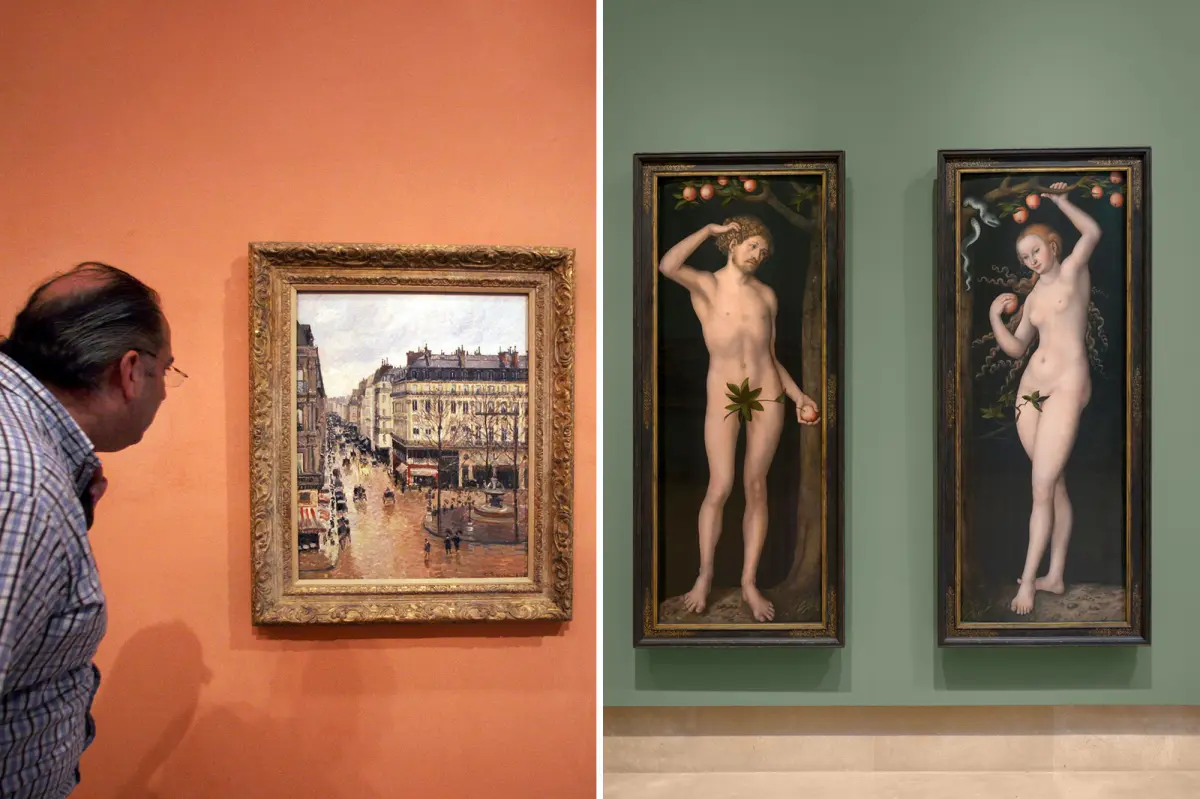
One lawsuit, filed this week in Los Angeles Superior Court by the Jewish Federation of Greater Los Angeles and its board, revives a long-running challenge involving the Norton Simon Museum in Pasadena. At issue are “Adam and Eve,” two life-size oil paintings on wood created by Lucas Cranach the Elder in 1530.
The same day, the daughters of Dinah Gottliebova Babbitt filed a separate case in federal court in Los Angeles. Babbitt, a Holocaust survivor and California animator, was imprisoned at Auschwitz during the Nazi era.
While held at the camp, Babbitt was compelled to create watercolor portraits of prisoners for Josef Mengele, the Nazi doctor infamous for his human experimentation and known as the “Angel of Death.” Her daughters are seeking the return of those paintings.
Neither complaint identifies a monetary value for the artwork involved.
The museums, however, argue that they possess valid legal title and say they plan to keep the works on public display.
The Norton Simon Museum cited a unanimous 2018 federal appellate ruling that determined it had lawful ownership of the Cranach paintings. The U.S. Supreme Court refused to hear the case in May 2019, allowing the lower-court decisions to stand.
The museum says the paintings were first owned by the Russian aristocratic Stroganov family. After the Soviet government placed them in an unauthorized Berlin auction in 1931, art dealer Jacques Goudstikker acquired them. Following a complex chain of ownership, a Stroganov descendant later sold the works to the museum, which restored and conserved them.
“For nearly 50 years, they have been on view at the Norton Simon Museum and will continue to be accessible to the public for years to come,” the museum said in a statement.
The lawsuits reflect a much larger international effort to reclaim Nazi-looted art. Between 1933 and 1945, the Nazi regime confiscated more than 600,000 artworks from Jewish families, collectors and museums throughout Europe—an operation widely regarded as the biggest art theft in history.
More than 80 years later, many of those pieces remain in the collections of major museums. Questions over their ownership continue to produce difficult legal and moral disputes, pitting Jewish families seeking property stolen during the Holocaust against institutions that say they obtained the works legally and have a duty to preserve and exhibit them.
California lawmakers have separately moved to reshape the legal rules governing such cases.
Assemblymember Jesse Gabriel, a Democrat from Woodland Hills, authored Assembly Bill 2867, which Gov. Gavin Newsom signed in September 2024. The law directs courts to apply California law in cases brought by state residents or their heirs seeking art taken during the Holocaust or other persecution.
Gabriel, who serves as co-chair of the California Legislative Jewish Caucus, introduced the bill after a federal court ruling allowed Madrid’s state-run Thyssen-Bornemisza National Museum to keep a multimillion-dollar Impressionist painting by Camille Pissarro.