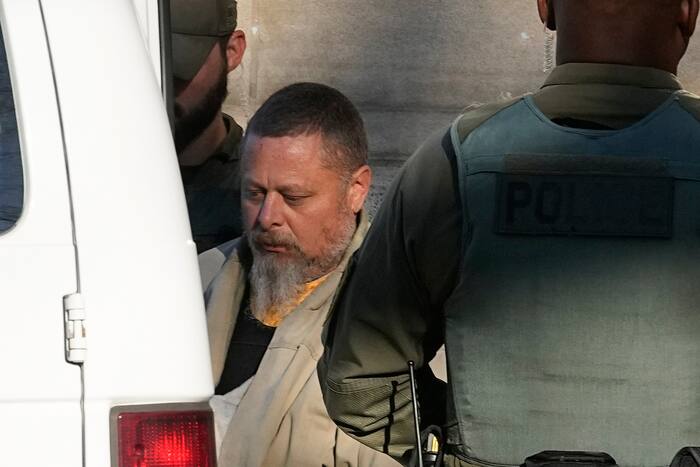


A man sentenced to 130 years for the Indiana murders of two teenage girls is asking an appeals court to set aside his convictions. Richard Allen’s attorneys argue that he confessed during a severe psychological crisis and that he was improperly prevented from presenting a theory that the girls may have been killed by unidentified people in a pagan ritual.
A jury found Allen guilty of killing 13-year-old Abigail Williams and 14-year-old Liberty German in 2024. The girls, known as Abby and Libby, disappeared in Delphi, a small Indiana community, in 2017. Their case remained unsolved for more than five years and drew widespread attention from true-crime followers before Allen’s arrest.
The Indiana Court of Appeals is scheduled to hear about an hour of arguments in Allen’s case Monday.
Prosecutors maintain that several of Allen’s incriminating statements were made before he displayed signs of serious mental illness and continued after his condition improved. They argue that, even without those confessions, the remaining evidence was sufficient for jurors to convict him.
The state says Allen acknowledged being on the trail near the spot where one of the girls recorded a short video of a suspicious man saying, “Down the hill.” Prosecutors also argued that allowing a defense expert to testify about a possible pagan ritual would have transformed the proceedings into a spectacle rather than a focused criminal trial.
Unusual evidence found near the teenagers’ bodies
The girls’ bodies were discovered on Feb. 13, 2017, down a steep slope from an abandoned railroad trestle along a hiking trail outside Delphi. The eighth graders had been dropped off in the area but never reached the location where they were supposed to be picked up.
Both victims had suffered fatal cuts to their throats, and several branches had been placed across or near their bodies. One girl was found without clothing, while the other was dressed in the first victim’s clothes. Investigators found no evidence that either teenager had been sexually assaulted.
According to prosecutors, Allen carried a gun and forced the girls away from the trail. They said he later confessed to intending to rape them, but abandoned that plan after a passing van approached and then killed them instead. A firearms expert testified that an unfired cartridge recovered between the bodies had been “cycled through” Allen’s handgun.
At trial, defense attorneys emphasized that no witness directly identified Allen as the man captured near the trail on the afternoon the girls vanished. They also pointed out that investigators found no fingerprints, DNA or other forensic evidence tying him to the crime scene.
Allen’s attorneys say isolation triggered a mental collapse and false confessions
Allen spent the period before trial in solitary confinement. He denied responsibility for the killings for months, but his lawyers say prolonged isolation caused his mental health to deteriorate dramatically. They contend that he eventually became so psychologically unwell that he persuaded himself he had committed the murders and made multiple false confessions.
“Allen lost forty pounds, was unable to care for himself, was tased, his face was black and blue and at times bleeding, and he was poisoned by fecal matter and toilet water,” attorneys Stacy Uliana and Mark Leeman wrote in their appeal.
Prosecutors countered that Allen’s statements came after he was confronted with evidence in the case, including details about the girls’ bodies and the condition in which they were found.
“The discovery materials forced Allen to face the horrifying evidence of what he did … images and events he had been able to ignore and repress over the five years in which his guilt had gone undiscovered,” Indiana Attorney General Todd Rokita wrote in a brief filed by his office.
Judge barred testimony about alleged pagan killings
Allen’s trial lawyers sought to call an expert who would have testified that the killings resembled a ritual sacrifice carried out by followers of Odin, a central figure in Norse mythology.
The proposed testimony was expected to focus on the victims’ positioning, the branches found around the bodies, the outdoor setting and the knife wounds, which the expert believed were consistent with pagan ritual practices.
Prosecutors argued that the expert had only a small number of examples to support the theory and said the defense should not be permitted to present an unsupported explanation for the murders.
Allen’s lawyers are also expected to challenge differences in witnesses’ descriptions of the suspicious man seen near the trail, including the fact that a composite sketch of a possible suspect did not resemble Allen. In addition, they question why their firearms expert was not allowed to testify about whether markings on the unfired cartridge could reliably be linked to a particular gun.